
The voices in our head can sometimes be quite critical and unkind. When we pay attention to the things we are saying to ourselves, we can learn to change negative self-talk into positive. We can speak to ourselves as we would to a friend. Learning to treat ourselves with compassion and kindness leads to more compassion for others as well. Our ability to be kind to others increases.
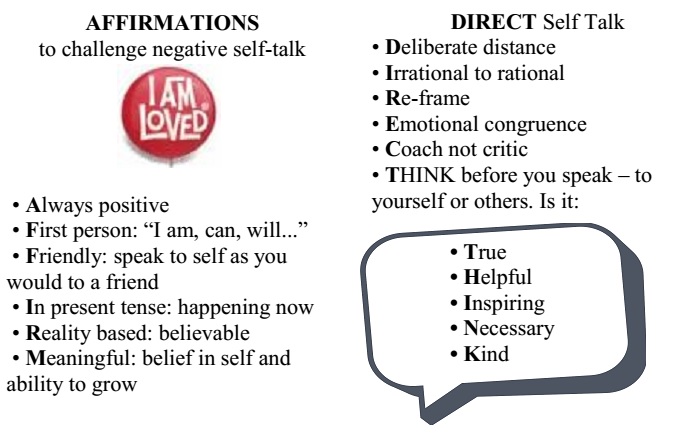
Affirmations are phrases that describe the results of adopting a positive belief that can help change our mindset when repeated frequently. Affirmations should be:
• Always positive
• First person or name: “I am, I can, I do…” [your name] is, can, does
• Friendly: speak to self as you would to a friend
• In present tense: happening now
• Reality based: believable
• Meaningful: express belief in self, resilience, agency, and ability to grow
Simply saying something does not make it so, but words can be powerful! Affirmations do not possess a magical power to change reality, but a close look at the accuracy of our thoughts and beliefs can be a good choice. Our feelings can be shaped by the things we tell ourselves. Our relationships can be altered by the things that we say. Striving to always be honest and kind with your words will go a long way toward creating the life that you want.
To REAP the benefits of affirmations:
• Repeat daily
• Expand emotion
• Add visualization
• Post where you will see often
EXAMPLES: I am loved. I can breathe deeply and fully. I practice compassion. See more examples at The Not So Big Life.
THINK before you speak – to yourself or others. Is it:
- True
- Helpful
- Inspiring
- Necessary
- Kind
Automatic negative thoughts (ANTs) are habitual, involuntary thoughts that pop into our brains. They are often false, unhelpful, and directly contribute to anxiety because a fear response is triggered by the perception of danger or threat.
There are two approaches for dealing with ANTS in Cognitive Behavioral Therapy (CBT).
Rational emotive behavior therapy (REBT) is a form of CBT developed by Albert Ellis that shows how beliefs about events lead to emotions. You learn to spot irrational thoughts, challenge them, and substitute rational thoughts instead.
With Acceptance and Commitment Therapy (ACT), you don’t fight the ANTs. Instead, you learn to notice and sit with them, but to not allow them to be in charge. It helps to gain a sense of meaning and purpose by taking actions that line up with your personal values. Whether you choose more realistic thoughts or a shift in attention to what really matters to you, automatic negative thoughts don’t have to control your life. (From https://therapyinanutshell.com/automatic-negative-thoughts/)
DIRECT Self Talk
• Deliberate distance
• Irrational to rational
• Re-frame
• Emotional congruence
• Coach not critic
• THINK before you speak
Speaking to yourself in third person can help you gain psychological distance and regulate emotions. An example is “[Your name], you’re okay, you’ve got this.” Re-frame with rational thoughts and a growth mindset. Align outward expression with internal emotions. Focus on solutions rather than dwelling on mistakes.
Books and TED Talks:
Books purchased with Amazon affiliate links below provide a small commission that helps support the Daily PlanIt. See more TED talks by authors at TED Talk Book Discussion.
- “Chatter” by Ethan Kross, TED talk Do you talk to yourself? Here’s how to harness your inner voice.
- “The Speaker’s Quick Guide to Presenting With Confidence” by David Otey, TED talk “What’s your internal signal-to-noise ratio?“
- “Above the Chatter” by Bruce Pulver, TED talk The secret to changing negative self-talk by renewing your mindset
- TED talk The magic of words – what we speak is what we create by Andrew Bennett
See also: Creating Clarity, Examine Mental Beliefs, Overcome Obstacles, 6 Rs of Resilience. Coping Skills, plus Positive Self-talk at PsychCentral and Positive Affirmations at coping.us.

I seek to create order from the chaos of complex information. Join me at the Daily PlanIt to gain insights, inspiration, and information to increase skills for a better life. I unlock the power of teaching reading with phonics in the pursuit of literacy at www.phonicspow.com. In my spare time I explore books and movies, often choosing titles available on both screen and page.


 Daily PlanIt
[…] are you thinking? Are your thoughts rational? DIRECT Self Talk • Deliberate distance • Irrational to rational • Re-frame • Emotional congruence • Coach […]
[…] Use Positive Affirmations and Self-talk. How often do we think negative thoughts that are not based in truth? To be impeccable with your […]