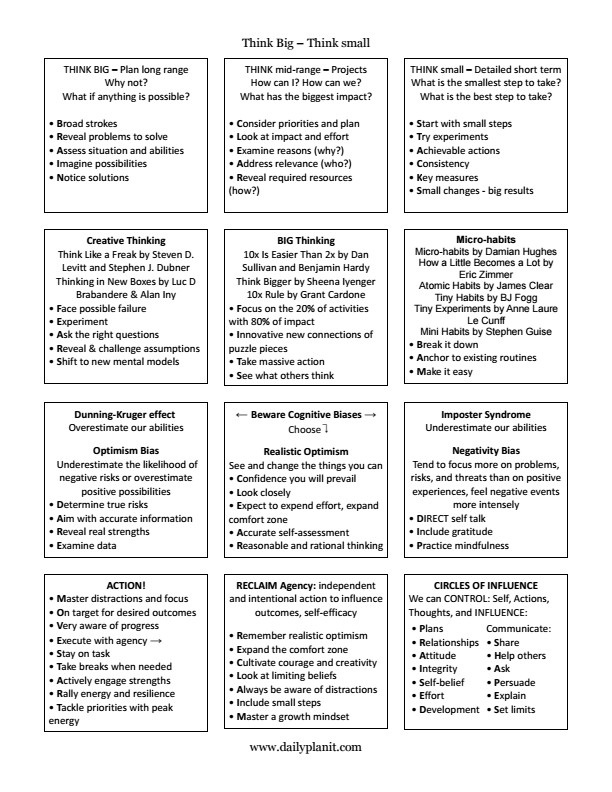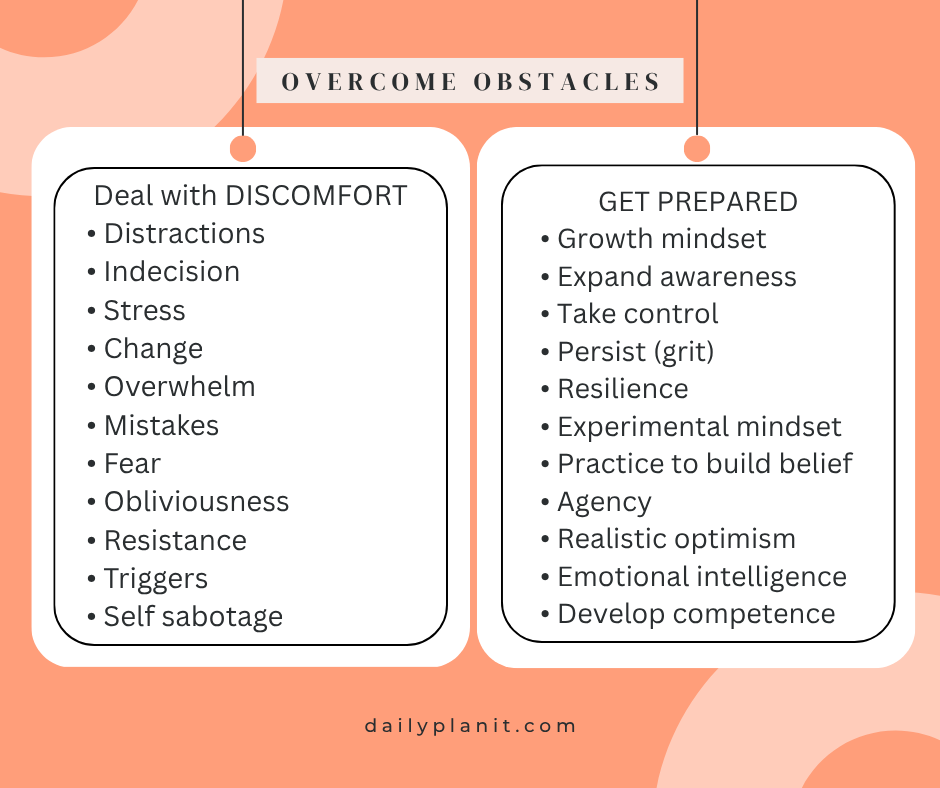
Goal Skills – Overcoming Obstacles

Progress toward goal achievement can sometimes be blocked by challenges and obstacles. Handling challenges can take courage, creativity, grit, and resilience. Some of the biggest obstacles are the ones that we create ourselves. Here are some ways to flip obstacles that might be encountered:

  • Fear – limit fear to the back seat: author Elizabeth Gilbert wrote a Letter to Fear.
  • Laziness – focus on the satisfaction that comes from hard work for a meaningful goal.
  • Indecision – find options for solutions and decide.
  • Perfectionism – seek progress rather than perfection and begin to get important stuff done.
  • Confusion – if the path is unclear: gain clarity, make a plan, and be aware.
  • Limiting beliefs – learned helplessness can prevent action. Re-frame thinking to become resilient.
  • Attitude – change from a negative attitude to an action oriented, can do attitude.
  • Motivation – if you feel unmotivated, the benefits of the results may not be enough to overcome inertia. Can you tip the scales? Motivation comes from action, not the other way around.
  • Procrastination – if you are avoiding a task, learn about procrastination triggers and how to overcome them.

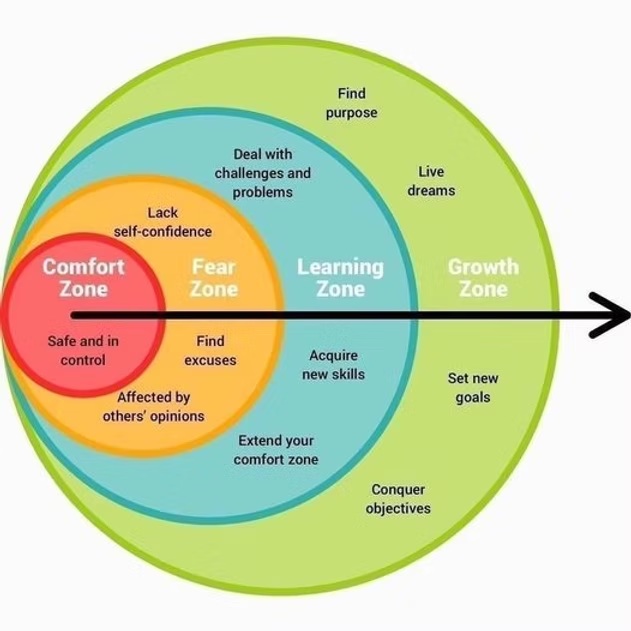
Don’t let your own limiting beliefs, the comfort zone, distractions, or fears prevent you from doing what you want to accomplish, or from connecting with others. Examine your mental beliefs and RECLAIM agency to overcome obstacles.

Of course, there can be external obstacles, and unknown obstacles that are not possible to plan for. Don’t let uncertainty, failures, or setbacks stop you. Gather all your resources, know how to solve problems, develop strengths, deal with time wasters, and keep trying.

The Victor poem by C.W. Longenecker

If you think you are beaten, you are.
If you think you dare not, you don’t.
If you like to win but think you can’t,
It’s almost a cinch you won’t.
For out in the world we find
Success begins with a fellow’s [person’s] will.
It’s all in the state of mind.
If you think you are outclassed, you are.
You’ve got to think high to rise.
You’ve got to be sure of yourself before
You can ever win the prize.
Life’s battles don’t always go
To the stronger or faster man [person who ran].
But sooner or later, the man [person] who wins
Is the man [person] who thinks he [they] can.

If you want to get ahead, use the one you’ve got!

Learn more about How to Set Goals, use time well, and develop Self-Esteem.

Posted in goals

Resources For Goals

When setting goals, consider the benefits of achievement and the resources required. The Economy of Goals means that benefits must exceed the cost in order for us to invest the needed resources. Goals are challenging, by definition. We can expect to encounter risk, uncertainty, perhaps failure, and quite likely fear along the way. The resources we need to accomplish goals can also reveal the strengths we need to persevere. Resources that are often needed to accomplish goals include:

  • Time
  • Energy
  • Abilities
  • Mind (and Money)

To set and reach for goals means embracing effort, expecting challenges, and expanding to the edge of the comfort zone. Facing challenges takes courage, because it means there can be setbacks. Amy Shoenthal delves into this topic in her TED talk How to turn setbacks into success, and her book The Setback Cycle (Amazon affiliate link to the book provides a small commission that helps to support the Daily PlanIt). There are things we can do if we experience failure or make mistakes. We can confront fear and change our mindset. Before we get to resources, the cycle she describes includes:

  • Establish: Recognize and acknowledge that you are in a setback.
  • Embrace: Get uncomfortable to analyze what went wrong, taking responsibility for your part while understanding external factors.
  • Explore: Experiment with new ideas, merge passion with strengths, and lean on your community to find clarity on what’s next.
  • Emerge: Take action, even if it’s scary, to move forward with the new clarity gained, understanding that this process builds resilience and creativity.

My extended thoughts about how skills can help us prepare for setbacks:

Here is how resources can reveal strengths.

  • Time. When do you lose all track of time and feel flow? When did you solve a problem? How can you start to manage time?
  • Energy. What tasks excite you and consistently energize you? What is a project you are proud of? How can you manage energy effectively?
  • Abilities. What are you good at? What is easy for you to do or learn about? (see Discover U) How can you develop skills and be your best?
  • Mind. What do you love to learn about? When are you most creative? How can you increase awareness, tend to focus, direct self-talk, cultivate creativity?

Supportive community is another resource that can help us reach goals.

Gain input from others
Learn in public
Outline thoughts
Work collaboratively
Spark creativity with social connections

Learn more at Discover U, and find more TED talks by speakers who are also authors at TED Talk Book Discussion.


Posted in goals

Pathway to Communication

Want to learn valuable communication skills? The twelve TED talks and books by the speaker below guide you along the way.

Links to the TED talks (plus more) can be found at the Communication Pathway board at Pinterest. Amazon affiliate links to the books provide a small commission that helps to support the Daily PlanIt. Learn more at 12 Communication Skills.

I. RECEIVE
ACTIVE LISTENING
I Want to Hear You by John Igwebuike, TED talk Strategies for active listening.
BODY LANGUAGE
Cues by Vanessa Van Edwards, TED talk You are contagious.
VOICE
How to be Heard by Julian Treasure, TED talk How to speak so people will want to listen.

II. RESPOND
FEEDBACK
The Feedback Fix by Joe Hirsch, TED talk The Joy of getting feedback.
QUESTIONS
Ask by Jeff Wetzler, TED talk How to learn something from anyone.
EMPATHY
We Need to Talk by Celeste Headlee, TED talk How to have a better conversation.

III. SEND
SPEAK: CONVERSATION
Big Talk by Kalina Silverman, TED talk The art of meaningful conversations.
COMMUNICATION TYPES
Supercommunicators by Charles Duhigg, TED talk The science behind dramatically better conversations.
COMMUNICATE CONFIDENCE
Let’s Go by Emily Jaenson, TED talk 6 tips for building your confidence.

IV. CONNECT
PRESENTATIONS
The Compelling Communicator by Tim Pollard, TED talk Why communication goes wrong, and what you can do about it.
STORYTELLING
The Science of Storytelling by Will Storr, TED talk The Science of storytelling
PERSONAL BRAND/NETWORKING
How to Wow by Frances Cole Jones, TED talk How to present your best self in any situation.

Find more pathways and TED talks by speakers who are also authors at TED Talk Book Discussion. Find more Great Reads Pathways at Pinterest.

Posted in communication

Engaging Creativity

A creative mindset can be critical in solving problems, connecting with others, and gaining clarity.

To cultivate creativity:

Connect ideas
Really look
Explore
Ask questions
Take time to think
Imagine and inspire ideas
Value play
Experiment
Seek other curious people

To encourage engagement:

• Self mastery with autonomy
• Take on important work
• Add meaning with impact
• Recognition of good work
• Target skills to develop
• Invite participation in growth opportunities
• Nurture interest and involvement
• Gain results with relevant work goals

To develop design thinking:

• New perspectives
• Observe – look broader, closer
• Think younger – beginners mind
• Improve things
• Create new things
• Explore possibilities
• Reveal efficiency and beauty
• See surprising connections

TED Talks and books:

TED talk links are found at the Create Pathway Pinterest board. Books purchased through the affiliate links below provide a small commission that helps to support the Daily Planit. Find more TED talks by speakers who are also authors at TED Talk Book Discussion.

Creative websites:

Get ideas at Get Creative, try creative arts, and learn more about overcoming procrastination and getting motivated.

Posted in personal development

Sources of Strengths

When we know our strengths, we can be our best. Strengths are important for discovering purpose and choosing priorities and goals. Using your strengths for purposeful AIMS adds meaning and satisfaction to life. Below are details about the strengths you can find through the following sources. Find links at the end of the post to a printable list of strengths and a form to write your own strengths alongside your goals to maintain focus on them. Learn more about how to Identify Strengths at Discover U.

Gain clarity FAST:

Find flow
Assess abilities
Spot strengths
Take stock of talents

Find MATCHES with these sources of strengths.

Myers-Briggs personality
Assess strengths free → (Red Bull, High Five)
Talents (Gardner)
Character strengths (VIA)
Holland code
Explore DISC
Strengthsfinder (Clifton) $

The Clifton Strengthsfinder is a good way to identify strengths, although this assessment has a fee. It describes 34 strengths in four domains. A free printable pdf describes the CliftonStrengths Themes.

The free Red Bull Wingfinder includes 25 strengths in four areas.

The free High Five assessment includes 20 strengths in four areas. A pdf with definitions of the High Five strengths is available from judsonu.edu.

Gardner’s multiple intelligences indicate talents.

VIA character strengths reveal personal qualities. Learn more at Map Your Values.

Holland codes indicate interests in six areas.

Myers-Briggs personality reveals strengths in eight areas.

DISC personality reveals strengths in four areas.

Knowing your strengths allows you to use them well. Download the pdf Sources of Strengths for a printable outline of all of these strengths.

Keep your strengths alongside your goals – Download a pdf of the Goal Shift Chart + Assessment Results to write your results on a form. Learn more at Identify Strengths, part of the Discover U series.

Once you identify your strengths, go FAR with:

Focus
Attention
Resilience

Discovering and using your strengths adds meaning to life.

Tagged with:
Posted in personal development

Delving Into DISC

Personality types can help you gain insight into yourself and others, and match with a compatible career choice. The DISC personality types are: Dominance, Influence, Steadiness, Conscientiousness.


Try the assessment at  www.truity.com/test/disc-personality-test to discover your DISC type. The Career Project also has an assessment and a career guide by type. Success.com is another resource for matching careers by DISC Type. Explore more at the DISC Pinterest board. Myers-Briggs is another popular personality type assessment.

Learning your DISC type can help you identify strengths and values as you DISCOVER U. You can then plan purpose based on values to prioritize using your strengths.

Posted in personal development

Cultivating Courage

Courage is acting despite fear. Mark Twain said, “Courage is resistance to fear, mastery of fear, not absence of fear.”

When we think about courage, we often think of the physical bravery of firefighters, emergency response teams, and warriors as they go into battle. But there are more types of courage too: the moral courage of those who stand up for what they believe, the mental courage of those who tackle hard learning challenges, and the emotional courage of those who keep trying in the face of adversity.

“Courage does not always roar. Sometimes courage is the quiet voice at the end of the day saying, ‘I will try again tomorrow.’” -Mary Anne Radmacher

When we detect potential danger or perceived threat, fear is automatically triggered. A cascade of physical reactions results: the release of stress hormones adrenaline and cortisol, increased heart rate and blood pressure, rapid breathing, and muscle tension. The primitive part of the brain takes over, hijacking the thinking part so that we can attack or run quickly. This survival mechanism that evolved to keep us alive at times when we might encounter a sabertooth tiger, is helpful when we are in real danger. However, it can prevent us from tackling hard challenges and learning. Trevor Ragan describes where fear comes from in his TED talk, How to “overcome” fear. He goes into more detail about how to get out of your comfort zone in another TED talk, Learning like a jungle tiger.

Prepare for moments of fear that trigger some common responses to perceived threat:
• Fight – confront. Pick battles wisely.
• Flight – avoid. Face challenges realistically.
• Freeze – shut down. Learn to use SOS to insert a pause before responding.
Fawn – appease. Develop self-confidence in abilities.

FACE FEAR

Failure = learning
Acknowledge it
Calming breaths
Exposure to experience
Delegate to backseat

While failure is always a risk when trying something new, great things are never accomplished without embracing discomfort. Many famous people have experienced failures before they succeeded. Thomas Edison said, “I have not failed. I’ve just found 10,000 ways that won’t work.” When failure is encountered, the best strategy is to analyze what happened, adjust, and perservere. John Danner TED talk The Other “F” Word, Tim Gibson TED talk Failure is knowledge, knowledge is success.

Recognize when fear is present, without allowing it to be in the driver’s seat. In Big Magic: creative living beyond fear, author Elizabeth Gilbert writes a letter to fear telling it that it can come along for the ride, but it is not allowed to drive. The physiological responses to fear are similar to excitement, so it can help to shift emotions to excitement by viewing problems as challenges and uncertain experiences as possibilities for adventure and opportunities.

CULTIVATE COURAGE

Be open to challenges
Rally strengths
Adjust mindset
View uncertainty as opportunity
Expect discomfort
Rely on resilience

Accept the reality that life is full of challenges and uncertainty. We cannot always avoid discomfort, and sometimes it is inevitable as we proceed on the path towards our goals. It often means getting out of our comfort zone. We can prepare by adopting helpful mindsets like a growth mindset and experimental mindset. It helps to know your strengths and build resilience.

TED Talks: “Proof” by Adam Kucharski, TED talk Why does uncertainty bother us so much?, Embracing uncertainty by David Murray, The art of discomfort by Leigh Bardugo.

BE BOLDER

Be curious
Overcome doubt
Live at the edge
Defeat resistance
Embrace change
Resist constant comfort

The Flywheel Effect from Jim Collins begins with curiosity. Anne-Laure Le Cunff on the Triple Check method for overcoming resistance at Big Think. “How Change Really Works” by Kristy Ellmer, TED talk The key to navigating change with confidence. “The Other Side of Change” by Maya Shankar, TED talk Why change is so scary, and how to unlock its potential. “Switch” by Chip and Dan Heath, “Leading Change” by John Kotter (not analyze, think, change – but see, feel, change)

With courage, we can re-claim agency to make choices based on awareness. Learn more about overcoming fear and combating procrastination.

Books and TED Talks

Amazon affiliate links to books provide a small commission to help support the Daily PlanIt.

RESOURCES

Explore more TED talks by speakers who are also authors at TED Talk Book Discussion.

Posted in personal development

Personal Development Micro-habits

Micro-habits are small actions with big impact. The following ideas are possibilites for adding growth and meaning with tiny experiments.

Download the Personal Development Micro-habits pdf

MIND – Learning and growth
Start the morning with a short ritual.
Take hourly breaks to refocus.
Act on 3 top priorities in prime time.
Reflect daily: Write down one personal achievement each day.
Try a digital detox: Set a daily limit for social media apps. Go tech-free for an hour before bedtime.
Share a skill or talent with someone else.
Kickstart your mind with engaging content that makes you think. (NPR, BBC, etc)
Identify one thing you want to learn.
Listen to a podcast, watch educational content, or read for 10 minutes a day.
Learn a skill with a quick, short course.

BODY – Increase health and physical strength
Relaxation & rest. Prioritize sleep with a consistent bedtime and wake-up time.
Include exercise. Take a movement break every 30 minutes during the day. Add a 10 minute walk into your daily routine.
Stay hydrated – drink water (8 8 oz. cups daily) Keep a water bottle with you and take a drink every 30 minute interval during the day.
Eat a healthy diet mindfully. Add 1 fruit or vegetable to every meal. Fill half of your plate with vegetables. Plan and cook at least three meals a week at home. Chew slowly and savor every bite without distractions like a tv or phone.

HEART – Cultivate fulfilling relationships
Send one thoughtful message to someone each day.
Try a weekly check-in with a family member or friend.
Add an act of kindness every week.
Notice what you are grateful for today. Express appreciation to one person weekly.
Dedicate one day each week for an outing with someone special.

SOUL – Exploration and enjoyment (Bonus points if you share it with someone else.)
Spend time outside and in nature for at least 10 minutes a day. Bonus points if you are active.
Try one new hobby each month
Explore: go one new place each month
Meditate at least 10 minutes a day.

These ideas for impactful actions can improve life, the choice to act is up to you!

Posted in personal development

Ikigai as a Pathway to Purpose

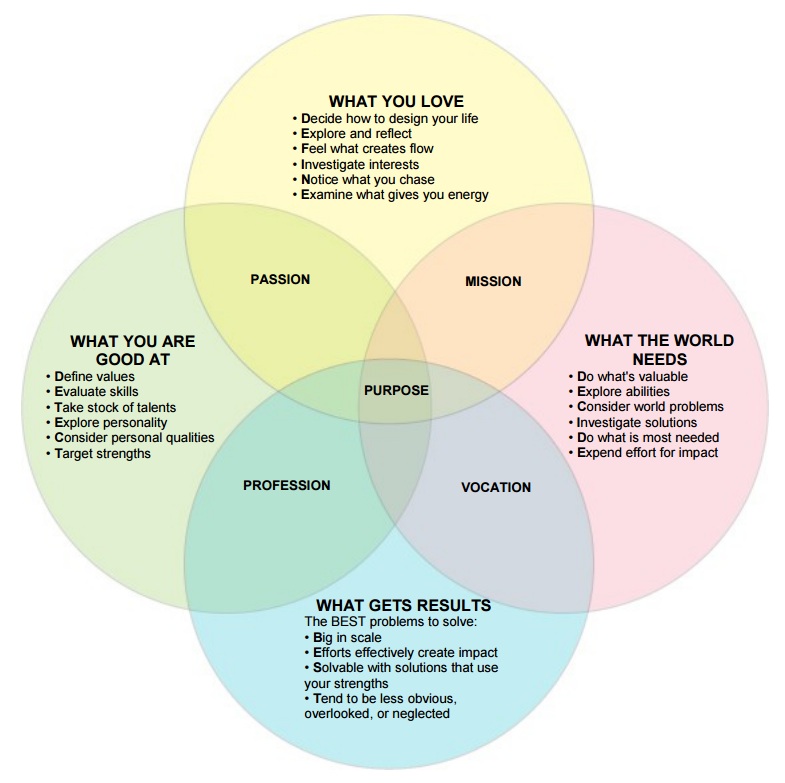
Purpose is one of the Four Ps of positive shift that contribute to happiness. The Ikigai diagram illustrates finding the intersection between what you are good at, what you love, what the world needs, and what you can be paid for. This can be challenging to discover, but a good starting point is identifying your strengths.

Ikigai is a Japanese word that roughly translates to “the reason you get up in the morning.” The following questions can help you navigate the process of discovery.

1. List your strengths. Strengths are developed abilities that may be learned skills or innate talents.
What abilities do you have that are easy for you to do?
What do people ask you to help them with?
What do people say you are good at doing?
What do you love to learn about?

2. Which of these do you love doing the most?
What did you enjoy doing as a child or in your early adult years?
What do you do now in your spare time that makes you happy?
What are you doing when you completely lose track of time?
What would you do if money didn’t matter?

3. Of these, what does the world need most?
What can you offer the world? What problems in the world do you most want to solve?
What would you be willing to sacrifice for?
Who inspires you? Why do you admire them and what do they do?
Who do you want to be and what actions will lead you to be your best self?

4. Of these, which would earn money? What could you be paid for?
Do your abilities provide a financial opportunity? What job would best use your abilities?
Could you teach a class or create a product that people would pay you for?
What would you do if you knew you could not fail?

5. Finally, finish the following sentences:
If I only had six months to live, I would spend my time…
If I were to die tomorrow, I would regret that I did not…

• Passion: what you’re good at + what you love
• Mission: what you love + what the world needs
• Profession: what you’re good at + what you can be paid for
• Vocation: what the world needs + what you can be paid for

Download the Ikigai Pathway to Purpose Worksheet pdf

More Resources

“How to Ikigai” by Tim Tamashiro, TED Talk How to Ikigai. (Amazon link to the book provides a small commission that helps support the Daily PlanIt)

Posted in positive shift

Develop Agency

When I began to struggle with extra pounds, I had to confront the fact that my fondness for the comfort zone was in direct opposition with achieving weight loss. Despite my best efforts to find shortcuts and avoid the work, it was simply not going to happen without getting up off the couch and doing the work. I watched a TED talk by Oonagh Duncan and read her book “Ditch the Diet.” She is really good at telling it like it is and I appreciated her calling me out, even as I wished she could do it with less colorful language. After reading it, I could no longer fool myself. As with any goal, this was going to take work. Now I know that work is not a four letter word, and I can work hard when I need to. But I’ve always been a lot more inclined to seek the fun stuff and the enjoyments of life.

Get some satisfaction (be willing to work hard for a meaningful goal)
About this time I watched a video of Arthur Brooks talking about what makes us happy. He describes the uniquely human ability to gain satisfaction from a job well done. Satisfaction supports the pillar of work, one of four pillars that sustain happiness. (Faith, family, and friendship are the other pillars.) Arthur Brooks’ happiness formula is: Happiness = Enjoyment + Satisfaction + Meaning. If we want happiness, challenges and effort NEED to be a part of our life. This was a ground shaking revelation for me, since I tended to avoid challenges and effort whenever possible. Honestly, shortcuts can sometimes be great time savers! But a shortcut mindset can create problems.

Agency is the key to action
Not only do I tend to love the comfort zone, I also have difficulty accomplishing all the plans that I make. Because it means really taking action. It is not enough to just aquire the knowledge of what to do and listen to motivational speeches. I have come to believe that Clarity and Choices are extremely important in living a meaningful and fulfilling life. The most important choice we can make is choosing to actually act to become the person that we want to be.

What is agency? the ability to act independently and intentionally to influence outcomes

Belief in self
Independent
Ability to influence outcomes
Solution oriented
to Action

Ways to RAISE agency:

Reflection – self-awareness
Autonomy – ability to independently act and influence outcomes
Intentionality – decide with deliberate and purposeful choices
Self-efficacy – boost confidence and belief in abilities
Engagement – be curious, interested, and involved

How can we develop agency? What can we read, watch, and do? The AI overview suggests many things that I have spent a lot of time learning about, so I guess I can be capable of putting forth effort, especially in what interests me. It outlined:
• Reflection, identification of values and strengths, goal setting and planning. Got it!
• Emotional regulation, growth mindset, and learning. Sure thing!
• Self-regulation, self-care, and mindfulness. No problem! But then it got into a little rockier ground for me:
• Taking initiative and ownership, believing in yourself, embracing challenges, and learning from mistakes. Uh oh.

Doing difficult things is RUFF, because we can expect to encounter:
Risk and discomfort
Uncertainty and unknown
Fear and anxiety
Failure and mistakes

Facing difficult things can trigger fear that can cause us to flee, freeze, or act in unhelpful ways. The human reaction when a percieved threat or danger is enountered is to avoid or attack, run or resist! The fight or flight response of our primitive brain instinctually takes over with increased heart rate and faster breathing. This automatic reaction highjacks the thinking part of the brain, making logical responses difficult. So doing difficult things takes awareness, accurate assessment, belief in the importance of what you are doing, belief in your ability to do it (self-efficacy), the courage to take it on, and the commitment to see it through. This is not easy, but when we do difficult things, we gain:

Growth
Resilience
Adaptability
Strength
Satisfaction

Have I done hard things? Oh, yes. Life often brings hard things whether we seek them out or not. And when interested enough, I have voluntarily taken on challenges. But my default position is usually to look for the most efficient and easy path and take that one. The problem with the easy path is that it may not lead to where you want to go. In fact, it probably won’t.

Get RESULTS with agency
Reflect (but don’t stop there)
Explore resources
Seek supportive relationships
Understand and manage emotions
Learn and grow
Take small steps
Support self-efficacy with strengths

The enemies of agency, and the antidotes.

The opposite of agency is passiveness and inaction. A person who lacks agency AVOIDS.
Attitude: do you feel helpless to create change? The solution is realistic optimism.
Victim mentality: do you have a fixed mindset? The solution is a growth mindset.
Indifference: are you too bored to care? The solution is to find engagement.
Overwhelm: are there too many choices? The solution is to simplify.
Distraction: is social media, television, videos, etc. sucking up all of your attention? The solution is to limit inputs.
Sedentary lifestyle: is much of your day inactive? The solution is to move more.

Agency Blockers from Nick Wignall

SEARCH for agency:

Seek purposeful actions
Explore with experimental mindset
Adopt a growth mindset
Realistic optimism ↴
Commitment to difficult tasks
Hack distractions

How to Identify High Agency People by Nick Wignall, Anne-Laure Le Cunff describes self-authorship and an experimental mindset at Big Think. John Ameachi on commitment at Big Think.

Use realistic optimism to overcome learned helplessness.

Learned helplessness can develop when we face negative situations or events that are outside of our control. We may generalize our inability to influence outcomes, which can result in a sense of powerlessness and a tendency to either not try at all to make changes, or to give up easily, even when the situation is different. Control may now be available to us, but beliefs still hold us back.

The elephant and the rope story describes how limiting beliefs can prevent the realization of true potential. A young elephant that is restrained by a small rope grows up believing it cannot break free, even when the rope is no longer strong enough to hold it. This belief becomes a now self-imposed limit that keeps it from breaking free. See Lauren Weinstein’s TED talk Don’t believe everything you think.

Realistic optimism means that you recognize the things you can change, accept the ones you can’t, and find courage to act on the ones you can. You know what is within your circle of influence, and SHAPE what you can with agency and communication skills.

Share information
Help others
Ask for what you want
Persuade with appeal
Express opinions
Set limits

Recognize when: It’s not personal (is the cause perceived to be internal or external?) It’s not permanent (is it a one-time event or eternal?) It’s not pervasive (is the event a specific situation, or is it global?) [from 3 ways to reverse learned helplessness]

Engagement means that you are curious, interested, and involved. To increase engagement, take a STAND:
Seek out connections
Try new things
Ask questions
Notice
Decide to make a difference

BOLDLY EXPLORE to develop agency
Be curious
Overcome resistance
Live at the edge of the comfort zone
Defeat inertia

Be Seen” by Jen Gottlieb, TED talk How to overcome self-sabotage, TED talk How to eliminate self-doubt forever by Peter Sage, TED talk The art of discomfort by Leigh Bardugo

Yes, you CAN do hard things
Involvement
Courage
Act even when hard
Never give up

It takes courage to act with agency.

Books and TED talks

Amazon affiliate links to books provide a small commission to help support the Daily PlanIt.

RESOURCES

Related to agency are being authentic, and the motivational factor of Autonomy.

Explore more TED talks by speakers who are also authors at TED Talk Book Discussion.

Posted in personal development
eBooks

Enter your email address to follow this blog and receive notifications of new posts by email.

Archives
Blog Stats
  • 741,700 hits