
Beliefs influence our behavior and our lives. As you Discover U, you examine mental and spiritual beliefs. When you stop to listen to self-talk, some of it likely comes from limiting beliefs that have developed. These create obstacles to making a meaningful life by building relationships, pursuing purpose, and achieving goals. Learn about the power of beliefs to begin your journey.
Author and TED speaker (What makes technology so habit forming?) Nir Eyal has written several books about frameworks to master attention, build better habits, and rethink the beliefs that shape behavior. Books purchased with Amazon affiliate links below provide a small commission that helps to support the Daily PlanIt at no additional charge.
In his latest book, “Beyond Belief,” the author describes how our (often unconscious) thoughts dictate our actions, in ways that are not always helpful to us. He presents research about beliefs and concludes that beliefs are mental tools rather than rigid facts. While fact is objective truth, and faith is conviction without evidence, belief is firmly held opinion that is open to revision based on new evidence. Beliefs help us navigate reality when the truth is not fully known, and we can choose beliefs that are helpful to us. The best beliefs are based on practical reality, open to adjustment, and hold up to real world feedback. Hoping that results will manifest on their own and waiting for problems to resolve by themselves can be unrealistic and an excuse for inaction. We often picture motivation as a straight line from behavior for a benefit, but believing that effort will make a difference is crucial.
The book is divided into three sections presenting stories and studies about the three powers of belief: attention, anticipation, and agency. Each chapter ends with a list of limiting beliefs that can be transformed into liberating beliefs. At the end of the book are Takeaways for each chapter.
Attention: beliefs shape perceptions, which in turn affects what we do. In his book “Indistractable,” the author shows how attention can be diverted by external and internal distractions. The opposite of distraction is traction: action toward what we really want. Mastering our own internal distractions means understanding what drives your behavior, which is often decided by avoidance of discomfort. An article at his website describes steps from Dr. Jonathan Bricker to keep a distraction log. https://www.nirandfar.com/distractions (Jonathan Bricker’s TED talk The Secret to Self Control). Learn more about dealing with Distractions.
Anticipation: we feel what we believe. The experience loop: believe – anticipate – feel – confirm, is often used to trigger desire for a product by marketers. In the book “Hooked,” the author describes a user’s interactions with a product as they pass through four phases: a trigger to begin using the product, an action to satisfy the trigger, a variable reward for the action, and some type of investment that, ultimately, makes the product more valuable to the user. The author suggests using selective skepticism. https://www.nirandfar.com/how-to-manufacture-desire/
Agency: what we believe affects our ability to act and stay motivated. Agency is the capacity to take action, make choices, and exert control over your life and environment. Albert Bandura researched self-efficacy, the belief in our ability to shape our lives through our own efforts. People with an internal locus of control believe that their personal decisions and efforts guide much of their lives. Those with an external locus of control believe that outside forces like fate, luck, circumstances, and temptations—are responsible for the events of their lives.
Limiting beliefs are often one of our biggest obstacles. This section of the book points out that research has shown that helplessness is a default, rather than being learned. The author says the antidote to limiting beliefs is hope, achieved through small, actionable acts of agency. Optimal challenges give us opportunities to build competence with mastery experiences. By successfully taking charge in a challenging situation, the brain pathways that override passive defaults are reinforced. Martin Seligman says that with optimism, we can “light up” what he calls a hope circuit in the medial prefrontal cortex. Confront your inner deceptions and insecurities with truth. Pay attention to self-talk and master your mindset. https://www.nirandfar.com/locus-of-control/
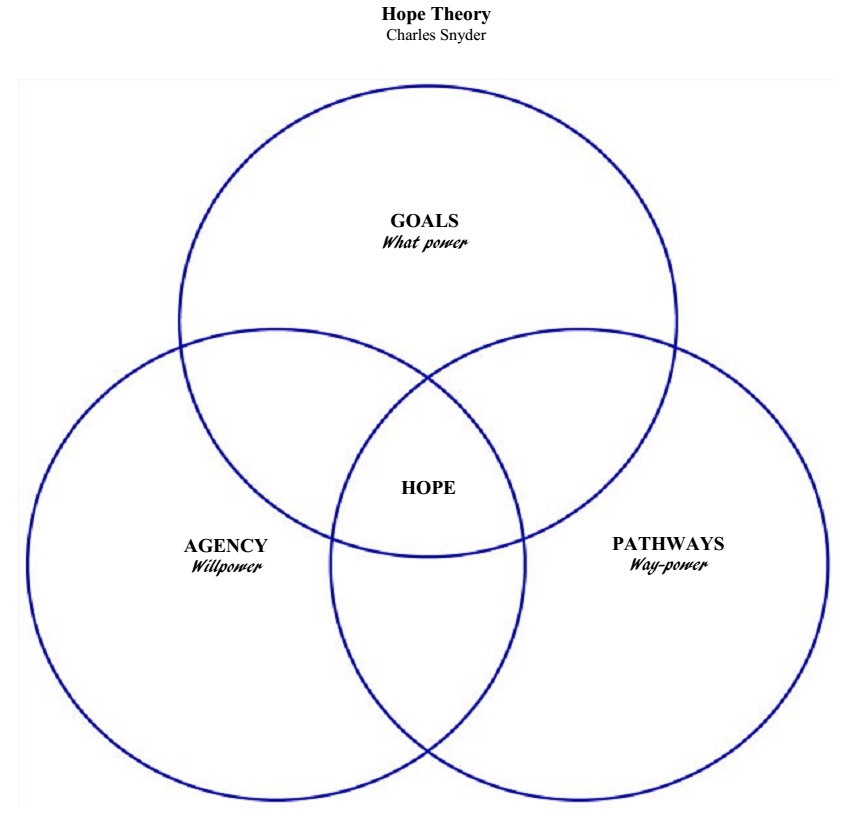
Charles Snyder was a professor at the University of Kansas who researched hope theory. Hope Theory defines hope not as an emotion, but as a cognitive and motivational state. It operates on a simple equation: Hope = Goals + Agency + Pathways. Hope comes from believing that you can achieve goals (what power), having confidence in your agency (willpower), and a pathway to achieve your goals (way-power). Willpower is the mental energy used to push through challenges which can deplete quickly. Self-efficacy is the belief in our ability to achieve goals. Way-power is the mental capacity to find good solutions for achieving them. With skillpower we can build systems that support helpful habits. Hopeful thinking activates specific neural pathways that help you navigate adversity with greater resilience.
GOALS – What power. To discover goals that you want to do, you need to understand yourself. The Discover U series includes resources for identifying strengths and more. Gain what power by developing skills for goal setting, planning, and productivity.
PATHWAYS – Way power. To build pathways: identify the problem (where you are stuck), look for effective options, and build a pathway forward with resources and your strengths.
AGENCY – Willpower. To develop personal agency (the ability to act independently and intentionally to influence life) use strengths and gain confidence with small steps toward competence. Be aware of what you can influence and overcome limiting beliefs. Learn more about Mental Beliefs
Books and TED talks about:
Beliefs (more about limiting beliefs at Behavior Change Pathway)
- Master Your Code by Darren Gold, TED talk The secret to an extraordinary life
- Big Trust by Shade Zahrai, TED talk Master your mindset
- Rewrite the Program by Eli Bowman, TED talk Overcoming limiting beliefs
- Journey to the Top by Jamie Crosbie, TED talk Liar, liar, life on fire
- You Are Enough by Megan Fenyoe, TED talk You are enough
- Primed by Rachel Wei, TED talk Overcoming limiting beliefs
- The Empowered Job Search by Lauren Weinstein, TED talk Don’t believe everything you think
Hope
- Change Anything by Al Switzler, TED talk Change anything! Use skillpower over willpower
- Hope Rising by Chan Hellman, TED talk The Science and power of hope
- The School of Hope by Cathleen Beachboard, TED talk What if hope is the key to a meaningful life?
- Learned Hopefulness by Dan Tomasulo, TED talk 7 Habits of the most hopeful people
- Making Hope Happen by Shane Lopez, Interview (also has two TED talks- see Purpose Pathway
More resources on:
Belief
- Beyond Belief Workshop
- Author visit at Montgomery County Library: video and discussion guide
- Interview with Scott Young
- Beyond Belief and Indistractable Talks at Google
- The Power of Belief book by Shawn Achor
Hope
- Hope Framework at cool.org
- How to have hope from Steve Kamb

I seek to create order from the chaos of complex information. Join me at the Daily PlanIt to gain insights, inspiration, and information to increase skills for a better life. I unlock the power of teaching reading with phonics in the pursuit of literacy at www.phonicspow.com. In my spare time I explore books and movies, often choosing titles available on both screen and page.


[…] – decide with deliberate and purposeful choices • Self-efficacy – boost belief in abilities with practice • Engagement – be curious, interested, and […]
[…] beliefs – without self-efficacy, belief in your abilities, you may fail to act. Choose realistic […]
[…] more about overcoming limiting beliefs. Find more books and TED talks at the Overcoming Obstacles Pinterest board and TED Talk Book […]
[…] The biggest self-created obstacle may be our inner deceptions – limiting beliefs that hold us back. Learn more at the Power of Belief. […]
[…] beliefs can be influenced by our […]
[…] to overestimate our abilities, while the opposite is true with the Imposter Syndrome and limiting beliefs. The Optimism Bias says that we may underestimate the likelihood of negative risks or overestimate […]
[…] Begin to examine beliefs (especially limiting beliefs) [The Power of Belief]: […]
[…] Do connect the dots [who you are – Discover U, what you believe – The Power of belief, what you want to do – Share the love] • Explore possibilities • Stop trying to solve the […]
[…] Shift your limiting beliefs, adjust your self-talk • Target a fear you want to conquer • Embrace a growth mindset and try […]
[…] in our head can sometimes be quite critical and unkind. Negative self-talk based on inaccurate beliefs can be one of our biggest self-created obstacles. When we pay attention to the things we are saying […]