
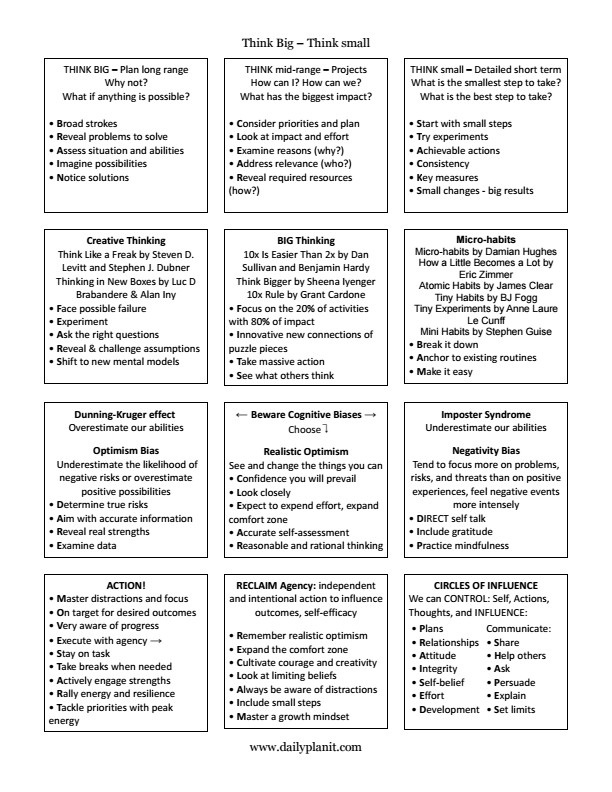
 Is it better to think BIG, or to think small? It turns out, both are important in their own ways.
Divergent thinking is about DREAMing up BIG ideas:
• Different perspectives
• Reveal novel solutions
• Explore possibilities
• Add creative ideas
• Make new connections
Creative thinking may be outside the box (unrestrained), or inside the box (constrained). But facing FEARS by asking the right questions can make a BIG difference.
• Face possible failure
• Experiment
• Ask the right questions
• Reveal and challenge assumptions
• Shift to new mental models
Limits and boundaries can actually drive creativity. David Epstein talks about constraints at Big Think and in his new book Inside the Box. Amazon affiliate links provide a small commission to help support the Daily PlanIt at no additional charge.
Books and TED talks about creative thinking:
- “Thinking in New Boxes” by Luc D Brabandere, TED talk Reinventing creative thinking and Alan Iny, TED talk Reigniting creativity in business
- “Questions are the Answer” by Hal Gregersen, TED talk What are you dead wrong about today?
- “A More Beautiful Question” by Warren Berger, TED talk The Catalyst’s Dance
- “Think Like a Freak” by Steven D. Levitt and Stephen J. Dubner
- Giovanni Corazza TED talk Creative thinking: how to get out of the box and generate ideas.
- Phil Hansen TED talk The Power of Constraints.
- Nick Thomass TED talk How flipping your perspective can change your life
Think BIG to plan long range goals that AIM at purpose. Ask “Why not?” and “What if anything is possible?” Thinking BIG is about using your BRAIN to:
• Begin with broad strokes
• Reveal problems to solve
• Assess situation and abilities
• Imagine possibilities
• Notice solutions
Books and TED talks about BIG Thinking:
- Think Bigger by Sheena Iyenger, TED talk The Art of Choosing
- The Science of Scaling by Blake Erickson, TED talk The secret to achieving impossible goals
- 10x Is Easier Than 2x by Dan Sullivan and Benjamin Hardy
- 10x Rule by Grant Cardone
- The Magic of Thinking Big by David J Schwartz
Find what FITS:
• Focus on the 20% of activities with 80% of impact (Pareto Principle)
• Innovative new connections of puzzle pieces
• Take massive action
• See what others think
Convergent Thinking is about narrowing focus to find the best solution.
• Focus on one best solution
• Reduce distractions
• Analyze ideas
• Make plans
• Eliminate obstacles
Thinking medium can be helpful for planning mid-range projects, the step between longer term goals and short term actions. Ask “How can I?” and “How can we?” “What has the biggest impact?” An article from Pamela Slim shows how to break it down. Be CLEAR when planning projects:
• Consider priorities and plan
• Look at impact and effort
• Examine reasons (why?)
• Address relevance (who?)
• Reveal required resources (how?)
Learn more about Divergent and Convergent thinking at Plan.io and University of Texas at Austin.
Thinking small is especially important for habits, because more doable actions are more likely to be accomplished. Think in detail for shorter term goals. Ask “What is the smallest step to take?” and “What is the best step to take?”
STACK habits:
• Start with small steps
• Try experiments
• Achievable actions
• Consistency
• Key measures
Micro-habits aim for significant results with small changes:
• Break it down
• Anchor to existing routines
• Make it easy
Books and TED talks about micro-habits:
- Micro-habits: Tiny changes that Supercharge high performance by Damian Hughes, TED talk How peak performers find the path to courage
- How a Little Becomes a Lot by Eric Zimmer, TED talk The battle of changing your behavior
- Book and TED talk by Anne Laure Le Cunff – see An Experimental Mindset
- Book and TED talk by BJ Fogg, Atomic Habits by James Clear – see Habits
- “Mini Habits by Stephen Guise
- “10% Better by Rob Yeung
- The Slight Edge by Jeff Olson
DARE to overcome cognitive biases. The Dunning-Kruger effect says that we tend to overestimate our abilities, while the opposite is true with the Imposter Syndrome and limiting beliefs. The Optimism Bias says that we may underestimate the likelihood of negative risks or overestimate positive possibilities, while Negativity Bias says that we tend to focus more on problems, risks, and threats than on positive experiences, and feel negative events more intensely.
• Determine true risks
• Aim with accurate information
• Reveal real strengths
• Examine data
Realistic Optimism is the best answer for dealing with cognitive biases. Be CLEAR to see and change the things you can.
• Confidence you will prevail
• Look at beliefs
• Expect to expend effort, expand comfort zone
• Accurate self-assessment
• Reasonable and rational thinking
After all this thinking, comes the time for action. MOVE and START:
• Master distractions and focus
• On target for desired outcomes
• Very aware of progress
• Execute with agency
• Stay on task
• Take breaks when needed
• Actively engage strengths
• Rally energy and resilience
• Tackle priorities with peak energy
RECLAIM Agency to act independently and intentionally to influence outcomes:
• Remember realistic optimism
• Expand the comfort zone
• Cultivate courage and creativity
• Look at limiting beliefs
• Always be aware of distractions
• Include small steps
• Master a growth mindset
Know your Circles of influence: what things are outside your control, what are within your control, and what you can influence.
We can CONTROL: Self, Actions, Thoughts, and INFLUENCE:
• Plans
• Relationships
• Attitude
• Integrity
• Self-belief
• Effort
• Development
Find more pathways and TED talks by speakers who are also authors at TED Talk Book Discussion.

I seek to create order from the chaos of complex information. Join me at the Daily PlanIt to gain insights, inspiration, and information to increase skills for a better life. I unlock the power of teaching reading with phonics in the pursuit of literacy at www.phonicspow.com. In my spare time I explore books and movies, often choosing titles available on both screen and page.


[…] Develop: Grow up – Intentionally navigate trials and tribulations by developing new psychological or professional skills, master and demonstrate the change. (7. work, 8. deep work, 9, embody the change) [Overcoming Obstacles, Thinking BIG, thinking small] […]
[…] • Do connect the dots [who you are – Discover U, what you believe – The Power of belief, what you want to do – Share the love] • Explore possibilities • Stop trying to solve the unsolvable • Investigate – ask others [Support squad] • Go test out ideas [Experimental mindset] • Narrow to choose best options [Think big, think small] […]
[…] strengths to help with valuable solutions to problems you are passionate about. Get Creative and Think Big to seek solutions to problems. How to Choose a World Problem at the 80,000 Hours suggests the BEST […]
[…] learn more at Goal Skills – Problem solving, and Decision making and Problem Solving (Skills Employers Want series), The Choice to Act, Think Big, Think Small […]