
Emotional – Activity: Express Emotions with I Statements
Just as we have choices about how to interpret an event, and how to label emotions, we also have options about how to express feelings. Take EXTRA TIME to express emotions appropriately.
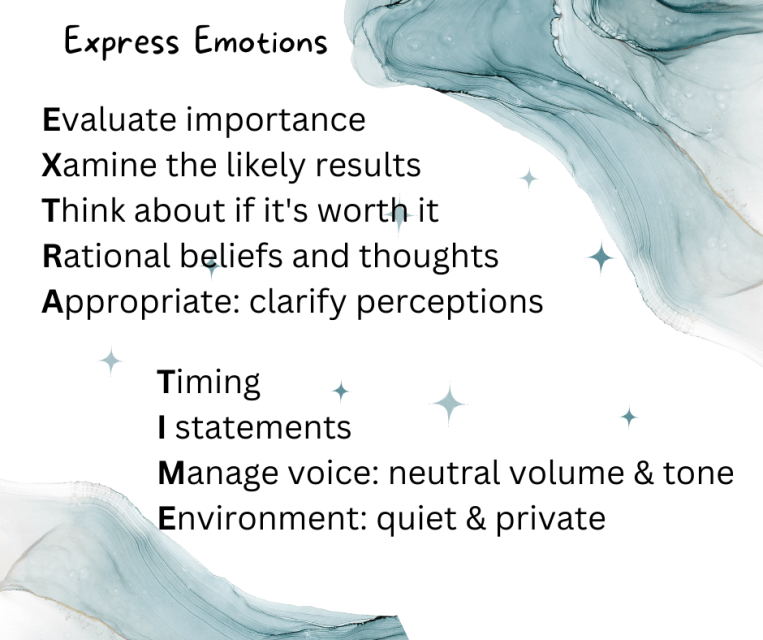
First, evaluate the situation:
- Evaluate how important it is to you
- Xamine the likely results: can something be changed?
- Think about whether the likely results are worth speaking up for.
- Rational response: are feelings based on rational beliefs and thoughts?
- Appropriate: clarify what you heard the other person say. Sometimes our initial perceptions and interpretations aren’t accurate.
If you do decide to communicate your feelings, consider:
- Timing: both people need the energy and ability to focus.
- I statements: use a communication style that focuses on the feelings or beliefs of the speaker.
- Manage voice: use neutral volume and tone.
- Environment: choose a private and quiet place.
There are five elements of an I Statement to consider:
- Observations – state the facts, describe the situation
- Feelings – describe your own feelings
- Thoughts – about the effects of the situation
- Wants – ask clearly for what you want
- Intentions – tell what you plan to do
Example: “When you keep your phone out at dinner, I feel unappreciated. I would prefer it if we give each other our full attention while we have a meal.”
Own the emotion. Say “I notice that I am feeling ____.” Not: “I am ____.” or “You made me ____.” Susan David writes about the importance of accurately labeling and communicating emotions in her book “Emotional Agility.”
Before you speak, THINK:
- T is it True?
- H is it Helpful?
- I is it Inspiring?
- N is it Necessary?
- K is it Kind?
SMART goal:
This week, I will decide if expressing emotions is the best choice in situations that arise. If I choose to express my emotions, I will use I statements. I will print a Five Message Worksheet (pdf) and use it each day.
Tools:
- Chart describing the five elements at newconversations.net
- Five Message Worksheet (pdf)
This is part of a series on emotional intelligence, and one of the weekly activities for a Year of Personal Development. Emotional intelligence is one of the building blocks of positive shift that have been shown by research to increase happiness.

I seek to create order from the chaos of complex information. Join me at the Daily PlanIt to gain insights, inspiration, and information to increase skills for a better life. I unlock the power of teaching reading with phonics in the pursuit of literacy at www.phonicspow.com. In my spare time I explore books and movies, often choosing titles available on both screen and page.


 Daily PlanIt
[…] aware of and express the feelings that are underlying the […]
[…] also: Express Emotions with I Statements Share this:ShareEmailPrintLike this:LikeBe the first to like […]
[…] Be aware of feelings and express them responsibly […]