
Emotional – Activity: Understand Emotions
Rational Emotive Behavior Therapy (REBT) is a form of cognitive behavior therapy developed by Albert Ellis. Learn more about Cognitive Behavior Therapies at Creating Clarity. With this method we gain an understanding of how our beliefs about events lead to our emotions.
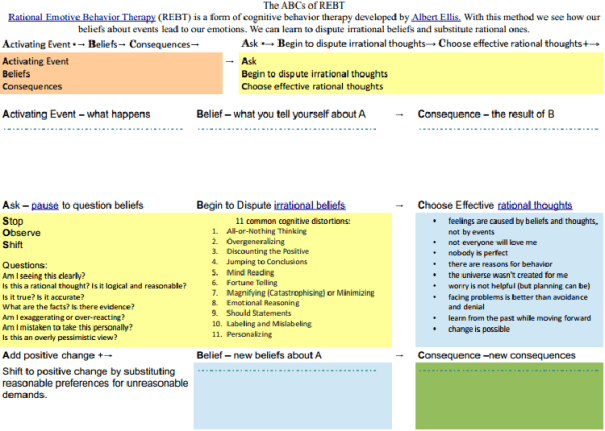
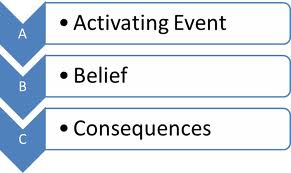
Activating Event ▪→ Beliefs → Consequences +→
- Activating Event
- Beliefs
- Consequences
If our beliefs are based on irrational thoughts, consequences may be negative. But we can insert a mental pause with the SOS method to ask questions and choose more effective rational thoughts for a more positive outcome.
Ask ▪→ Begin to dispute irrational thoughts → Choose effective rational thoughts +→
Ask: Use the SOS technique to insert a mental pause to identify emotions and ask questions:
- What are my feelings?
- Am I seeing this clearly?
- Is this a rational thought? Is it logical and reasonable?
- Is it true? Is it accurate?
- What are the facts? Is there evidence?
- Am I exaggerating or over-reacting?
- Am I mistaken to take this personally?
- Is this an overly pessimistic view?
Begin to dispute irrational thoughts. Some common cognitive distortions:
- All-or-Nothing Thinking
- Overgeneralizing
- Discounting the Positive
- Jumping to Conclusions
- Mind Reading
- Fortune Telling
- Magnifying (Catastrophising) or Minimizing
- Emotional Reasoning
- Should Statements
- Labeling and Mislabeling
- Personalizing
Choose to substitute effective rational thoughts:
- feelings are caused by beliefs and thoughts, not by events
- not everyone will love me
- nobody is perfect
- there are reasons for behavior
- the universe wasn’t created for me
- worry is not helpful (but planning can be)
- facing problems is better than avoidance and denial
- learn from the past while moving forward
- change is possible
This week, I will notice how my feelings, beliefs and thoughts are connected. I will print an REBT self help form and use it each day. I will replace irrational beliefs and thoughts with rational ones.
Download the ABCs of REBT worksheet (pdf) Watch a video about the ABCDE Model. (6:35)
Knowing what you are thinking is a part of Creating Clarity. One of the Four Agreements is to Be Impeccable With Your Words. Uplift yourself with honest self-talk using REBT.
learn more about understanding emotions:
- Jennifer Willis TED talk What’s Your Frame?
- Printable REBT self help form (pdf)
- The Feedback Loop at becomingbetter.org
- Practical Lesson: ABCDEF worksheet from jayuhdinger
- www.getselfhelp.co.uk
This is one of the weekly activities for a Year of Personal Development and part of the series on emotional intelligence.

I seek to create order from the chaos of complex information. Join me at the Daily PlanIt to gain insights, inspiration, and information to increase skills for a better life. I unlock the power of teaching reading with phonics in the pursuit of literacy at www.phonicspow.com. In my spare time I explore books and movies, often choosing titles available on both screen and page.


 Daily PlanIt
[…] PlanIt Understand EmotionsThis Emotional LifeIdentify EmotionsPractice the Four AgreementsEarth Day […]
[…] PlanIt Understand EmotionsThis Emotional LifeIdentify EmotionsPractice the Four AgreementsEarth Day […]
[…] Nine: Punch fear in the face. Question your self-talk, use positive […]
[…] Rational thoughts, positive thoughts and affirmations, a Growth Mindset, a can-do attitude, Grit, confident posture […]
[…] Albert Ellis – Rational Emotive Behavior Therapy […]
[…] REFRAME “What are more helpful thoughts, feelings, and actions?” • Rational thoughts • Growth mindset • Helpful actions […]
[…] What are you thinking? Are your thoughts rational? DIRECT Self Talk • Deliberate distance • Irrational to rational • Re-frame • Emotional congruence • Coach not critic • Try REBT (Rational emotive behavior therapy) […]
[…] Emotive Therapy, Albert Ellis shows how our feelings come from the thoughts we think. Learn how to understand emotions with […]
[…] as we have choices about how to interpret an event, and how to label emotions, we also have options about how to express feelings. Take EXTRA TIME to […]
[…] beliefs – learned helplessness can prevent action. Re-frame thinking to become […]
[…] reality, but a close look at the accuracy of our thoughts and beliefs can be a good choice. Our feelings can be shaped by the things we tell ourselves. Our relationships can be altered by the things that […]
[…] Affirmations. Use Positive Affirmations and Self-talk. How often do we think negative thoughts that are not based in truth? To be impeccable with your word is one of the Four Agreements, and it means to be honest with yourself as well as others. Learn more about thinking rationally at Understand Emotions. […]
[…] Re-frame: look at problems as challenges, check the validity of assumptions, dispute irrational thoughts. […]