
Verbal communication is like playing ping pong while juggling and jumping on a trampoline. There is far more going on than just bouncing back and forth between a speaker and listener! A speaker must choose words and transmit them with both voice and body language. A receiver of a message must listen to hear both the words and the voice, observe body language, interpret the meaning of all of it, and then respond with feedback to ensure understanding. Practice these 12 communication skills for better communication.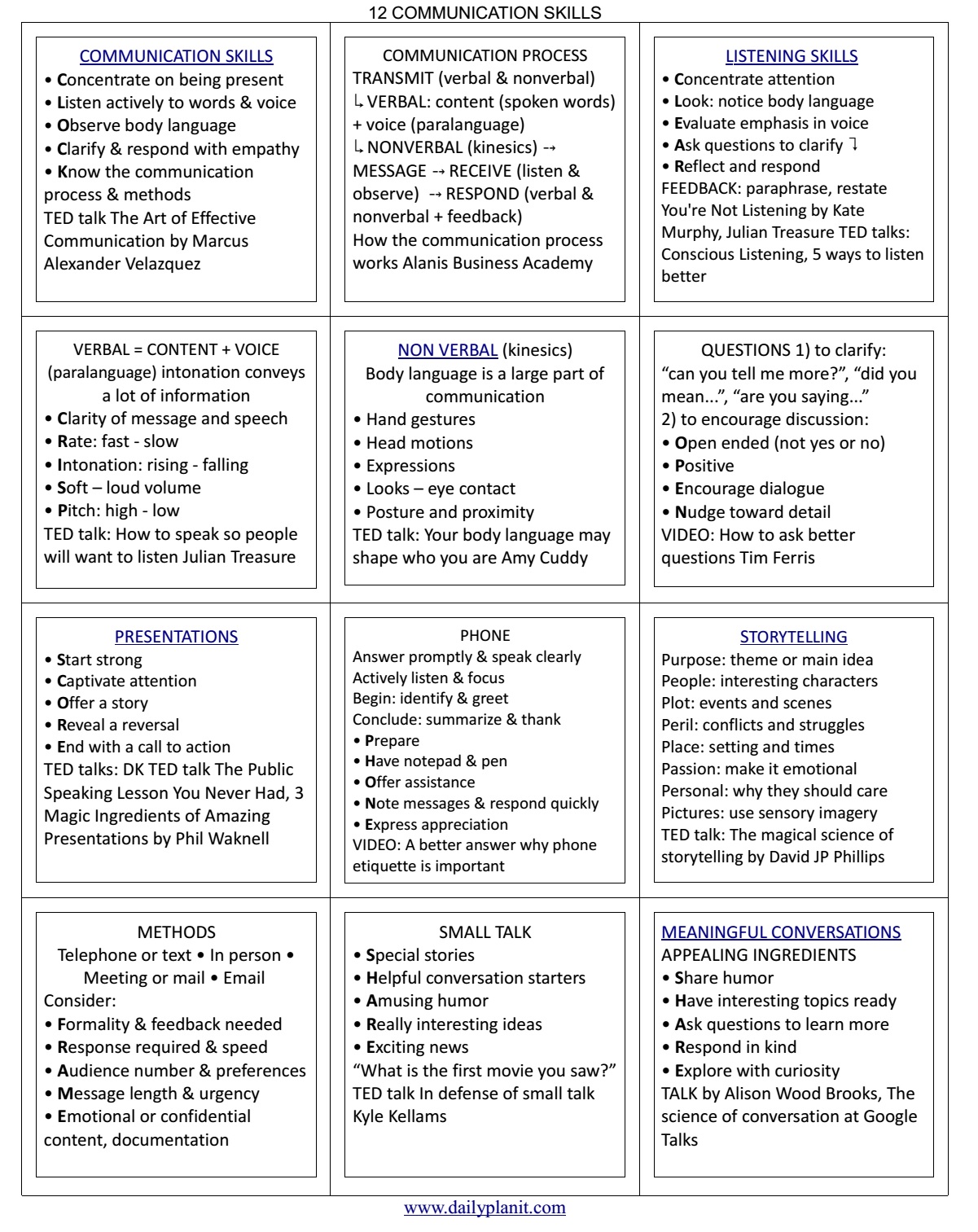
1. BASIC COMMUNICATION SKILLS
• Concentrate on being present
• Listen actively to words and voice
• Observe body language
• Clarify and respond with empathy
• Know the communication process
TED talk “The art of effective communication” by Marcus Alexander Velazquez
2. Know the COMMUNICATION PROCESS
TRANSMISSION (verbal & nonverbal)
↳ VERBAL: content (spoken words) plus voice (paralanguage) [clarity • rate • intonation • volume • pitch]
↳ NONVERBAL (kinesics): [hand gestures • head motions • expressions • looks: eye contact • posture & proximity] A large part of communication comes from intonation and body language.
MESSAGE [encoding (to transmit) and decoding (to receive) meaning]
⤍ RECEPTION (listen & observe)
⤍ RESPONSE (verbal & nonverbal plus feedback)
How the communication process works Alanis Business Academy
3. LISTENING SKILLS – listen actively to words and voice, be CLEAR:
• Concentrate attention
• Look to notice body language
• Evaluate emphasis in voice
• Ask questions to clarify
• Reflect and respond
FEEDBACK: paraphrase, restate in your own words
“You’re Not Listening” by Kate Murphy. TED talks: Conscious Listening, the sound of happiness, and 5 ways to listen better by Julian Treasure, The Power of Listening by William Ury
4. NONVERBAL (body language, kinesics)
• Hand gestures
• Head motions
• Expressions
• Looks – eye contact
• Posture and proximity
TED talk: Your body language may shape who you are by Amy Cuddy (21.02)
5. VOICE (paralanguage)
• Clarity of message and speech
• Rate: fast – slow
• Intonation: rising – falling
• Soft – loud volume
• Pitch: high – low
TED talk: How to speak so people will want to listen by Julian Treasure
6. Ask QUESTIONS to clarify:
• Reflect “how do you feel about that?” “So you feel…” “It sounds like you…”
• Ask “can you tell me more about that?” “do you mean…?”
• Paraphrase, summarize in your own words: “let’s see if I understand what you’re saying…” “is that right?”
to encourage discussion:
• Open ended (not yes or no)
• Positive
• Encourage dialogue
• Nudge toward detail
Watch: How to ask better questions Tim Ferris (5.29) Why asking questions is important (5.07) Questioning techniques from MindTools (3.20).
WORK communication skills ↴
7. PRESENTATIONS
• Start strong
• Captivate attention
• Offer a story
• Reveal a reversal
• End with a call to action
Plan • Practice • Perform with passion. It’s About the audience, Begin w/bang, Caution w/bullets. TED talks: DK TED talk The Public Speaking Lesson You Never Had, 3 Magic Ingredients of Amazing Presentations by Phil Waknell. See more at The Simple Way to Create a Compelling Talk
8. PHONE
Answer promptly and speak clearly, Actively listen and focus, Begin: identify and greet, Conclude: summarize and thank.
• Prepare
• Have notepad and pen
• Offer assistance
• Note messages and respond quickly
• Express appreciation
texts and messages: concise, clear, check!
A better answer why phone etiquette is important (1.56)
9. STORYTELLING
Purpose: theme or main idea
People: interesting characters
Plot: events and scenes
Peril: conflicts and struggles
Place: setting and times
Passion: make it emotional
Personal: why they should care
Pictures: use sensory imagery
Pixar’s Secret to Storytelling, TED talks: The magical science of storytelling by David JP Phillips, Business Storytelling Made Easy by Kelly Parker, Why Storytelling Matters by Garr Reynolds
More work interpersonal communication skills: Assertiveness, Branding, Conflict management, Difficult conversations, Meetings, Networking, Performance reviews, Teamwork. More non-verbal communication skills:
- DIGITAL: email, video conferencing, social media, online collaboration, netiquette
- WRITING: creative, business, reports
10. Know communication METHODS – Telephone or text ♦ In person ♦ Meeting or mail ♦ Email
• Formality and feedback needed
• Response required and speed
• Audience number and preferences
• Message length and urgency
• Emotional or confidential content, documentation
11. SMALL TALK
• Special stories
• Helpful conversation starters
• Amusing humor
• Really interesting ideas
• Exciting news
“What is the first movie you saw?”
TED talk In defense of small talk Kyle Kellams
“What exciting work are you doing?”
“Do you have any trips planned?”
”Has something good happened today?”
TED talk: You are Contagious by Vanessa van Edwards (18.16)
12. MEANINGFUL CONVERSATIONS – include appealing ingredients:
• Share humor
• Have interesting topics ready
• Ask questions to learn more
• Respond in kind
• Explore with curiosity
TALK by Alison Wood Brooks, The science of conversation at Google Talks
TED talks: How to skip the small talk by Kalina Silverman (19.41), 10 ways to have a better conversation by Celeste Headlee (11.45)
Amazon affiliate links to books provide a small commission to help support the Daily PlanIt. More TED talks by speakers who are also authors at TED Talk Book Discussion.
Download the 12 Communication Skills pdf.
Communication Youtube Playlists: DailyPlanIt, LearnFree, ABC Life Literacy Canada, Latimer Group

I seek to create order from the chaos of complex information. Join me at the Daily PlanIt to gain insights, inspiration, and information to increase skills for a better life. I unlock the power of teaching reading with phonics in the pursuit of literacy at www.phonicspow.com. In my spare time I explore books and movies, often choosing titles available on both screen and page.


 Daily PlanIt
[…] 12 Communication Skills […]
[…] Links to the TED talks (plus more) can be found at the Communication Pathway board at Pinterest. Amazon affiliate links to the books provide a small commission that helps to support the Daily PlanIt. Learn more at 12 Communication Skills. […]