Get Organized with Home Helpers

Time management resources usually fall into one of two categories: Work Wonders or Home Helpers. Here are a few Home Helper Resources I’ve discovered.

I’ve been reading the book, “1000 Best Quick and Easy Organizing Secrets.”by Jamie Novak. There’s lots of great ideas, and at the back are Simple Sevens for Success: 7 favorite tools, 7 ways to start small…

Websites

Laura Stack, the Productivity Pro has helpful content. So does Smead.
Messie’s Anonymous by founder Sandra Felton, and Flylady.net are both helpful sites.  Real Simple magazine is great, and also has a website with lots of neat information.Getorganizednow.com and  Organized Home are wonderful websites too.

enjoy the little things notebook

Photo by Miesha Renae Maiden on Pexels.com

Books
“The Organizing Sourcebook” by Kathy Waddill-nine strategies for organizing your life with real life examples from a professional organizer.

“Best Organizing Tips” by Stephanie Winston-great overall guide.

“Get Your Act Together” by Pam Young and Peggy Jones-a card system for keeping track of keeping house for sidetracked home executives. Also check out “The Messies Manual” by Sandra Felton,” and Confessions of a Happily Organized Family” by Deniece Schofield.

“Ready, Set, Organize” by Pipi Campbell Peterson-has helpful information about filing and storage.

“Let Go of Clutter” by Harriet Schecter-ideas to simplify. There are two articles by her at Soulful Living: From Chaos to Comfort and Shedding Sentimental Clutter.

“One Year to an Organized Life” by Regina Leeds-breaks a big project into doable steps.
shopping cartLinks to my favorite books and products for productivity and personal development at The Daily PlanIt Amazon Store

See also:

Don’t miss the Home Helpers section of the Free Tools page at the Daily PlanIt.

Posted in Books, productivity

Household Records File

Adventures in Home Ownership

The good news is I am on a clutter busting roll! The bad news is I’m exhausted…whew. I have just enough energy to share my mistakes that you may learn from them. It all started when a VCR of fairly recent origin ate a tape. I wasn’t sure where I had put the book for it, let alone the receipt. I had one huge file labeled “warranties” that I’ve been throwing things into (when I remembered to) for awhile. Others had made their way to various locations around the house. I was inspired to make separate hanging files for all major appliances and label them: dishwasher, refrigerator, stove, washer and dryer, air conditioner, etc. Then I made a list with the information: date purchased, where, price, brand, etc. Next I will make more files divided by location: small appliances-kitchen, electronics and so on.

So from now on, here’s the plan every time I purchase something over $20.

  • Right away, make a file for the book.
  • Write the date & where purchased on the front cover and staple the receipt inside the back cover.
  • When something breaks, or is otherwise no longer around, remember to take out the book and discard it.
  • Less expensive versions of some things can be more inclined to break sooner. Sometimes you get what you pay for.
  • When gifts are received that have a book, make a file for them too.
  • Some books may contain pages with information you may need for maintenance or operation. Make a copy of those to add to a Household Notebook. For example, instructions for a thermostat or for telephone functions.
  • Include a seasonal maintenance checklist in the Household Notebook.
  • Keep track of home repairs and improvements.

See also Files

Posted in information management

Quiet Leadership

Booknotes on “Quiet Leadership” by David Rock. (Affiliate link: I receive a small commission at no additional cost to you if you click through and make a purchase with an affiliate link. Thank you for your support!)

Pathways in our brains are formed as connections are made through our experiences. Attempts to change those pathways are difficult and often ineffective. A more effective way to improve performance is to create new connections. The best way to learn is to make connections yourself. To form new connections, focus on thinking and solutions. When new connections are made, we are excited by the possibilities in the aha moment. Grab onto that energy and follow-up with concrete ideas for actions.

If your advice is sought to solve problems, ask others questions about their thinking to help them come up with solutions.

  • How important is this to you?
  • How often have you been thinking about this?
  • How do you feel about your thoughts on this?
  • Do you know what you need to do?
  • What are the possibilities?
  • What actions can you take?
  • What have you learned?

See also The Power is in the Focus

Posted in Books, work skills

Click

grayscale photo of remote control near eyeglasses

Photo by Steve Johnson on Pexels.com

A universal remote that actually controls life is the premise for the Adam Sandler movie, “Click.” After going to the “beyond” department of Bed, Bath and Beyond, he thinks he’s found a wonderful tool. However, the more he attempts to control life, the more out-of-control his life becomes. There is plenty of trademark Adam Sandler humor (i.e. usually rude & crude!) and some funny moments like when he discovers he can turn down the dog’s barking. But it actually makes a serious point that if we fast-forward through the tough times, we miss a lot of important stuff. And how vital it is that our actions reflect what we say we believe.

Posted in personal development

Why We Procrastinate

I have tackled a big project: cleaning the garage. It’s so easy to find almost anything I’d rather do, because I *really* don’t want to do it. I’d even rather do exercises, and that’s saying something for me. I’m trying to focus on the vision of a beautifully organized space, and break down the job into smaller parts. Even so, this is a tough one.

The Require/Desire Grid from “The Organizing Sourcebook” by Kathy Waddill:

RequireDesireGrid

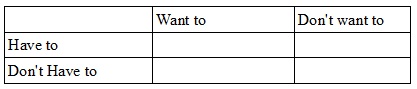
My riff on needs vs. wants, love vs. hate:

NeedWantLoveHateGrid
These will vary for each person, and may overlap a bit. But one thing you can count on: the things you really hate to do but which need to be done are going to require healthy doses of motivation, all the techniques to overcome procrastination, and hefty rewards to accomplish! They will drain your energy batteries. The ones you enjoy doing can be rewarding in themselves and will recharge your batteries. It may be a good idea to alternate between these two extremes.

Task selection factors

from the book “Manage Your Time, Your Work, Yourself” by Merrill E. and Donna N. Douglass:

· Demands of others
· Closeness of deadlines
· Amount of time available
· Degree of enjoyment
· Order of arrival
· Degree of familiarity

The authors say we tend to do first the smallest, easiest, most interesting tasks first, although they may not be the high priority tasks that contribute toward meeting goals.

Related:

Posted in productivity

Discoveries of the Day

Reading Orbit Now! Troy Worman’s Weblog (don’t wait for permission to succeed) led me to…

Genuine Curiousity -Always on the lookout for new things to learn. Has some great stuff on GTD. This led to…

ToDoOrElse -yup. more great stuff on GTD.

which led to…

Bobby Anderson’s post on GTD for Emotions. Totally cool idea.

Must stop…need sleep.

Posted in productivity

Dealing with Automated Telephone Hell

“Businesses choose effectiveness over efficiency to listen to customers.”

Wouldn’t you like to see that headline?

Do businesses really believe that automated telephone systems equals effective communication with customers? Hard to imagine. Who has not experienced the telephone hell of being runaround in endless circles, the clock ticking away while listening to unhelpful machine menus with the problem no closer to being solved? It’s frustrating in the extreme. If you are stuck in this situation, think of it as the perfect opportunity to practice persistence and patience. If that fails, check the gethuman 500 database to see if the company you are dealing with is listed.

Posted in Ideas That Work

Food is a Four Letter Word

Recipe for Menu Planning

No matter how busy you are, you’ve got to eat!

1. Organize Recipes. Favorite recipe websites are: AllRecipes.com and Taste of Home.

RecipeCards

Blank Recipe Card Template in Simply Dinner: the Game Plan

I use the resources in my eBook “Simply Dinner: the Game Plan” to organize my recipes and plan meals. Check out Simply Dinner: the Game Plan! It has a blank recipe card template with four 3×5 cards on one page. Not to mention enough recipes designed for a low-carbohydrate diet for a month of menus. No fancy ingredients here, and please note they are not vegetarian.

Before I created this, I used a Google Doc template to keep my recipes on my computer and smartphone. To find it, go to templates at Google Docs,  search “recipes” and choose the template by Mikelle Auman Williams. This template has tabs along the bottom for different categories of recipes. To print them two to a page I needed to insert a row at the bottom of each recipe.

2. Plan meals as part of your weekly planning. I like the Vertex42 Weekly Meal Planner. Consider sales and seasonal foods, nutrition, variety, visual appeal and textures. When there is little time for cooking, use crockpots, freezer meals, and make-ahead mixes. After planning, make a grocery list of items you need to buy. If you have a smart phone, consider apps: Fooducate

Plan A: Download a blank monthly calendar from Vertex42.com and fill in a month of menus. Here is mine (pdf) And my now low-carb version (pdf)

Plan B: Use daily themes – see Eating For One

Plan C: List some of your favorite meal plans on cards. Include a main dish, side dishes, and dessert. Make about 10-15 cards, on the other side list ingredients needed for a shopping list.
Example:

  • Pork Chops
  • Sour cream scalloped potatoes
  • Green Beans
  • Rolls
  • Apple Crisp

Plan D: Make separate lists of main dishes, side dishes, and desserts, then randomly select an item from each. You could even use a dart-board for this! Eatingwell.com provides healthier alternatives too.

menu

Plan E: Eat out! Keep a list of favorite restaurants.

UPDATE: For a fun & simple system for meal planning, check out my eBook with recipes designed for a low-carb diet, Simply Dinner: the Game Plan!

See also: Refrigerator Magnets from The Red Chair Blog. and more ideas here. The Menu Planning post at Titus2Homemaker is very helpful too.

FORMS: planners from Vertex42.com.

Cookbooks: Taste of Home Most Requested Recipes, 400 Calorie Fix

Food Diaries: printable food diaries at Make Healthy Food Choices and Track Diet.

See also: Learning About a Low Carb Diet, Daily Themes, and Eating For One.

AWESOME: A Month of Menus is a 72 page printable pdf from Kansas State University complete with recipes, shopping lists, measures and substitutions! Everything you need is right there. Still more recipes are at Free Healthy Recipes from the National Heart, Lung & Blood Institute.

George Foreman Grill Recipes, and a 120 page ebook.

This is one of the weekly activities for a Year of Personal Development.

Posted in productivity

Unforgettable Customer Service

When our three-hole punch at work stopped punching effectively (meaning it took super-human strength applied to a single sheet of paper for it to make a few holes) I took it for a trip to our local office supply store. I enquired whether it would be cost-effective to replace the three cutter pieces, or if it would be better to simply buy a new three-hole punch. Jerry gave me the answer. However, he also did something else. He took it to the back and applied WD-40, and made that three-hole punch good as new. Total sale=zero, customer satisfaction=priceless. That’s not the kind of customer service you forget. And when we needed a new stapler, I went back and got not just your standard stapler, but a new kind that cost a few bucks more. Okay, admittedly I’m a sucker for a new gadget, but I still think service like that ultimately leads to more sales. For those who want to know the answer: it costs less to replace the whole hole punch than to replace three cutters.

Posted in work skills

Tag, You’re It

Are you your tags?

Phil at Make It Great! mentioned this interesting nametag in his post about barcamp:

nametag

HELLO, My Name is Scott, (who makes a living with his nametag!) talks about how we often aren’t given options that really fit who we are and what we do as people try to fit us into boxes.

planit plans productivity project

Word or tag clouds with frequently used words in larger fonts are pretty cool. It gives a visual image of what you talk about the most. They are a unique way to reveal your unique interests. You can even get tshirts, mugs or mousepads printed with your word cloud. Does this communicate to the world who you are? While it’s helpful to know your interests, you are more than your labels.

It would be neat to add my tag cloud to this blog. But I can’t figure out how to do it. Here is a somewhat unclear image of what it looks like right now:

tag cloud

I guess that goes to show we need to be clear about our image!

Posted in personal development
eBooks

Enter your email address to follow this blog and receive notifications of new posts by email.

Archives
Blog Stats
  • 742,929 hits