
Emotional – Activity: Identify Emotions
Feelings come in a wide variety of types and intensity. Emotions may be painful when our needs are not met, or pleasurable when needs are met. Learning to increase awareness to recognize the emotions we are feeling is an important skill to develop our emotional intelligence. [Learn more about emotional intelligence]
Emotions in the Body
Physical sensations can provide clues to what we are feeling emotionally. It can be easier to get irritated when hot, or to be distracted when cold. Temperature is one of the physical indicators of emotions. So are breath and heart rates, which can increase with painful emotions of fear or anger, and sometimes when we feel brave or in love. Paying attention to tension and posture is also important to identify feelings. We tend to clench muscles when emotions are painful, and to stand upright with head up and shoulders back when emotions are pleasurable. When our needs are not satisfied, we may feel drained of energy, and when they are satisfied we often feel full of energy. These are not the only ways that emotions manifest in the body, but awareness of these is a good place to start. Learn more at the Wheel of Awareness.
RATE these key physical indicators to identify your feelings:
- Rates: breath & heart
- Assess posture
- Temperature & tension
- Energy levels
Scan the body, starting at the top and moving downward to check head, chest, shoulders, and the rest of the body. Pay attention to aches and pains. Head: do you feel tight and tense, or relaxed? Neck and shoulders: are you slumped or upright? Chest: is your breath and heart rate fast, or slow? Body: do you feel hot or cold? tired and drained, or energized?
To manage emotions, it can help to gain control of rates with biofeedback, deep breathing, and meditation. For better posture, stretch and strengthen muscles and practice power poses (see Amy Cuddy’s TED Talk). Practice self care and other coping skills to manage stress and increase energy. Strong self-esteem makes managing emotions easier.
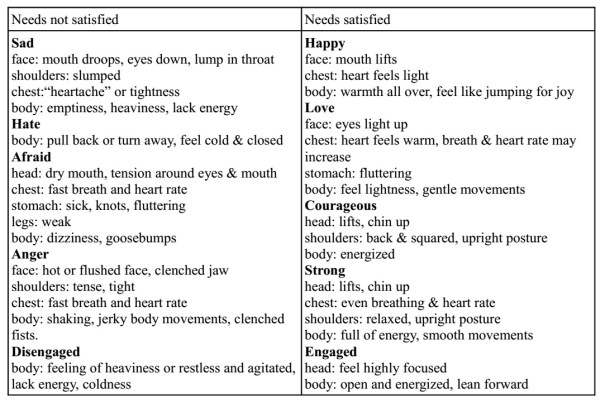 Recognize the emotions that these physical signs may be indicating. Signs of anger can include…hot or flushed face, clenched jaw, tense and tight shoulders, fast breath and heart rate, shaking or jerky body movements, clenched fists. Some of these may also indicate anxiety, stress, or fear. Recent research has created body maps showing where and how emotions are felt. See what they have discovered at this NPR article and at greatist.com. The Emotions Sensations Wheel at lindsaybraman.com is also helpful for this.
Naming Emotions
When needs are satisfied, we feel: happy, love, courageous, strong, and engaged. When needs are not satisfied, we feel: sad, hate, feear, anger, and disengaged. Many words are used to describe feelings, which can vary in intensity. The following tools can help to clarify emotions.
Tools to Identify Emotions
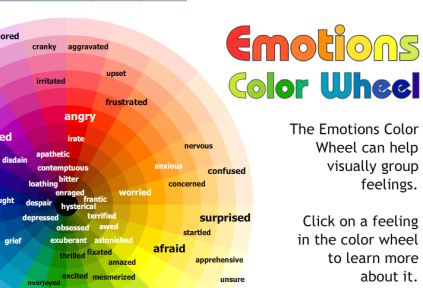
- Emotions Color Wheel
- Feelings Wheel printable pdf from the Gottman Institute
- Printable Mood Diary pdf from http://www.getselfhelp.co.uk/
- Printable Feelings Chart at the Daily PlanIt Shop
SMART goal:
This week, I will print a feelings chart and mood diary, and each evening note what I’ve been feeling during the day.
Resources for identifying emotions
- More tools are at the Emotional Intelligence Pinterest board
- How to recognize emotions from oohc toolbox
- Emotions are physical at psychcentral
- The Importance of Checking In with your Body at thethrivecenter.org
- The 5 Rs of Resilience at thethrivecenter.org
- Guide to the Best Habit and Mood Tracking Apps at tech.co
- Emotional Intelligence, Anger Management, and Quick Stress Relief at Helpguide
- Recognizing Emotions at www.emotionalcompentency.com
- Emotional Style Quiz at University of Wisconsin-Madison
- Noticing emotions meditation http://www.self-compassion.org/noting.practice.MP3
- The book The Heart of the Soul: Emotional Awareness” by Gary Zukav
More on Emotional Intelligence, Resilience, and the Coping Skills Toolkit
More activities for a Year of Personal Development

I seek to create order from the chaos of complex information. Join me at the Daily PlanIt to gain insights, inspiration, and information to increase skills for a better life. I unlock the power of teaching reading with phonics in the pursuit of literacy at www.phonicspow.com. In my spare time I explore books and movies, often choosing titles available on both screen and page.


 Daily PlanIt
[…] Daily PlanIt Manage AngerExpress Emotions with I StatementsUnderstand EmotionsThis Emotional LifeIdentify Emotions […]
[…] Be aware of feelings and express them responsibly […]
[…] of the most popular posts here is about Identifying Emotions. It can sometimes be difficult to know what we are feeling, if we can access our feelings at all. […]
[…] Identify Emotions […]
[…] Identify Emotions […]
[…] Download Image More @ dailyplanit.com […]
[…] of ↳ internal sensations in body ↳ emotions ↳ thoughts ↳ focus ↳ […]
[…] awareness involves knowing how to identify your own feelings and recognize the emotions of others. Emotional intelligence increases when we the skills to manage […]
[…] as we have choices about how to interpret an event, and how to label emotions, we also have options about how to express feelings. Take EXTRA TIME to express emotions […]
[…] Use the SOS technique to insert a mental pause to identify emotions and ask […]