
Purpose – Activity: Map Your Values
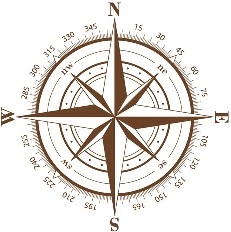
Knowing what your values are is crucial for discovering purpose and creating a personal mission statement of what you do and why. Knowing your values creates clarity and focus, and helps you to always be communicating the value that you add. Values also help you develop character, choose meaningful goals, be mindful about your choices, focus your soul attention, and empower you to live authentically and with integrity. If you are ever uncertain about what to do, your values will guide you like a compass to point you in the right direction.
GAIN direction with values
- Guide choices
- Aid focus
- Increase confidence
- Never fail to point the way
Let’s look at different meanings of the word “value” and some ways to discover them.
“Value is a word that carries multiple levels of meaning. The ultimate measure of our effectiveness is the value we create. The ultimate measure of our satisfaction is the value we feel. The ultimate measure of our character is the values we embody.” -Tony Schwartz in “The Way We’re Working Isn’t Working.”
Value Definitions:
- the regard that something is held to deserve; the importance, worth, or usefulness of something.
- a person’s principles or standards of behavior; one’s judgment of what is important in life.

Map Your Values is part five of the Discover U series, one of the weekly activities for a Year of Personal Development, and part of a self-assessment to uncover hidden talents.
How to clarify values – look for CLUES
- Card sort – rank value words in order from least to most important to you. Sort value words with this Flippity, or use an online value card sort from thegoodproject.org. A printable and pdf version can be found there too. More card sorts at meetingpointcounseling.com are the ACT Values Card Sort and a Personal Values Card Sort, developed by W.R. Miller, J. C’de Baca, D.B. Matthews, and P.L. Wilbourne, of the University of New Mexico. See it also here and online.
- List – You can simply choose words that resonate with you from lists of values. Download the printable pdf Map Your Values for lists of value words. More lists of value words can be found at the Character and Values Pinterest board.
- Understand your why (purpose) – Plan purpose and explore more at the Brand and Purpose Toolkit.
- Explore a quiz – try the Intrinsic Values Test from clearerthinking or one from a list at developgoodhabits.com.
- Set goals – when you think about what you want to create in life, you gain insight into what you value. You can try tools like a vision board, a wheel of life, or the life energy gauge.
Core values are the values that are of highest importance to you. They are often constant, and your guiding principles. Some values have intrinsic worth and are fairly universal among cultures and religion. The Six Pillars of Character from Character Counts: Trustworthiness, Respect, Responsibility, Fairness, Caring, & Citizenship, are examples of core values. See Develop Character and passiton.com for more core values as well as some personal values.

Personal Qualities are positive character traits, sometimes called character strengths or virtues. There are resources to identify personal qualities you possess at viacharacter.org and letitripple.org. Explore links at the Discover U Toolkit at Wakelet: try a traits quiz to identify your personal qualities or use a Johari Window to ask others. The personal qualities below are part of the skills identified as necessary for succeeding in work by the Secretaries Commission on Achieving Necessary Skills (SCANS). Self-management skills are personal qualities often sought after by employers. Learn more at Develop Work Skills.
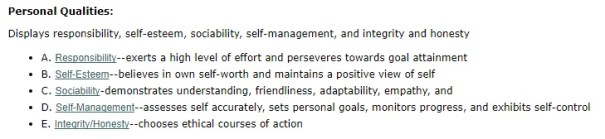
Personal values are subjective and can vary. You might place a high value on art or humor, while others may value something else. They may be related to skills, talents, work values or strengths. Different personality types may tend to have different values.

Work values are the things you value in a work environment. Identify your work values at careeronestop.org or onetonline. There is an online card sort for work values at Capella University. See a list of work values at What’s the Motivation? and match careers to work values at onetonline.org.
A value statement is a mission statement or a Unique Selling Proposition that pinpoints what you do and why. It is a concise, clear statement of the special benefit that you provide. It is the power tool for Purpose, one of the Four Ps of Positive Shift that organize the 12 practices that have been shown by positive psychology to increase happiness.
Goal values are words that describe the answer to the question “In this life area, what would make my life awesome?” More detail about choosing goal value words follows.
More Resources at the Character and Values Pinterest board. See also Look at Your Values, Part Five of Discover U in Ten Steps.
TED Talks: Core Values, Your Inner Compass | Why values matter | Aligning Values | Yes, even when nobody is watching |
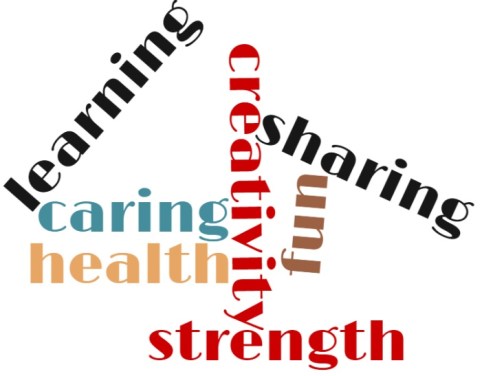
Goal Value Words made at wordclouds.com
Goal values – add value to your life with your goals.
When choosing goals, it can be helpful to think about what would add value to your life in different life areas. Another way to put this is: “What would make your life awesome?” The words that come to mind when you ask yourself “what would make my life awesome” and “what do I want to create? are the qualities that will most improve your life if they are increased – your goal values. A more in-depth look at how your energy levels are makes it easy to pinpoint which areas are priorities to focus on.
Learn more with a short video explaining the Map Your Values exercise from my eBook, “Get Goaling.” at Choosing Goals.
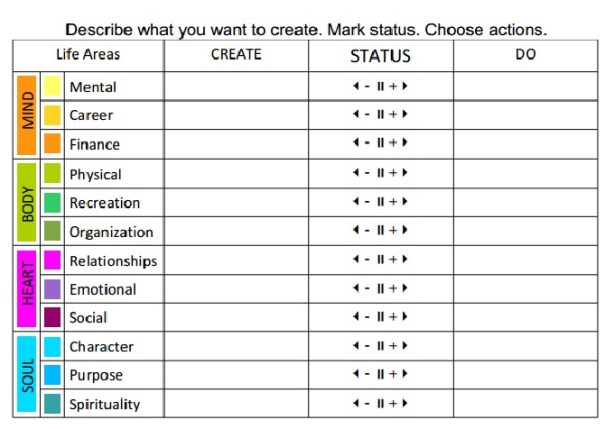
Choosing goals that are your top priority is one of the skills you need to learn to begin setting and achieving your goals.
This simple exercise from my eBook “Get Goaling,” makes it easy.
To get started, you need key values.
The value words I’m talking about are qualities that will most improve your life if increased.
For this exercise, print the Map Your Values pdf from the link above, and there’s also a link to a list of value words if you need ideas.
It’s pretty easy to pick a word to answer the question: “What will fill my life with value?” for each life area.
For example, in the physical area, the word “health” might come to mind.
If your health is good, you may think of words that add more value, like “strength” or “energy.”
Remember Maslow’s hierarchy of needs which shows that once basic needs are met, we move up to higher needs.
Look for a word that is realistic, and doesn’t limit you too much.
Once you have a word for each life area, mark the current level of each value, and you quickly see which areas to focus on.
The good news is many goals are already known to increase some values, so there’s no need to re-invent the wheel.
If you choose the word “health” for the physical area, clearly that value can be increased by following a healthy diet and increasing the amount of exercise you get. Make your goals SMART.
Find ideas for some commonly chosen goals, many with SMART plans, at dailyplanit.com under the Goal Plans tab.
Some goals may be uniquely your own and require more planning.
Learn how to do this and more with the Daily PlanIt eBook, “Get Goaling.”
A value statement is a mission statement or a Unique Selling Proposition that clearly pinpoints what you do and why. Like a compass, it always points in the right direction.
Looking at all these types of values is the first step on the path to a meaningful journey.
More ways to clarify values
- The Pave Your Life Roadmap at Idea Sandbox is a great tool for clear purpose.
- Core Values Assessment from “the Compound Effect” by Darren Hardy.
- Select a choice in a scenario about an ethical or moral dilemma.
- More resources at Clues to Purpose, Discover U Part Five, and Develop Character.

This is one of the weekly activities for a Year of Personal Development.
See more tools at the Brand and Purpose Toolkit

I seek to create order from the chaos of complex information. Join me at the Daily PlanIt to gain insights, inspiration, and information to increase skills for a better life. I unlock the power of teaching reading with phonics in the pursuit of literacy at www.phonicspow.com. In my spare time I explore books and movies, often choosing titles available on both screen and page.


 Daily PlanIt
[…] Daily PlanIt Create a Vision BoardYour Unique Selling PropositionHousehold Notebook ContentsLeaving a LegacyMap Your Values […]
[…] Map Your Values describes different meanings of the word value. […]
[…] Map Your Values describes different meanings of the word value. […]
[…] See also Choosing Goals | Clues To Purpose | Map Your Values […]
[…] want to put into it. Think about the personal qualities you want to reflect in your character, the values you want to express as part of your life, the goals and important work that you want to […]
[…] via The Daily PlanIt […]
[…] via The daily plan […]
[…] via The Daily PlanIt […]
[…] via The Daily PlanIt […]
[…] Inspiración de The Daily PlanIt […]
[…] via The Daily PlanIt […]
[…] via The Daily PlanIt […]
[…] via The Daily PlanIt […]
[…] via The Daily PlanIt […]
[…] via The Daily PlanIt […]
[…] by means of The Day by day PlanIt […]
[…] via The Daily PlanIt […]
[…] via The Daily PlanIt […]
[…] via The Daily PlanIt […]
[…] by way of The Day by day PlanIt […]
[…] through The Every day PlanIt […]
[…] via The Daily PlanIt […]
[…] Follow the VALUES that are your guiding principles [see map your values] • Variable personal values • Always point the way • Lead to what matters • Unchanging core […]
[…] VIP AIMS that are Important: VIP AIMS are vital to values, increase happiness, and pursue purpose – things like building relationships and taking steps […]
[…] – meaningful goals have built-in motivation, so follow your values. AIM for a vision that is Active, Inspiring, and […]
[…] the personal qualities that are your positive traits are called character […]
[…] yourself and follow your values. Practice self care. Meditate. […]
[…] principles you believe in, and they provide a solid foundation for all other elements. Learn how to Map Your Values to discover what your values […]
[…] your personal mission statement. Does it still reflect your values and pinpoint what you do and why (purpose), or does it need to be updated? If you update it, how […]
[…] management skills are personal qualities like being analytical or […]
[…] top priorities based on values, practices that contribute to happiness and […]
[…] Assess personal qualities and work values | learn more at Map Your Values […]
[…] are active, inspiring, meaningful, and significant is easier when you follow your values. Start by mapping your values to find your guiding principles. Then learn how to create a value statement of what you do and why, […]
[…] What else is IMPORTANT to do? IMPORTANT VIP AIMS are: Vital to values, Increase positive shift, Pursue purpose, Active, Inspiring, Meaningful, Solutions. You have no […]
[…] your positive character strengths or personal qualities at Map Your Values. Under BE by the compass rose, write three that you have, and one that you want to develop. Find a […]
[…] Pursue purpose • Look at values • Action steps • Note measures • Set […]
[…] values: what are my guiding […]
[…] and personal qualities. Learn more about different kinds of values and how to discover them at Map Your Values. Look over the qualities listed below and choose some that you would like to […]
[…] by way of The Every day PlanIt […]
[…] via The Daily PlanIt […]
[…] via The Daily PlanIt […]
[…] via The Daily PlanIt […]
[…] via The Daily PlanIt […]
[…] Focus your soul attention with a value statement that pinpoints what you do and why. It is sometimes called a personal mission statement or unique selling proposition. I like to call it a value statement, because it is about the value you add based on what you value. […]
[…] through The Each day PlanIt […]
[…] through The Every day PlanIt […]
[…] struck me: Flow often requires your sole attention; Focus requires your soul attention on what you value. This has been so for me in 2020 as I built the Phonics Pow website and populated it with fun tools […]
[…] press pause with SOS to be aware and live thoughtfully. Also be connecting your actions with your values. Follow through with a daily commitment, choosing to act on your top […]
[…] Focus your soul attention with a value statement that pinpoints what you do and why. It is sometimes called a personal mission statement or unique selling proposition. I like to call it a value statement, because it is about the value you add based on what you value. […]
[…] Either way, the key question is: What are your guiding principles? They are connected to the values that you hold to be […]
[…] Target why with key values […]
[…] your DISC type can help you identify strengths and values as you DISCOVER U. You can then plan purpose based on values to prioritize using your […]
[…] VIA character strengths reveal personal qualities. Learn more at Map Your Values. […]
[…] achieving these. For RELEVANCE – choose goals that contribute to mission, vision, and values. For RESULTS- see results with measures for goals, and performance […]
[…] and Rewarded. Relevant goals align with values and provide good return on investment. Set RPMS – Rewards Provide Motivation. Turn on inspiration […]
[…] • challenge assumptions • emulate heroes • choose grit [the wimpy person’s guide to grit] • follow values [map your values] […]
[…] In each life area, what will fill your life with value? […]
[…] It helps to gain a sense of meaning and purpose by taking actions that line up with your personal values. Whether you choose more realistic thoughts or a shift in attention to what really matters to you, […]