Leaving a Legacy

Most of us would rather avoid thinking about the possibility of health issues, accidents, other problems that might happen, or even death. So proactively preparing for these things is easy to postpone. However, a little bit of time spent planning can save you and/or your loved ones a lot of pain and suffering.

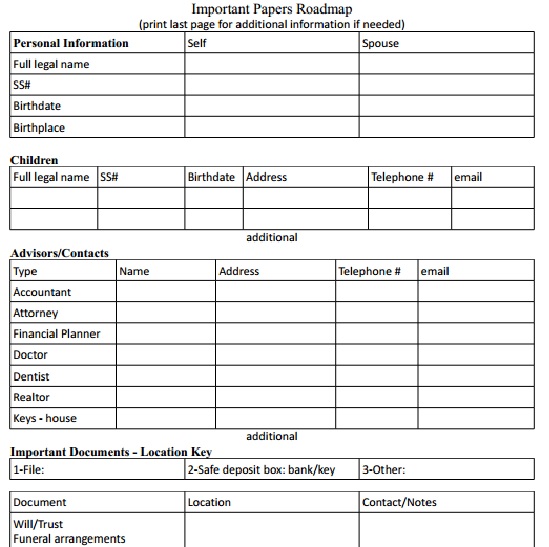
Having your files and household records organized is the first step. The next step is planning your estate, and organizing all the information so that everything is in order. No matter how simple a life you lead, it’s can be surprising how many details there can be. This is a financial goal that will provide peace of mind for you in knowing your wishes are carried out, and one that loved ones will much appreciate.

ImportantPapersRoadmap

  • Print out the Important Papers Roadmap pdf and fill out the information about locations of all important documents and necessary contacts. Keep this in a secure location, as it includes a lot of confidential information.
  • Gather together as many important documents as you can, and consider keeping them in a locked fireproof file box or safe deposit box.
  • Share the location of this document with those who will need it.
  • Also share the location of File Headings Index.

More resources:

Posted in goals

Map Your Values

Purpose – Activity: Map Your Values
CompassRose2

Knowing what your values are is crucial for discovering purpose and creating a personal mission statement of what you do and why. Knowing your values creates clarity and focus, and helps you to always be communicating the value that you add. Values also help you develop character, choose meaningful goals, be mindful about your choices, focus your soul attention, and empower you to live authentically and with integrity. If you are ever uncertain about what to do, your values will guide you like a compass to point you in the right direction.

GAIN direction with values

  • Guide choices
  • Aid focus
  • Increase confidence
  • Never fail to point the way

Let’s look at different meanings of the word “value” and some ways to discover them.

“Value is a word that carries multiple levels of meaning. The ultimate measure of our effectiveness is the value we create. The ultimate measure of our satisfaction is the value we feel. The ultimate measure of our character is the values we embody.”   -Tony Schwartz in “The Way We’re Working Isn’t Working.”

Value Definitions:

  1. the regard that something is held to deserve; the importance, worth, or usefulness of something.
  2. a person’s principles or standards of behavior; one’s judgment of what is important in life.

ValuesMap

Map Your Values is part five of the Discover U series, one of the weekly activities for a Year of Personal Development, and part of a self-assessment to uncover hidden talents.

How to clarify values – look for CLUES

Core values are the values that are of highest importance to you. They are often constant, and your guiding principles. Some values have intrinsic worth and are fairly universal among cultures and religion. The Six Pillars of Character from Character Counts: Trustworthiness, Respect, Responsibility, Fairness, Caring, & Citizenship, are examples of core values. See Develop Character and passiton.com for more core values as well as some personal values.

VIAcharacterstrengths

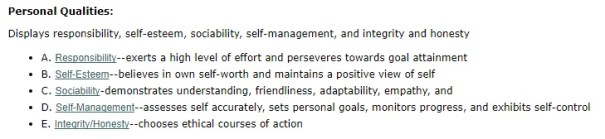
Personal Qualities are positive character traits, sometimes called character strengths or virtues. There are resources to identify personal qualities you possess at viacharacter.org and letitripple.org. Explore links at the Discover U Toolkit at Wakelet: try a traits quiz to identify your personal qualities or use a Johari Window to ask others. The personal qualities below are part of the skills identified as necessary for succeeding in work by the Secretaries Commission on Achieving Necessary Skills (SCANS). Self-management skills are personal qualities often sought after by employers. Learn more at Develop Work Skills.
Personal Qualities

Personal values are subjective and can vary. You might place a high value on art or humor, while others may value something else. They may be related to skills, talents, work values or strengths. Different personality types may tend to have different values.

PersonalWorkValues

Work values are the things you value in a work environment. Identify your work values at careeronestop.org or onetonline. There is an online card sort for work values at Capella University. See a list of work values at What’s the Motivation? and match careers to work values at onetonline.org.

value statement is a mission statement or a Unique Selling Proposition that pinpoints what you do and why. It is a concise, clear statement of the special benefit that you provide. It is the power tool for Purpose, one of the Four Ps of Positive Shift that organize the 12 practices that have been shown by positive psychology to increase happiness.

Goal values are words that describe the answer to the question “In this life area, what would make my life awesome?” More detail about choosing goal value words follows.

More Resources at the Character and Values Pinterest board. See also Look at Your Values, Part Five of Discover U in Ten Steps.

TED Talks: Core Values, Your Inner Compass | Why values matter | Aligning Values | Yes, even when nobody is watching |
GoalWordCloud

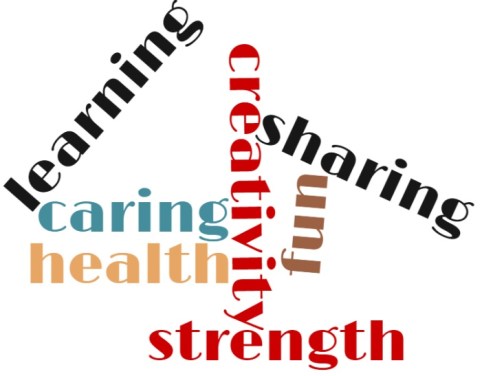
Goal Value Words made at wordclouds.com

Goal values – add value to your life with your goals.

When choosing goals, it can be helpful to think about what would add value to your life in different life areas. Another way to put this is: “What would make your life awesome?” The words that come to mind when you ask yourself “what would make my life awesome” and “what do I want to create? are the qualities that will most improve your life if they are increased – your goal values. A more in-depth look at how your energy levels are makes it easy to pinpoint which areas are priorities to focus on.

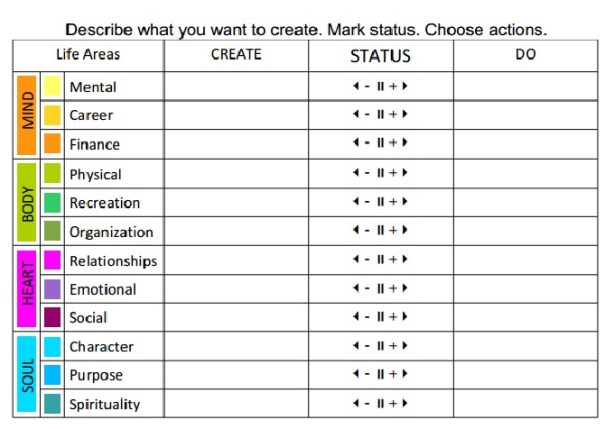
Learn more with a short video explaining the Map Your Values exercise from my eBook, “Get Goaling.” at Choosing Goals.
GoalShiftChart

Choosing goals that are your top priority is one of the skills you need to learn to begin setting and achieving your goals.

This simple exercise from my eBook “Get Goaling,” makes it easy.

To get started, you need key values.

The value words I’m talking about are qualities that will most improve your life if increased.

For this exercise, print the Map Your Values pdf from the link above, and there’s also a link to a list of value words if you need ideas.

It’s pretty easy to pick a word to answer the question: “What will fill my life with value?” for each life area.

For example, in the physical area, the word “health” might come to mind.

If your health is good, you may think of words that add more value, like “strength” or “energy.”

Remember Maslow’s hierarchy of needs which shows that once basic needs are met, we move up to higher needs.

Look for a word that is realistic, and doesn’t limit you too much.

Once you have a word for each life area, mark the current level of each value, and you quickly see which areas to focus on.

The good news is many goals are already known to increase some values, so there’s no need to re-invent the wheel.

If you choose the word “health” for the physical area, clearly that value can be increased by following a healthy diet and increasing the amount of exercise you get. Make your goals SMART.

Find ideas for some commonly chosen goals, many with SMART plans, at dailyplanit.com under the Goal Plans tab.

Some goals may be uniquely your own and require more planning.

Learn how to do this and more with the Daily PlanIt eBook, “Get Goaling.”

A value statement is a mission statement or a Unique Selling Proposition that clearly pinpoints what you do and why. Like a compass, it always points in the right direction.

Looking at all these types of values is the first step on the path to a meaningful journey.

More ways to clarify values

This is one of the weekly activities for a Year of Personal Development.

See more tools at the Brand and Purpose Toolkit

Posted in Year of Personal Growth

Foldable Goal and Productivity Information

In the process of updating The portable GTD mini-system, I’ve added two new printables:

These will work best for portability if upper & lower parts are cut apart & printed front & back.

Posted in goals, productivity

Foldable Diet and Exercise Forms

Two new printable, portable forms to track diet & exercise:

Daily PlanIt Exercise Chart (side one)

Daily PlanIt Food Diary (side two)

(6 forms per page, close to 3 x5 size)

Posted in goals

Uncover Hidden Talents

Purpose – Activity: Uncover hidden talents.

Talents are natural abilities that come easily to you and allow you to use your strengths. Strengths are activites that require effort and give you strength when you engage in them. Your strengths may include talents, skills you’ve learned, and personal qualities or character strengths that are important to you.

Look for your GIFTS to uncover hidden talents:

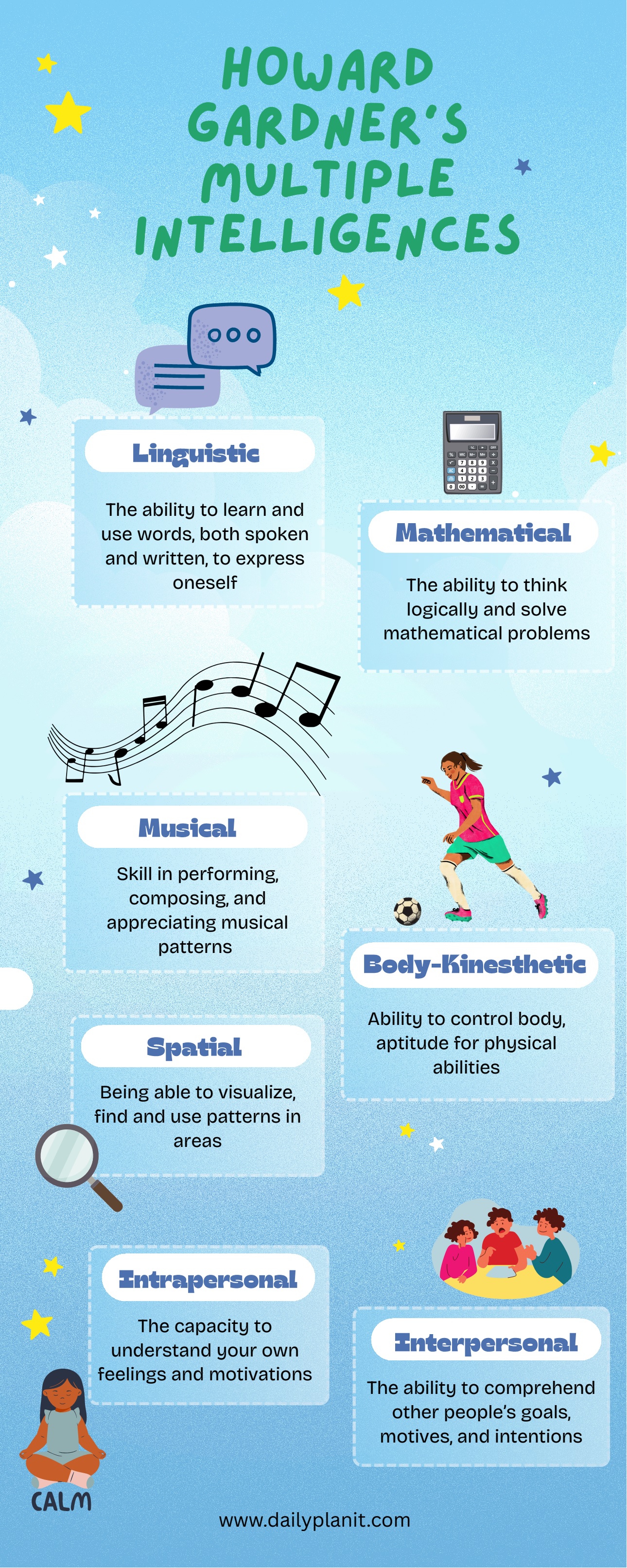
  • Gardner’s Multiple Intelligences
  • Ikigai
  • Flow
  • Take a look at a list
  • Seek to Discover U

Gardner’s Multiple Intelligences

Howard Gardner proposed different types of intelligences: linguistic, mathematical, musical, bodily-kinesthetic, spatial, interpersonal, and intrapersonal. Try the assessment at literacynet.org.


Ikigai

Ikigai is a Japanese word that roughly translates to “the reason you get up in the morning.” Look for the intersection between: what you’re best at, what you love to do the most, and what the world needs most.

Flow

One of the best indicators of talent is the state of flow. Especially notice activities that capture your attention so much that you lose track of time while you are focused on them.

Flow requires your sole attention. Focus requires your soul attention.

Take a look at a list

See the Google database based on a great list of talents from explorepsychology.com.

Seek to Discover U

At Discover U, explore your strengths, skills, and more with the top online assessment tools. Capture the results on a self-assessment form. (or the Talent Matrix Table is a more detailed version available at the Daily PlanIt Shop) Find more online resources at the Discover U Toolkit at Wakelet or via Google. Download a free ebook “How to Start a Fire.”

Words added on pinwords.com:

Brian Tracy on talents:

  • You love to do it.
  • You do it well.
  • It is responsible for most of your success and happiness.
  • It was easy to learn and easy to do.
  • It holds your attention.
  • You love to learn about it.
  • When you do it, time stands still.
  • You admire and respect other people who are good at it.

When you know and use your talents, you are living on purpose, and purpose is one of the Four Ps of Positive Shift that organize the 12 practices that have been shown by positive psychology to increase happiness.

Book and TED Talk

Howard Gardner, Frames of Mind, TED talk Beyond wit and grit

more resources


Tagged with:
Posted in Year of Personal Growth

Talents Slideshare

Posted in personal development

More ways to make goals visual

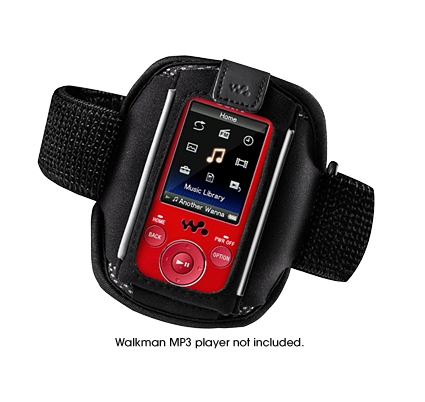
  • Print goal on a business size card and put in a wristband
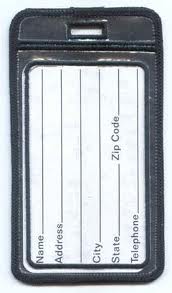
  • Put into a luggage tag attached to keys, purse or car dashboard
  • Stick into a magnetic photo frame on fridge or file cabinet
  • Design your own travel mug

see also Keep Goals Visual and Visible

Posted in goals

Shine

Lyrics from Katy Perry’s song “Firework”: 

Baby, you’re a firework
Come on, let your colors burst
Make ’em go “Oh, oh, oh”
You’re gonna leave ’em all in awe, awe, awe

You just gotta ignite, the light, and let it shine
Just own the night like the 4th of July

Boom, boom, boom
Even brighter than the moon, moon, moon
It’s always been inside of you, you, you
And now it’s time to let it through-ough-ough

‘Cause baby you’re a firework
Come on, show ’em what you’re worth
Make ’em go “Oh, Oh, Oh”
As you shoot across the sky-y-y

The best way to shine is to know how you want to add value.

When you see what will fill your life with value in each life area, it’s easy to choose a goal that will increase the area with the lowest level of value. And your life will glow brighter.

To really turn the wattage up, know how you will use your talents to add value to life. To uncover talents and clarify how you will use them, think about your Unique Selling Proposition, the special benefit only you can provide. Then you can focus your energy in a powerful light that shines to brighten the world.

Posted in goals, personal development

Why Goals? The Science of Goals

Is there evidence that proves that it is important to set goals? What are the benefits of setting goals, and what are the most effective methods? Here are answers to these questions based on research.

Edwin Locke’s Goal Setting Theory is summarized at Mind Tools. To motivate, goals must have:

  1. Clarity.
  2. Challenge.
  3. Commitment.
  4. Feedback.
  5. Task complexity.

Studies by Locke conclude that 90% of the time, specific and challenging goals led to higher performance than did easy or no goals.

These principles are often described as S.M.A.R.T. goal setting. There are some variations on what the initials refer to, but often they stand for:

  • Specific
  • Measurable
  • Achievable
  • Realistic
  • Time Bound

Is there evidence that proves written goals are most effective?

A Study Validating the Effectiveness of Written Goals

There are many references to a supposed study at Harvard/Yale that showed those who wrote down goals were 10% more successful, but it has been debunked. However an actual study has been done with results received from 149 participants at Dominican University. The results of the study show that the positive effect of written goals was supported: Those who wrote their goals accomplished significantly more than those who did not. The study provides empirical evidence for the effectiveness of three coaching tools: accountability, commitment, and writing down one’s goals. (Source: Summary of Recent Goals Research (PDF), by Gail Matthews, Ph.D., Dominican University, see also here)

In fact, Michael Hyatt says in The Science of Goal Setting that just by writing down your goals you are 42 percent more likely to achieve them.

In the book 18 Minutes, Peter Bregman describes studies from the book “The Power of Full Engagement” by Jim Loehr and Tony Schwartz which reveal that deciding when and where we will do something makes it 80-100% more likely to be done.

Is there evidence that proves that goals that are measured are more likely to be achieved?

Measures matter. What we measure improves (Pearson’s Law)- “That which is measured improves. That which is measured and reported improves exponentially.”

ScienceofGoals
Science of Goals infographic at Slideshare created with easel.ly

The Science of Goals
  1. Clarity
  2. Challenge
  3. Commitment
  4. Feedback
  5. Task Complexity
Goal Theory: principles to improve chances of success in achieving goals from studies by Locke & Latham.-Mind Tools, and WikiSpaces

Track data on progress for feedback-Keeping a food diary doubles weight loss.-Science Daily

(For feedback on establishing habits: Jerry Seinfeld’s Don’t Break the Chain Strategy.)

S.M.A.R.T. Specific, Measurable, Achievable, Realistic, Time Bound
Written
Habits
  • Goals have an end point. Studies have shown it takes an average of 66 days to form a habit.-Brain Pickings

More about establishing habits:

Use Incentives: Positive (reward) and Negative (punishment) from Behavioral Economics-pbs.org

  • Financial pressure-We are loss-averse and likely to follow through if we lose money when we fail.
  • Social pressure- Knowing we will report to an accountability partner can help.-Quirkology
 See also

The Science of Productivity

 Download the Science of Goals at Slideshare

Goals provide a clear direction and keep us focused on the results we want. Learn more with the free short course How to Set Goals, and my eBook, “Get Goaling” is a clear step-by-step guide to setting & achieving goals.

Watch the video The Science of Goals from The Science of People.

Read More ….about the benefits of setting goals: The Beginner’s Guide to Setting Goals from Productive Magazine. The Science of Goals infographic from Happify. Article on Time Perspective from the National Library of Medicine. The science of positive psychology meets the science of goal accomplishment in the book Creating Your Best Life: the Ultimate Life List Guide by Caroline Miller and Dr. Michael B Frisch. This research-based book shows how goals contribute to a meaningful life.

See also Game On! The Rules of Setting Goals, Make Good Habits Easy, and Bad Habits Hard from the Daily PlanIt.

Posted in goals

Get Buttoned Up

I was looking for a printable Goal Master List and discovered this great site: Getbuttonedup.com. It has not only the Goal Master List and an Individual Goal List but lots of other neat free printable tools as well.

Posted in goals
eBooks

Enter your email address to follow this blog and receive notifications of new posts by email.

Archives
Blog Stats
  • 742,849 hits