Productivity adds up

justice scales and gavel on wooden surface

Photo by Sora Shimazaki on Pexels.com

In Can Life Really Be Balanced? at Your Life. Organized., Monica Ricci does some math:

Total hours in a week: 168

Subtract hours for the following:
Sleep: (7 hours average per night) 49
Work: 40
Commuting: 10
Meals: 10
Home & life maintenance: 40 (this encompasses everything from laundry to getting dressed to running errands, to washing the car, to grocery shopping, and more)

That adds up to 149 hours of your week. That leaves 19 hours for everything else.

Laura Stack, the Productivity Pro summarizes some of the results of the American Time Use Survey.

Your Goals as Waveforms is an article with an interesting metaphor by Graham English.

Timeanddate.com provides a variety of interesting date calculators. You can use the Duration Calculator to enter your birthday as the start date and today’s date as the end date to determine how many days you’ve lived. Subtract that number from the approximate 30,000 days mentioned above for an estimate of days remaining. Using them well is what it’s all about.

Posted in productivity

Booknotes

“What Got You Here Won’t Get You There” by Marshall Goldsmith and Mark Reiter.

Create a “To Stop” List from a list of 20 habits that hold you back. Most of these come from inappropriately sharing or withholding information or emotion. Ask “Is this appropriate? and how much should I convey?”

Obtain feedback from others on how you’re doing. The wisdom of the Johari Window: what is unknown to us may be well-known to others. Our perceptions may well be inaccurate.

Feedforward

  • Choose one behavior you’d like to change
  • Ask a person for two suggestions that might help
  • Listen
  • Say “Thank You”

A Simple process for change (not easy, but simple!)

  • apologize-recognizing mistakes have been made
  • advertise-announcing your intention to change
  • listen-with attention
  • thank-gratitude is good
  • follow-up-act and check back regularly

Follow-up is vital

  • Follow-up is an ongoing process
  • It’s how we measure progress
  • It reminds others of our efforts

Communication

  • Send message
  • Ask if it was received
  • Ask if it was understood
  • Ask if it was acted on

Just because we understand, doesn’t mean we will actually do.

We may learn information about the importance of changing something and yet fail to do so. Without follow-up, nothing happens.

Project Phases (can’t skip from 3 to 7):

  1. assess the situation
  2. isolate the problem
  3. formulate solutions
  4. woo up-upper management approve
  5. woo laterally-peers agree
  6. woo down-direct reports accept
  7. imlementation

See Marshall Goldsmith’s Blog and Library with lots of free information.

Posted in Books, personal development

Discoveries of the day

WOWNDADI (Work Out What Needs Doing and Do It! Living a Productive Life) has written another excellent article about Frogs, Gnats, Butterflies and Gems, and how they masterfully disguise themselves so we won’t recognize their true identity.

That article mentioned a blog I don’t know how I’ve missed until now: Simple Productivity has a wonderful series about simplifying inboxes. It’s amazing how many there can be!

Posted in productivity

Top 100 Web Applications

From Webware.

Posted in information management

Discovery of the day

Great articles at Morris Institute for Human Values including Avoiding the Wrong Goals and The Definition of Insanity via Exceptional Dental Practice Mangagement.

Posted in personal development

Information and Findability

Like talents that are never found or expressed, like ideas that languish and are lost, “Information that’s hard to find is information you can’t use.” -Peter Morville, author of “Ambient Findability.

This is something that fascinates me about productivity and information. Productivity methods enable us to save information so that we can find it again when needed. Blogging is a very effective way of doing this. And information can be valuable indeed.

It also fascinates me the way we sometimes find the most interesting information in a very serendipitous way. I read the above quote from a blog in my feedreader and it aroused my curiousity to Google the name, which led me to Findability.org. There I found a post that mentioned an article “Being Shallow” by Grant Campbell at boxesandarrows. It deals with the difficulty of “doing it all” and the advantages of focusing. One of the most commented posts there is “Comics: Not Just for Laughs” by Rebekah Sedaca, which talks about comics as an effective way to communicate.

Back to findability

See the honeycomb diagram in the article User Experience Design at Semantic Studios.

Is this site?

  • useful-providing innovative solutions?
  • desirable-visually attractive and a clear brand?
  • accessible-designed for access for all?
  • credible-providing regular, dependable information?
  • findable-
  • can users find the site?
  • can users find their way around the website?
  • can users find info on the site despite the website?
  • usable-user friendly?
  • valuable-advancing the mission through the user experience?

“Findability precedes usability. In the alphabet and on the Web. You can’t use what you can’t find.” – Peter Morville

Posted in information management

The portable gtd mini system

OLYMPUS DIGITAL CAMERA

A system to manage tasks can be electronic, paper, or a combination or hybrid sytem. Over time I have come to lean more upon the electronic option, and Keep It Super Simple, relying mainly on various Google apps like Docs for lists and Keep for notes, projects and reminders.

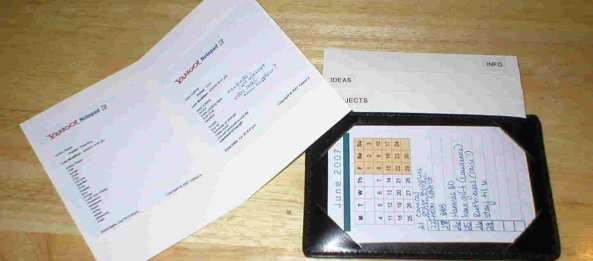
In the past, I relied more on paper, and devised this GTD mini system that tucks into a leather index card holder, using mini-folders made from notecards. I printed monthly calendars from Calendarsquick.com that could go in the top slot of the index card holder, inside a cut down project folder for portection. These minimal elements were easy to carry around. Getting Things Done (or GTD for short) is a book by David Allen and a popular time management system, although I prefer different terminology.

The 4 mini-folders:

  1. Next steps/incoming (next actions)
  2. Projects
  3. Ideas (someday/maybe)
  4. Information

Inside these are lists printed out from my Google docs. (any list application would work for this) This is a great capture/collection tool, as well as providing the information I need for planning on the fly. It works well in tandem with the desk paper planner for the weekly review and lists on the computer.

For awhile, I used a Mead Pocket Planner, with folded free printable set of a weekly planning form plus five daily planning forms (pdf) tucked inside the front of the plastic cover, and folded goal info tucked inside the back of the plastic cover. Nine productivity information cards in one pdf file can be found here.

Please explore more Free Tools!

  • The leather index card holder is still handy, with blank index cards in the pocket, and my to-do list on the other side, inside a plastic project file.
Posted in productivity, videos

Hop to it!

Hop To It…That’s Brian Tracy’s advice in the book “Eat That Frog!”

EatThatFrog!

Tasks that have a positive impact are often those that align with your values, purpose, and vision. They may be the result of Purpose Planning. These tasks might come in two varieties: some are things you are eager to do (the gems), while others are so difficult that you dread doing them (the frogs). Gems may be tasks that you understand and that you have the skills for, and therefore are easier to do. While both types may be important, the “frogs” are much harder to force yourself to do. Tracy was inspired by the Mark Twain quote: “Eat a live frog first thing in the morning and nothing worse will happen to you the rest of the day.”

FROGS

Frogs may be so big that you don’t know where to begin. (hint: learn how to break large projects into smaller action steps.) They may be things you’ve never done before and don’t really know how. Some frogs may have less impact but still be urgently necessary to accomplish. You will need to employ strategies to combat procrastination and overcome resistance. Resolve to develop grit and adopt a growth mindset. Like real frogs that have PLUNKED into your pond, you may wish to avoid them, but they will keep hanging around until you do something about them. Frogs may be:

  • Painful
  • Large
  • Unknown and uncomfortable
  • Need skills you lack
  • Confusing
  • Keep hanging around
  • Extremely annoying
  • Difficult and desire to avoid

GEMS

Gems are a real PLEASURE. They may be tasks that you enjoy, understand, and that you have the skills for, and therefore are easier to do. It will take less energy and willpower to accomplish these.

  • Pleasurable
  • Like doing
  • Enjoyable
  • Actually understand
  • Satisfying
  • Use skills you possess
  • Relevance is obvious
  • Easier

Brian Tracy’s advice is to just jump in and start with those unpleasant frogs that must be done right off the bat and get it done. You will feel such a sense of relief once it is over with, and then you can use that mood boost to move on to more pleasant things. Remember: it only gets harder the longer you put it off. It is easiest to tackle the hardest things earlier in the day when we have the most energy and willpower to overcome the procrastination that becomes so attractive when we want to avoid doing something that we are anxious about tackling.

After the frogs have been eaten, you can proceed with the more pleasant gems…but don’t get distracted by the attractive butterflies that are enjoyable things that are not needed, (perhaps social media?) or annoying gnats that nobody likes or needs to do! (some meetings, emails, and phone calls.) This is sometimes also known as the worst first method.

While “Do the hardest task first” is often advocated as a good strategy for dealing with priorities, there are some drawbacks. Maybe just a few easy wins to get going would be okay? There is also the sandwich method: start with a high priority task you want to do, followed by one you don’t want to do. This has the advantage of making you look forward to beginning your day, rather than dreading it.

Here’s a short video to watch about it.

See also: Start Your Day at the Top and It’s All Downhill From There at timemanagementninja.com, Eat That Frog at Asian Efficiency, and Dreading Your Next To-Do? at success.com.

Check out the Overcome Procrastination and Get Motivated Board at Pinterest…but not until you’ve eaten that frog!

Posted in Books, productivity

Contexts

I want to highlight a comment by Andy of Naunce Labs that just might make me re-think my opinon of contexts. (darn it!) By the way, I’m very intrigued by what they are working on there and will be watching for what they come up with. Here’s what Andy had to say about contexts:

As a GTD freak maybe I can shine some extra light.

Contexts are important because they are an axis just like your time and your energy should be axes too. You may have access to a computer and a phone 24×7, but you’re not always talking, and you’re not always typing.

When you do want to make calls, it’s good to see what’s available within that specific context of telephony. You should also pay attention to how much time and energy it will require you to do an item while at that context.

If you have a lot of time but no energy that automatically scopes you into a certain flow. You’re not going to want to make two huge client calls, you’re going to want a series of low hanging fruit / easy wins.

It’s one of the more interesting things that isn’t written as much as David says at seminars but you need to be aware of the other things that make sorting, defining, and doing, those lists easier. That’s being more aware of your own state at the time of decision making.

A lot of applications/solutions forget this part and thus fall back into the ‘each list is either attracting or repelling you’, which most of us are probably being repelled by our solutions.

The idea of paying attention to amount of available energy as well as to the amount of available time is good to be reminded about. This was in the workflow chart I recently mentioned….sometimes I need to see/hear stuff several times before I get it!

See Also at Naunce Labs: The Basics of Getting Things Done

Additional Reading: Contexts at OrganizeIt

Posted in productivity

A paper planner tool for the weekly review

OLYMPUS DIGITAL CAMERA

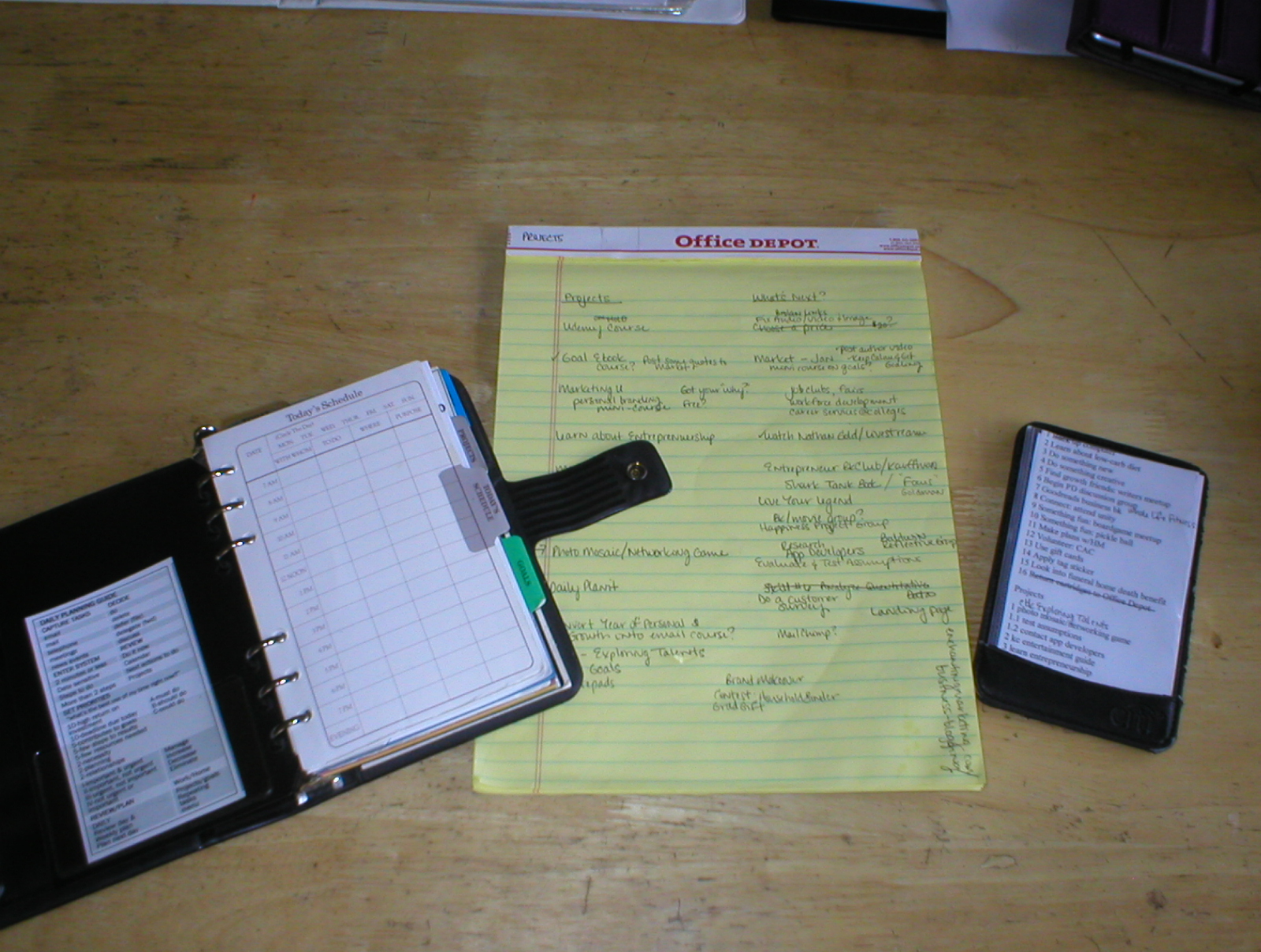
My paper planner began gathering dust as I switched to an Android smartphone and tablet. I transformed it into a tool to use at my desk for the weekly review. This clarified the process for me and makes it more visual. I spiffed it up with custom tabs and slash pockets from Day Runner. My tabs are: Today’s Schedule, Projects, Goals, Follow-up, Ideas, and Notes.

Set Up Part One

Permanent printable information to consult on each process:

Set Up Part Two

Personal lists that change frequently:

  • To Do List (next actions)
  • Repeating tasks
  • Projects
  • Goals
  • Follow up
  • Mission statement
  • Ideas

I now use Google Task Taskary is my go-to app for my to-do list. (see Android Apps for Productivity) The other lists I keep in Google Drive, but sometimes forget to look at them. I like to print the frequently changing lists during the weekly review, and put them in the slash pockets. This makes them more visually accessible than a computer list and more visually attractive than a hand-written, scribbled up paper version. There are also adhesive plastic pockets (the kind for business cards or floppy disks) applied to the index tab dividers to hold information. My to-do list I print out and keep in a leather holder with blank index cards for notes on the other side. I add tasks via Google Tasks when I’m at the computer, or via the apps on my smartphone or tablet. To print the to-do list, the Gtasks app works best for sending myself an email. I then copy the list from email, paste it into a word processor and delete the repeating tasks that I don’t need. I also print a monthly Google Calendar for my desk with events, regularly scheduled meetings, and birthdays. This seems to work best when printed from the Chrome browser.

Weekly Review

Weekly Review

Review of Projects list on a yellow legal pad and to-do list in leather index card holder

Update: Four free printable planner inserts, and four more.

Another option is a Mead Pocket Planner with nine information cards in one pdf file, free printable set of a weekly planning form plus five daily planning forms (pdf), and folded goal info.

See also: The portable gtd mini system, Planning is Thinking, and Weekly Review

Posted in productivity
eBooks

Enter your email address to follow this blog and receive notifications of new posts by email.

Archives
Blog Stats
  • 742,916 hits