
Motivation is important to accomplish goals, establish habits, combat procrastination, and get the Important Stuff Done. Motivation drives the desire to act or initiate change, and finding the motivation to take action can be challenging! Motivation is the result of movement, not the other way around. Read more about “The Motivation Myth” by Jeff Haden, Ted talk The most successful person in the world. (Amazon affiliate links to books provide a small commission to support the Daily PlanIt.)
Motivation can come from within (intrinsic) or from outside yourself (extrinsic). It can be intangible, like feedback, or tangible, like grades or money. It may be positive like praise, or negative like losing a privilege.
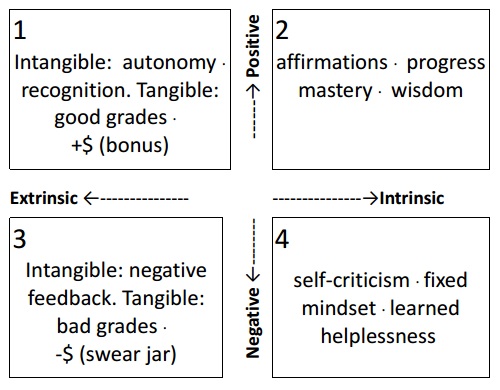
Some examples of extrinsic motivators that are positive are being paid a bonus for a good job (tangible), and receiving recognition, (intangible). Negative extrinsic consequences may be paying a penalty (tangible) or receiving negative feedback (intangible). Positive intrinsic motivation like affirmations can be powerful, but the opposite of this is negative thoughts like self-criticism, which are demotivating and limit progress.
What motivates each individual varies as we are different in our personalities and what we find rewarding. Explore ways to MOTIVATE!
- Match Personality
- Outcomes
- Timing
- Intrinsic or Extrinsic
- Values
- Add rewards and consequences
- Tangible or Intangible
- Energy
Match Personality
Myers-Briggs is a popular method for determining personality types with eight categories in four dichotomies that can combine in sixteen types. Extroverts who organize with order (Judging) are likely to be motivated by external factors such as power and prestige and tangible rewards like money and awards. Extroverts who organize with flexibility (Perceiving) are likely to seek public recognition, novelty, and chances to collaborate with others and express creativity. Introverts who organize with order (J) are likely to be motivated by internal factors and intangible rewards like opportunities to learn, use skills, and generate ideas. Introverts who organize with flexibility (P) are likely to seek creative exploration and want to improve the world and help people. Mastery likely appeals to all types with high Judging, and all types with high Perceiving may seek autonomy.
Outcomes – gain motivation by observing progress on measures.
Timing – consider how often and how soon rewards are received after behaviors. Self-motivation is easier during our peak time. The science shows that prime time for most of us is for two hours about an hour after waking.
Intrinsic or Extrinsic – Intrinsic (internal) motivators are often intangible. Positive intrinsic motivation is powerful, but can be affected by moods, so extrinsic (external) motivators that come from outside of ourselves can have a place. However, be aware that external incentives can decrease intrinsic motivation. Also beware of negative internal thoughts and beliefs that are demotivating and limit progress.
Dan Pink, author of “Drive: the surprising truth about what motivates us,” talks about Mastery, Autonomy, and Purpose. Mastery is the urge to get better at stuff, to learn and create. Autonomy is the desire to act with self-direction. Purpose is the desire to make an impact and add value to life with our strengths and talents. The desire to connect with others is also a powerful motivator. These all related to needs, and are all positive intrinsic motivators. A value statement that clarifies what we do and why is the power tool for purpose.

• Contribution (Purpose) – AIM for a vision that is active, inspiring, and meaningful
• Connection (People) – relate with others
• Competence (Mastery) – correct level of challenge to find flow
• Control (Autonomy) – take action with self directed choices
Values – meaningful goals have built-in motivation, so follow your values. AIM for a vision that is Active, Inspiring, and Meaningful.
Add rewards and consequences – a “carrot” is a reward for good behavior. Everyone has their own ideas about what they find most rewarding, so rate the importance level of various rewards for you. Some rewards are bigger than others, so choose a small reward as incentive to accomplishing small steps toward goals, and a larger one for completion. A “stick” is a negative consequence for poor behavior, and they can influence behavior too. For example, putting a dollar in a swear jar each time you slip up can be an effective way to break a bad habit.
Tangible or intangible – rewards can be tangible like grades or money, or intangible like recognition or positive feedback.
Energy – energy is a limited resource. Tasks and projects that require high motivation are best tackled when energy levels are high. Increase energy with self-care activities like getting enough exercise and rest, drinking lots of water, and eating healthy foods.
All of these factors are important for both self-motivation and at work. There are additional things to consider for work motivation.
Motivation at Work
Identifying your work values can help in finding a compatible career and clarifying motivation. Learn more about your work values at careeronestop.org.
Work Values
- power
- money
- prestige
- independence
- challenge
- mastery
- achievement
- recognition
- security
- self expression
- collaboration
- service to others
- relationships
- creativity
- variety
To STREAM motivation in the workplace:
- Set work goals that are relevant to the mission and goals of the organization. Optimal organizations are clear about them.
- Train with learning activities to develop skills. Optimal organizations provide opportunities for learning and encourage and support growth.
- Recognize and reward progress. Optimal organizations provide incentives that employees want. A word of praise for a job well done can go a long way.
- Expect the best. Optimal organizations communicate their expectations. Employees also have expectations of an employer.
- Always be aware of the value that your job provides. Optimal organizations provide feedback to employees.
- Measure outcomes and notice results. Optimal organizations provide information about progress. A simple scorecard makes outcomes like a game providing motivation to improve the score.
Self motivation is one of the skills of emotional intelligence. It can help to mind the GAPPS:
• Growth Mindset
• Add habits
• Plan goals
• Pursue purpose
• Set priorities
• Select strategies to overcome procrastination
Books and TED talks
- “The Motivation Myth” by Jeff Haden, Ted talk The most successful person in the world
- “Drive: the surprising truth about what motivates us” by Dan Pink, TED talk The puzzle of motivation
Additional Reading
- Here’s What Motivates each Myers-Briggs Personality Type at mbtionline.com
- Motivation according to Myers-Briggs Type at wellandgood
- Autonomy, Mastery, Purpose at Brainpickings.org
- Can betting against yourself online help you save money? from pbs.org
- New Years Resolutions Stick When Willpower is Reinforced from The New York Times
- How to Make Commitments You Will Actually Keep by Scott H Young
- How the Overjustification Effect Reduces Motivation from verywellmind.com
- Carrot and Stick Motivation at indeed.com
- Twentysomething: 7 ways to motivate your Millennial at Brazen Careerist
- Motivations and Rewards (pdf)
More on Motivation from the Daily PlanIt:
- Alex Vermeer on How to Get Motivated
- Tip the Scales To Master Motivation: Visual Strategies to Overcome Procrastination
- 25 Quotes and Affirmations to Finally Defeat Procrastination
- Rewards
- The Angst Guide to Motivation
- Overcome Procrastination and Get Motivated Pinterest Board

I seek to create order from the chaos of complex information. Join me at the Daily PlanIt to gain insights, inspiration, and information to increase skills for a better life. I unlock the power of teaching reading with phonics in the pursuit of literacy at www.phonicspow.com. In my spare time I explore books and movies, often choosing titles available on both screen and page.


 Daily PlanIt
Daily Report, Feb 6
Team Collaboration What’s the Desired Outcome? … That question is important even for team projects (duh!). “This is even more pronounced for collaborative projects. Educating and energizing audiences through collaborative projects is an emerging to…
Great points. I also have motivation software available online at http://www.motivator.ws/ — it’s no cost, so check it out if you’re interested!
Intrinsic and Extrinsic Motivation
It’s cold here. The wind sends chills right through my bones. Normally, I enjoy walking, I try to walk to places whenever I can, but on a day like this, I would not venture outside but for my two dogs
Fabulous points you make about how to motivate yourself and others. The eleven points are a valid guide for those of us wishing to make the changes. Identify where you nedd to change one at a time, prioritise and then take action.
Phoenix
http://www.easymotivationalstrategies.com
[…] I immediately thought of David Sheah’s Printable CEO Series and how this could fit in to motivate ourselves. (or […]
[…] you’re very clear about what it is that you really want to do, the next thing is to get yourself motivated to TAKE ACTION. Like this Nike advertisement says: “Yesterday you said tomorrow. Just do […]
[…] others with your vision. Motivate yourself and others. Think like an entrepreneur. Encourage engagement with playfulness and […]
[…] Purpose, Autonomy, and Mastery are key to motivation. […]
[…] What’s the Motivation? from the Daily PlanIt […]
[…] Feel the intrinsic rewards of the […]
[…] Creating an effective To Do list is a part of daily planning to help you combat procrastination and get motivated to get the important stuff […]
[…] Does this meet needs and motivate? see What’s the Motivation. […]
[…] right this minute, but do you know why you are avoiding it? The key to changing resistance into motivation may be contained within the answer to that question. We all have times when we just can’t […]
[…] is one of the factors that influences motivation. Choose to DIRECT your […]
[…] SELF MANAGEMENT SKILLS ↳ Focus ↳ Adopt a growth mindset ↳ Self-discipline ↳ Self-motivation […]
[…] for work values at Capella University, and more at the List.ly links. See a list of work values at What’s the Motivation? and match careers to work values at […]
[…] to my central AIM of freedom through education. Goals that align with values have intrinsic motivation built in. Learn more about choosing goals in different life areas. Goals for mission and vision may […]
[…] How can you manage your time to accomplish it?How can you overcome procrastination and get motivated? Do you have all the information you need? How much do you want to achieve it? Do you have the […]
[…] what will you change? how can you add motivation and increase focus and […]
[…] Activities in Quadrant 2 contribute High Impact but have Low Engagement. For this area, develop strengths, find ways to involve imagination, learn more, and hack rewards for motivation. […]
[…] motivation by knowing what is most important to you. Choosing VIP AIMS that are active, inspiring, meaningful, […]
[…] Self motivation – understand personality and motivation. […]
[…] Pink “Drive” + TED Talk “The Puzzle of […]
[…] Use a commitment contract: deposit money in an account that will be donated to a cause if you fail to follow through. (if it is a cause you don’t agree with there is even more motivation) […]
[…] Learn more about motivation at the Daily PlanIt post “What’s the Motivation?” […]
[…] are going. Images & words – include pictures that illustrate your goals and quotes that motivate you! Objectives & goals – describe the goals you choose in various life areas in a SMART […]
[…] Motion creates motivation […]
[…] MOTIVATION and meaning Contribution (Purpose) Connection (People) Competence (Mastery) Control (Autonomy) […]
[…] in scientific validation, MBTI may be helpful in choosing careers, communication, understanding motivation, and even finding a good match to volunteer oppotunities by Myers-Briggs Type. This post provides […]
[…] grit and the ability to delay gratification. The abilities to focus, use your strengths, and get motivated are […]
[…] takes courage to act with agency. Also related are being authentic, and the motivational factor of […]
[…] Motivation and focus• Master distractions• Observe outcomes• Values• Engage interest and energyTED […]
[…] personality models can be useful in designing a brand message and telling a story that appeals to motivational drivers for a target audience. Each of the archetypes have desires that they […]
[…] them • Inspire: with great communication, courage, compassion, an understanding of people, and motivation • Make important things happen: they know how to solve problems and deal with change and […]
[…] Get ideas at Get Creative, try creative arts, and learn more about overcoming procrastination and getting motivated. […]
[…] – make a choice and plan a path • Invest in independence • Resolve to persevere • Execute with agency • Confront fear with courage • Take […]
[…] Relevant and Rewarded. Relevant goals align with values and provide good return on investment. Set RPMS – Rewards Provide Motivation. Turn on inspiration and maintain motivation. […]
[…] the benefits of the results may not be enough to overcome inertia. Can you tip the scales? Motivation comes from action, not the other way […]
[…] more TED talks and books for learning about productivity and goal setting. See also posts about Motivation, the Career Search Process, the Work Skills List, Top Skills Employers Want, Learning Activities […]
[…] ambitions into smaller, actionable steps. Overcome procrastination and other obstacles. Maintain motivation and focus on what energizes you. Regularly review progress and re-align daily actions with your […]