
Time Frames and Target Dates

Long and short range goals
projectplan

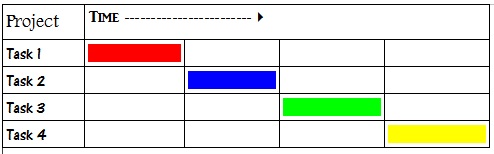
Some goals are big and ambitious and will take a long time to accomplish. One of the first steps in the process of setting a goal is to break it down into specific action steps. Projects are often a step between goals and daily activities: the intermediate, or middle range. Daily activities are the choices we make today that will contribute to our goals and projects. We derive our activities from the top down, and achieve our goals from the bottom up.

goals — projects — daily activities

long range — shorter range — within reach today

In the book “Getting Things Done,” David Allen goes further with a six-level model:

  • 50,000+ feet: Life (why do you/company exist?)
  • 40,000 feet: 3-5 year vision.
  • 30,000 feet: 1-2 year goals.
  • 20,000 feet: Areas of responsibility.
  • 10,000 feet: Current projects.
  • Runway: Current actions.

David Allen defines a project as anything you want to achieve that requires more than one step. He poses the following questions for these levels:

  • long term goals – “What projects will accomplish this?”
  • projects – “What actions will accomplish this?”
  • daily activities – “What actions are top priority?”

Setting a Target Date

To set a target date, consider the:

  • difficulty level
  • available resources
  • number of steps involved

Look for the sweet spot: a place of high value with low effort. However, some very worthwhile goals require more effort and more resources like time, energy and money. Consider what the results will be, how much impact it will have, and how big a contribution it will make. The Economy of Goals means that we are unlikely to pursue a goal when the costs exceed the benefits. End goals provide built-in motivation. Choose a realistic yet challenging date. Often a target date is simply an estimate, a self-imposed deadline to provide motivation to reach the goal. It may need to be reassessed and adjusted as part of the weekly review.

Setting time frames and target dates is part of planning SMART goals.

Learn more about How to Set Goals and find lots of free printables at the Goal Toolkit.

Posted in goals

Re-Write Right

I’ve been trying to get organized again. This time I’m trying improve the organization of this blog! The amount of entries has gotten to the point of being unwieldy. So I’ve set up a new Archives page with sort of a “Best Of” selection. In the process, I’ve learned a few things:

As I’ve gained clarity with my own goals, the increase in growth is immediately obvious in my posts. Writing on a regular basis is certainly a way to gain some clarity. Some posts are personal observations based on things that happen in my life-those I may add to “About Me.” I noticed that I like to write about books I’ve read and movies I’ve seen, and keep track of little snippets of useful information I run across. That’s just me, and some of that will undoubtedly continue.
I see several posts that I’d like to go back to and update, expand upon or just plain fix stuff. As I do this, my hope is that it’s not too annoying to people who are reading. Just like me, this site is a work in progress!

Since I was lifehacked, I’ve been in a constant state of discovering tons of awesome sites that are new to me. I’ve been madly posting bookmarks to del.icio.us as I attempt to keep them all straight. My head is awhirl with all this learning! I do not intend to duplicate information that is available elsewhere, and if ideas for unique content come to a screeching halt, so will I.

I’ve always thought that one of my talents is finding the best information and creatively organizing it so people can find it. But I’m beginning to see that the explosion of information on the Internet and the tools that are now available are likely rendering that obsolete. So it may be time to re-think a few things too! But that’s ok, the important thing is to right any wrongs as soon as we can. It’s not too late to change, it’s not too late to say what you wish you had said.

Posted in personal development

Rewards

Incentives

All these incentives can shape behavior: positive outcomes are desirable and attractive, while negative outcomes are undesirable and avoided.

Quadrant I Positive Intrinsic (internal) – affirmations, meaning, progress, competence, mastery, wisdom

Quadrant II Positive Extrinsic (external) – recognition, belonging, autonomy, good grades, monetary bonus

Quadrant III Negative Intrinsic (internal) – self-criticism, learned helplessness, fixed mindset

Quadrant IV Negative Extrinsic (external) – negative feedback, bad grades, putting money in a swear jar

Accomplishing a goal is rewarding in itself. Some rewards are intangible, such as growth, respect and mastery. Others, like fame and fortune, are more tangible! Consequences can be immediate or delayed. It may be more immediately rewarding to eat a doughnut, rather than exercise, so it becomes important to focus on the rewards of the long-term goal.

Everyone has their own ideas about what is most rewarding for them. Some might consider shopping punishment rather than reward! Also, some rewards are bigger than others. Select the item on the list that you consider the most rewarding and assign it 5 reward points. Select the least agreeable reward and assign it 1 reward point. Using this scale assign points to all rewards. When selecting rewards for accomplishing tasks or goals, the size of the reward should be comparable to the size of the task or goal. Provide mini-rewards for small steps forward, a big reward for accomplishment of a big goal.

Reward Ideas

  • Visiting a bookstore
  • Going to the park
  • Visiting an art gallery or museum
  • Going for a drive
  • Going to a concert
  • Going to see a movie
  • Renting a video
  • Purchasing a new book, tape or CD
  • A new gadget
  • Attending a class
  • A bouquet of flowers
  • A candy bar
  • Going out to eat fast food
  • Going out to eat at a fancy place
  • A hot bath or shower
  • Going shopping
  • Ice cream
  • A massage
  • A nap
  • Games
  • Sports activities
  • Outdoor activities
  • Crafts/hobbies
  • Visiting friends or relatives
  • Other

See also What’s the Motivation?

Posted in goals

Evaluate Goals

Once you’ve generated ideas for goals, take a closer look at the ideas to select the best ones. Dreams become goals and ideas become projects when you decide to take action on them. Go for the goals that are the most meaningful to you. Do a regular weekly review of your progress. Learn more about Evaluating Ideas and Projects.

Questions

Evaluate Goals and Ideas:

1. WHY do you want to acheive this goal? Does it fit your purpose and involve Active, Inspiring, Meaningful Solutions that aim for a vision?

2. WHICH will make best use of your strengths and talents? Which will provide the greatest value? Which give the most significant results? Which are the top priorities? Which fit your mission statement most closely?

3. WHAT is the goal or idea? What would the result look like? What are the chances of achieving it? What actions will need to be taken? Will it lead to learning, growth, and improvement? Will it contribute to long-range goals? What obstacles might be encountered, what solutions can you employ?

4. HOW could it be accomplished? What resources will be needed? Are they available? Are the benefits of achieving the goal worth the investment of resources? How can you manage your time to accomplish it? How can you increase focus? How can you overcome procrastination and get motivated? How will you measure results? Do you have all the information you need? How much do you want to achieve it? Do you have the Desire? Are you willing to make the commitment of resources required?

5. WHO is involved? What is the effect on others? Will it benefit everyone involved? Who will be responsible for implementation?

6. WHEN will it be accomplished? How long would it take? Is there a deadline involved?

7. WHERE will you go?

Posted in goals

A Gradual Awakening

I like gadgets, and especially clocks. I heard about an alarm clock that wakens you gently, first with a light that comes on and then with nature sounds that gradually get louder, until finally the actual alarm goes off. It even has a place to put scented beads (coffee smell, or whatever else) that are activated by the light. I had to have it. I made a special trip to find one, and spent some of my Christmas money, but it was worth it. It worked great for awhile. Then something happened. First it became erratic, functioning fine at times and not at others. Now the light still works, but the alarm is a pathetic weak sound that has virtually no chance of waking me up. I still use it in conjunction with another, more conventional alarm clock (although it does update with a radio signal which is pretty cool) However, it’s no longer the smooth, gentle process that it was for awhile.

I’m not a person that wakes up easily. It’s something of a struggle for me. Oh, I wish waking up were easier.

Posted in personal development

Design Your Ideal Workspace

When it is time to generate ideas, focus, be productive, and get creative, you need a workspace that will help.

computer-Pixabay

Image by Rudy and Peter Skitterians from Pixabay

A great workspace inspires you and is designed for the way that you learn, think, and work. Design a comfortable, well-lighted and well-supplied area for thinking without distractions. Organize everything you need to be convenient, with your most used tools closest to you.

Make SPACES

  • Special lighting – natural light is best, with bright direct lighting where needed.
  • Perfect temperature – the ideal temperature for most people is 77 degrees F (25 C)
  • Add scents – A lemon scent creates alertness, while vanilla or spiced apple can reduce stress symptoms. Rosemary, cinnamin, and vanilla scents help concentration and creativity. You might like scented oils or candles.
  • Consider colors to soothe or inspire – Blue is generally considered a relaxing color, while red may be energizing. Visual surroundings can offer inspiration or distraction, depending on the nature of tasks undertaken.
  • Ergonomic workstation – A workstation that is ergonomic is very important. Check your workstation with OSHA guidelines and a How-to Guide from Mayo Clinic.
  • Set the sound for the way you work best. 0ne study determined that people were 35% more creative with 70 decibels of ambient noise. You may respond well to nature sounds, or instrumental background noise. For more focus, silence can be the best choice, or try classical music that enhances brain waves. See more about music. There are four types of brain waves. Alpha waves reflect a calm, relaxed, yet alert mind, and are the most conducive to learning. See Surfing the Alpha Waves at DIYPlanner. In an open office situation, noise-cancelling headphones may be helpful.

Think BIG

  • Boost Brainpower
  • Increase Inspiration
  • Get Creative

BOOST BRAINPOWER

Access the creative right side of the brain, which includes imagination, visual and musical abilities. Then apply the reasoning, judgment, language, and logic abilities that reside in the left brain.

INCREASE INSPIRATION

Surround yourself with tangible evidence of your success and creativity. Include images, quotations, and poems that inspire you. You might want to hang a picture you made, a cartoon that makes you smile or a quote that touches your heart.

GET CREATIVE

Give yourself permission to unleash your untapped powers of creativity! Get a creativity prompter based on 101 ways to brew up a great idea. To get your mind moving, try taking a shower, going for a walk, throwing darts or working puzzles. Determine the time of day that is your peak for energy and efficiency to learn, work, or think. Ideas are wild creatures, so have a plan for their capture. Meditation and prayer, journaling, and reading inspirational literature can help us connect with our authentic selves.

To brainstorm ideas for goals in different life areas, switch on your imagination. If money and time were unlimited, what would you most want to do? If you get stuck, look at these goal plans and example goals.

Brainstorming guidelines:

  • Work rapidly
  • Free association
  • Large quanitity of ideas
  • Unlimited possiblities
  • Suspend judgement
  • To be evaluated later

See also:

Posted in goals, productivity

9 Things That Helped Me During the Divorce

Email to a Friend

Date:8/18/2006
From:Me
To: My dear friend
Subject: Dealing with divorce

I know how difficult it can be when you’re going through a divorce. Here are a few things that helped me:

1) I spent a lot of time playing the addictive bubblet game. Don’t say I didn’t warn you that it’s addictive!

2) The book “How to Survive the Loss of a Love” by Peter McWilliams.

3) Friends!

4) I walked the dog a LOT.

5) Discovering a dream and working toward it.

6) On a purely practical level, my mom sent me a copy of Uncle Bill’s Bill Manager.

7) Here are some ideas from the book “Mars and Venus Starting Over” by John Gray:

  • Listen to music
  • Go to movies or watch videos
  • Read books and discuss them
  • Go for a drive
  • Burn candles
  • Join a support group
  • Learn something new
  • Practice an art or craft
  • Go shopping
  • Buy a gift for yourself
  • Buy flowers
  • Garden
  • Make home improvements
  • Bake bread
  • Go somewhere new, meet new people
  • Care for a pet
  • Ask for help and support from friends
  • Ask for hugs from friends
  • Count your blessings
  • Be patient with yourself and others
  • Go for a walk
  • Watch a sunset
  • Do something good for others
  • Go to church
  • Exercise or practice a sport
  • Keep a journal
  • Get a massage

8) My sister took me on a shopping therapy trip. I found a beautiful book of children’s prayers that included this one:

I hear no voice, I feel no touch
I see no glory bright;
But yet I know that God is near
In darkness as in light.
He watches ever by my side
And hears my whispered prayer:
The Father for His little child
Both night and day doth care.
-Anonymous

9) Remember you are loved.

Posted in love & relationships

Discovery of the Day

I can’t think of enough superlatives that are adequate to desribe Scott H Young‘s site. His name is synonymous with lots of great content about goal setting, time management and personal development. Trust me. Go there. You won’t be sorry.

Posted in goals, personal development, productivity

Mistakes

I made a mistake this week. Actually, probably more than one, but I’m only going to mention one! I got a bill ready to send and then somehow it got under some papers on my desk. By the time I discovered it, there was a late fee. There is a certain irony to this if you think about it, like time management books that are returned to the library late.

Paul and Sarah Edwards wrote about What to Do When You Make a Mistake in the book “Making It On Your Own.” One of the items under “Do’s” is: Learn everything you can from it. Under “Don’ts” is: don’t berate yourself. DO take responsibility. DON’T give up. DO any necessary damage control. DON’T repeat the same mistake. Choosing a growth mindset means viewing mistakes as opportunities.

Michael Scott attributing himself attributing Wayne Gretzky on "The Office".

One of my favorite quotes is from hockey player Wayne Gretzky: “Statistically, 100% of the shots you don’t take don’t go in.” So after a mistake, we need to dust ourselves off, get up, and try again! Apply grit, determination, and conquer fear.

Posted in personal development

Idea Generation and Capture

Ideas are wild creatures

Entice them

Actively pursue a creative environment that will attract ideas. Feed and water ideas so they will grow and multiply. To track them down, get out of your comfort zone, try creative arts, and mingle with creative people whenever you can.

Set Traps to Capture them

Blanket your space with capture implements: scatter notecards, paper, and pens everywhere you might encounter ideas. When you spot one, leap on that critter, grab it and don’t let it go.

Corral them

Have one central spot where you herd them all, whether it is digital or analog. Ideas will escape if you give them half a chance.

Group them

Arrange them so you can find them again. Otherwise they tend to lie on top of each other and you lose sight of them. Organize like subjects together, use tags in a notetaking app, or create an index and A-Z tabs in a binder. Whatever works for you.

Take a closer look at them
Focus your binoculars during a regular review to observe them clearly. Evaluate which ones are the best ones to pursue.

Most importantly…
Never underestimate the importance of ideas. Pay attention! Remember that you need to capture them and DO IT!

Daily PlanIt Idea Page

Read More: The Secret of Capturing Ideas from Time Management Ninja, 7 Idea Dumping Tips at LifeDev.net

Posted in goals, productivity
eBooks

Enter your email address to follow this blog and receive notifications of new posts by email.

Archives
Blog Stats
  • 742,933 hits