
“Doing work that matters is much harder than doing work that doesn’t.” – Peter Bregman, author of “18 Minutes.”
The important work that we say that we want to do is often hard. It’s so much easier to fritter away time on things that don’t matter like Facebook, Pinterest, or Farmville. These easy distractions give us an immediate pay-off which is hard to resist. The long-term pay-off of pursuing our goals is much more valuable, but also much farther away.
Once the important and urgent DAM CRAP from Stephen R Covey’s Time Management Matrix are out of the way, it’s time to include the VIP AIMS in the important but not urgent quadrant. This include things like planning, clarifying values, and relationship building. These are the activities we should spend more time on, but that often fall by the wayside, pushed aside by more trivial matters. Take these steps to overcome the pitfalls and get important stuff done.
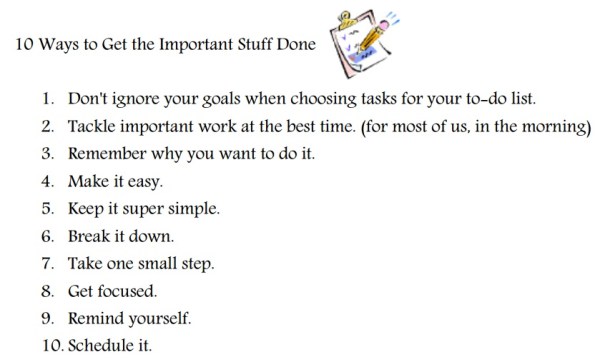
10 Ways to Get the Important Stuff Done
10 Tactics for accomplishing important work:
Don’t overlook your goals when choosing your Most Important Tasks (MITs) for the day
Important tasks can be routine work, like the report that is due today and repeating tasks like the car that needs an oil change. Important activities are also in the important but not urgent quadrant of the time management matrix, but without a deadline they can often be easily postponed. Take time to pursue purpose and practice activities that increase happiness and well-being.
Tackle important work at the best time
It’s best to work on tasks that require thought and creativity when you have the most energy, usually in the morning. Don’t waste your most productive time. Short hourly breaks may work the best. (see more about the Science of Productivity)
Remember the benefits
Consider the consequences if it is not done, and the benefits of accomplishing it.
Make it easy
In his book and TED Talk, Peter Bregman uses an example to illustrate this. His family thought they would eat outdoors at a table, but found they never used it…until they moved it a little closer to their door. Make good habits easy, and bad habits hard.
Maybe you don’t need a complicated plan. Maybe you only need to know the first step. Some projects may be complex, but keep them as simple as possible. Don’t make it harder than it needs to be.
Break it down
Big tasks can seem overwhelming unless they are broken down into smaller action steps.
Take one small step
Get started by telling yourself you will do just one small step. Often once inertia is overcome, it’s easy to keep the momentum going.
Get focused
Do an annual review to choose goals and areas of focus. The Energy Level Gauge is a simple tool that makes it easy to see which areas of your life need more attention.
Keep it visual, and keep it on your radar. Peter Bregman’s 18 minutes: 5 minutes in the morning to plan, 5 minutes in the evening to review, and a timer set hourly during the day to re-focus.
Schedule it
Assign a date and time in your calendar. In “18 Minutes,” Peter Bregman describes studies from the book “The Power of Full Engagement” by Jim Loehr and Tony Schwartz which reveal that deciding when and where we will do something makes it 80-100% more likely to be done.
Want to learn more? Read “18 Minutes” by Peter Bregman, download an excerpt, and watch his TED Talk, The Work Buffet.
More resources to learn about productivity: Time Management 101, master skills of productivity, learn about the study of productivity, with videos at Learn about Productivity, and courses at Skills Employers Want – Planning.

I seek to create order from the chaos of complex information. Join me at the Daily PlanIt to gain insights, inspiration, and information to increase skills for a better life. I unlock the power of teaching reading with phonics in the pursuit of literacy at www.phonicspow.com. In my spare time I explore books and movies, often choosing titles available on both screen and page.


 Daily PlanIt
[…] after 25 minutes, the 90/20 rule advocated by Tony Schwartz is based on Ultradian rhythms, or Peter Bregman’s 18 minutes with a minute each hour during the […]
[…] Important tasks can be routine things, like a report that is due today. But important tasks are also work that matters to you, like action steps toward your goals. Keep the important on your radar so that it doesn’t get lost in all the other things that compete for attention. See more about Getting the Important Stuff Done. […]
[…] Putting the things we need to do on a regular basis on autopilot allows us to focus on more important matters. Studies have revealed statistics about the effects of interruptions and multi-tasking, the best […]
[…] Bregman’s 18 Minutes: set timer for hourly reminder to stretch, breathe, and […]
[…] It can be a lot more enjoyable to spend time learning about productivity than to actually act on the information. Keep in mind the ratio of time spent studying vs. the number of ideas you find that will work for you. Try to set a limit on the amount of time on these activities and focus on getting the important stuff done. […]
[…] to reflect in your character, the values you want to express as part of your life, the goals and important work that you want to accomplish. Maybe you want to focus on Stephen R Covey’s Quadrant II of the […]
[…] 18 Minutes by Peter Bregman – Getting the Important Stuff Done […]
[…] is important to accomplish goals, establish habits, combat procrastination, and get the Important Stuff Done. Motivation drives the desire to act or initiate change, and finding the motivation to take action […]
[…] is about making choices: choices about what you think is important, about how you want to make a significant impact, about how you will act. To set goals, you […]
[…] and energy are limited resources, and we simply can’t do it all. Choose wisely to say yes to what matters most. A TED article by author Ryan Holiday reminds us that every “yes” to one thing is a […]
[…] peak time in your schedule to concentrate on what is most important. Becoming intensely involved in important work can lead to feeling the flow experience. To inspire flow, look for the right balance of challenge […]
[…] setting is such an important skill in life and work, because goals make it possible to focus on what matters most. The TED talks below, plus a few more videos and books have helped me learn about setting and […]
[…] 6. Use peak time for important work. […]
[…] on important work. To find work that really matters, look for your VIP AIMS: Very Important Pursuits that are active, inspiring, and meaningful solutions. Focus on these even if it may be […]
[…] can be one of the biggest obstacles we face in getting important things done. They can make getting and staying focused very […]
[…] is it Important? Is it high priority? Is it […]