Look at Your Values

Knowing your values creates clarity and focus, helps you to be mindful about your choices, and empowers you to live authentically and with integrity. Your values are guiding principles that point you in the right direction like a compass.

Core values

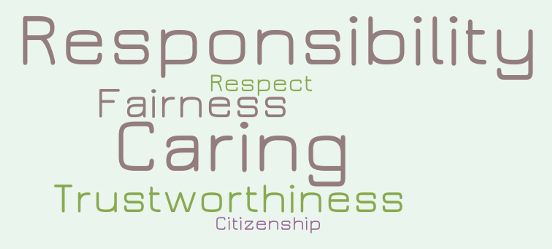
Core values are the values that are of highest importance to you. They may be values of intrinsic worth that are fairly universal among cultures and religion. Many of these values are based on respect and responsibility for ourselves and for others. Developing character often involves core values.
values

Personal Values

Some values can vary depending on individual preferences, and may come from personality traits or work values. One person may value adventure and freedom, while another values safety and security. Some people like working with others, and some prefer to focus on tasks. Personal qualities are sometimes called character strengths. Some of these values can be more subjective and variable.

Different kinds of values can be explored with tools at Map Your Values.

Look at Your Values is Part Five of Discover U in Ten Steps, and one of the weekly activities for a Year of Personal Development. Find a free printable self-assessment form at the Brand and Purpose Toolkit, and links to online tools at the Discover U Toolkit at Wakelet.

Once you identify your most important values, you can create a value statementmission statement or a Unique Selling Proposition that pinpoints what you do and why. It is a concise, clear statement of the special benefit that you provide. It is the power tool for Purpose, one of the Four Ps of Positive Shift that organize the 12 practices that have been shown by positive psychology to increase happiness.

Discover U in Ten Steps

  1. Discover your heroes
  2. Identify your strengths
  3. Explore your skills
  4. Examine your beliefs
  5. Look at your values
  6. Develop a mission statement
  7. Learn about your personality and interests
  8. Think about your talents and goals
  9. Tell your story
  10. Express yourself

Brand and Purpose Toolkit at Resources

Posted in Discover U, goals, personal development

Examine Your Mental Beliefs

Beliefs may be either spiritual or mental. Some of the biggest obstacles we encounter are the ones that we create ourselves. Our own fears, limiting beliefs, desire for the comfort zone, or distractions can prevent us from acting with agency to accomplish what we want to do. They can prevent us from connecting with others. They can stop us from making a meaningful life. RECLAIM agency to get unstuck.

Remember realistic optimism
Expand the comfort zone
Cultivate courage and creativity
Look at limiting beliefs
Address distractions
Improve and build strengths
Master a growth mindset

Examining your beliefs is one way to Discover U, and part four of a Year of Personal Development.

Hyrum Smith, CEO of Franklin Covey, talks about his “Franklin Reality Model” in the book “The 10 natural laws of successful time and life management.” Look at your beliefs to determine: 1 ) are they are based on truth? and 2) do the results of choices based on those beliefs work for you? Beliefs are learned and may have been formed in situations that were something less than perfect. If they are not working for you, they can be changed. Sometimes we internalize negative messages. For example, Instead of learning great communication, we may have gotten the message that it’s not ok to talk about certain things. We can choose new positive beliefs like “I can talk about things that are important to me.”

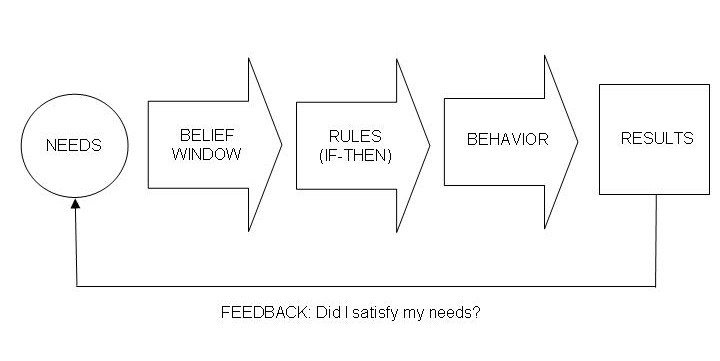
In the Franklin Reality Model, our belief window is a filter as we take actions (behavior) as we attempt to meet our perceived needs. Examine beliefs, actions and long term results to determine if needs are met.

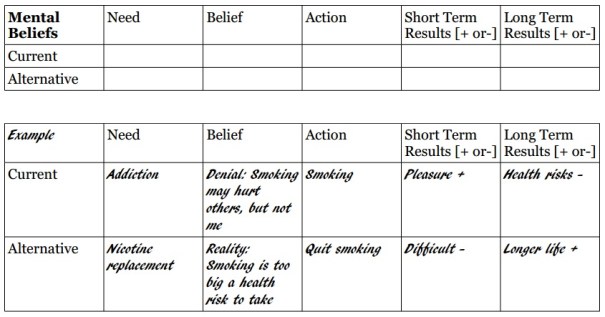
MentalBeliefsIn this example, the current need is the addiction of smoking, which is driven by the belief that “smoking may hurt others, but not me.” The short term result is the positive pleasure from nicotine. The long term result is the negative effect on health. An alternative belief is based in reality: “smoking is too big a health risk to take.” Quitting smoking is difficult in the short term, but leads to a longer and healthier life in the long term. Read more about the Franklin Reality Model at Franklin Covey Synthesis.
loved

Our mindsets can have a big effect on our lives. Positive affirmations are first person present tense descriptions. Pay attention to what you say when you talk to yourself and choose positive self-talk rather than saying critical and negative things.

“The Four Agreements” is a book by Don Miguel Ruiz that describes how we form beliefs based on fear. When we change our agreements, we can change our lives. The four agreements are:

  1. Be impeccable with your word.
  2. Don’t take anything personally.
  3. Don’t make assumptions.
  4. Always do your best.

Beliefs and our emotions

One of the Emotional Intelligence activities is a look at Rational Emotive Behavior Therapy to see how beliefs lead to emotions, which helps us Understand Emotions.

Make a list of your beliefs about yourself, others, and life. For each one, ask if it works for you. If it doesn’t, re-write it.

Discover U in Ten Steps

  1. Discover your heroes
  2. Identify your strengths
  3. Explore your skills
  4. Examine your beliefs
  5. Look at your values
  6. Develop a mission statement
  7. Learn about your personality and interests
  8. Think about your talents and dreams
  9. Tell your story
  10. Express yourself
Posted in Discover U, goals, personal development

Explore Your Skills

desktop-1246512_1920

Image by Free-Photos from Pixabay

Skills are learned abilities. In this post, you will learn how to:

  • Assess current skills
    • Types of skills
  • Identify skills to learn
  • Develop skills
  • Describe skills

ASSESS current skills.  Look over the Work Skills List. Do you have the top skills that employers want? The Career Search Process can help to evaluate skills. At Discover U in Ten Steps, find a free printable self-assessment form and links to free online tools. More tools to explore skills are at the Discover U Toolkit at Wakelet or via Google. The Skills Assessment at CareerOneStop and at onetonline.org are great places to start identifying your skills.

Types of Skills – Identifying your skills at dol.georgia.gov describes these skills:

  1. Job skills are specific to an occupation, like special computer software or reading blueprints.
  2. Transferable skills are general work skills like the ability to use a computer program or writing a report.
  3. Self management skills are personal qualities like being analytical or reliable.

More Skills (see more links at the Work Skills List)

See The Work Skills Toolkit for more information.

The Secretary’s Commission on Achieving Necessary Skills (SCANS) identified skills needed for success in the world of work. They categorize skills as: Basic Skills, Thinking Skills, and Personal Qualities. People Skills are included at Career Key. Try an online assessment of SCANS skills.

Look at your work experience and list the different skills you have used. You can look at it two ways:

  1. Specific to general: what job duties were performed? what projects were accomplished? What transferable skills and self-management skills were demonstrated? or
  2. General to specific: How have you demonstrated self-management and transferable skills in your work?

IDENTIFY a target skill to develop. Which skill, if improved, would have the most impact? Use a development plan and find learning activities to set a goal for developing the skill.

DEVELOP the skill. Find many resources at Develop Work Skills and The Development Center at the Daily PlanIt Sticky Wiki. Find more links at the Work Skills Pinterest Board.

DESCRIBE skills. Learn how to describe your accomplishments with specific examples at Marketing U.

Discover U in Ten Steps

  1. Discover your heroes
  2. Identify your strengths
  3. Explore your skills
  4. Examine your beliefs
  5. Look at your values
  6. Develop a mission statement
  7. Learn about your personality and interests
  8. Think about your talents and goals
  9. Tell your story
  10. Express yourself

Brand and Purpose Toolkit at Resources

Posted in Discover U, goals, personal development

Identify Your Strengths

cat-lion

People who use their strengths are more productive, engaged, and successful. Knowing your strengths can help you choose priorities, to leverage your time to make the most of them. Knowing your strengths can help you find a compatible career and begin to discover purpose or Ikigai. Using your strengths contributes to confidence and self-esteem, and helps to cultivate strong relationships.

Your strengths may include innate talents or skills that you have learned. Sometimes the personal qualities that are your positive traits are called character strengths. Strengths may be something that you want to share with others, and people may tell you that you are good at it. To identify strengths, look for:

  • Flow. When an activity draws you in and time flies by, it may be a strength.
  • Energy. Activities that you love doing often energize you when you engage in them.
  • Abilities. Strengths are abilities that require physical or mental effort.
  • Talents. Strengths may be talents that come naturally and easily to you.
  • Skills. Strengths may be developed skills that have been learned.

Identify Strengths

CliftonStrengths

You can also pay attention and observe to notice talents that you are naturally good at, and skills that you enjoy using. Identify Your Strengths is Part Two of Discover U in Ten Steps and part of a self-assessment to uncover hidden talents. More tools to identify strengths are at the Discover U Toolkit at Wakelet or or via Google, and the Strengths Pinterest Board. A SWOT analysis is a planning tool to clarify strengths, weaknesses, opportunities, and threats.

Develop Strengths

It takes strength to do hard things, and strengths can be developed with practice.

Stand strong
Tackle the tough
Rely on resilience
Endure hard times
Notice the necessary
Grow with grit
Try tenacity
Have the hustle

Develop Skills | Work Skills List | Work Skills Toolkit | Develop Character | Development Plan

The book “The Power of Full Engagement” by Jim Loehr and Tony Schwartz has ideas for developing four sources of energy: physical, mental, emotional and spiritual. In the same way we can develop physical strength with exercise, we can develop strength in all areas.

Discover U in Ten Steps

  1. Discover your heroes
  2. Identify your strengths
  3. Explore your skills
  4. Examine your beliefs
  5. Look at your values
  6. Develop a mission statement
  7. Learn about your personality and interests
  8. Think about your talents and goals
  9. Tell your story
  10. Express yourself

How to Start a Fire is a free eBook on discovering what you are passionate about.

Brand and Purpose Toolkit at Resources

Posted in Discover U, goals, personal development, work skills

Discover Your Heroes

Part One of Discover U in Ten Steps

superman

Since my website is called the Daily PlanIt, it might not surprise you that one of my heroes is Superman! Knowing your heroes gives you insight into your character.

Getting started

Grab a pen and a notebook or some index cards. At the top of the page (or card) write HEROES. Think about some people that you really admire and why. Plant this thought in your brain and let it vegetate awhile until some really good ideas come out. A hero could be someone you know or someone who is famous, real people or characters from books or movies, from the present or the past.

Resources:

See a slideshow for more ideas at Who Are Your Heroes, one of the weekly activities for a Year of Personal Development.
The next step of Discover U in Ten Steps is to identify your strengths.

Posted in Discover U, goals, love & relationships, personal development

Life Areas for a well balanced life

LifeAreasColor

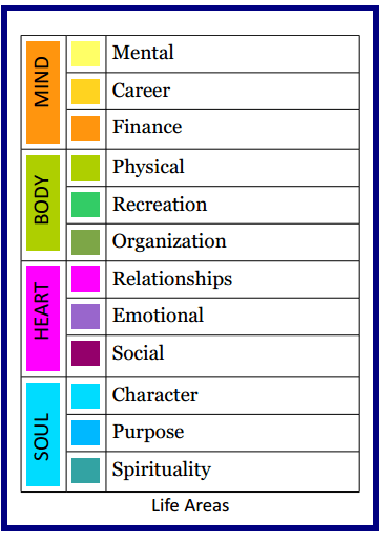
The 12 life areas in the Year of Personal Development challenge are:

  • MIND: Mental, Career, Financial
  • BODY: Physical, Recreation, Organization
  • HEART: Relationships, Emotional, Social
  • SOUL: Character, Purpose, Spirituality

Consider these life areas when choosing goals, generating goal ideas or creating a personal development plan. The Life Area Energy Level Gauge is a tool that pinpoints areas where levels are low to help you know where to start.

Learn how to set goals, get ideas for goals, and find goal setting tools at the Goal Toolkit. Sometimes goals in one area may be in conflict with another area. For example, spending money on recreation means there will be less added to savings. Some activities combine areas. For example, taking a walk is good for both emotional and physical areas. If you go with a friend, it can also be good for the social area. Activities that you find enjoyable or important are different for each person, so consider what is most meaningful to you.

weekly personal development plan with a focus on one area each day of the week beyond your usual activities is one method to achieve balance. You can choose a focus area on a regular day or randomly.

Tagged with:
Posted in goals, personal development

Example Goals

If you want to generate ideas for goals, but don’t know where to start, here’s some ideas to get you thinking:

Here are some ideas from a list in the book “You Can Find More Time For Yourself Every Day” by Stephanie Culp:

  • Save more money
  • Get a new job
  • Buy a house
  • Buy a new car
  • Get organized
  • Spend more time with family
  • Write a book
  • Travel
  • Lose weight
  • Exercise
  • Learn Spanish

Design a workspace to inspire ideas and creativity, and remember to balance life areas.

The next step is to make goals specific and measurable.

Posted in goals, Ideas That Work

Top ten blogs on time management

Updated 6/20/11

There are many great sites dedicated to exploring ways to use time well. Here are my top favorites. For these and more, go to my del.icio.us bookmarks list.

  • Lifehack — Daily digest and pointers on productivity, getting things done and lifehacks. Keep an eye on what Chris Brogan is up to-he’s an incredibly creative guy who writes regularly at Lifehack.org among other things
  • DIYPlanner-Paper, productivity and passion
  • David Seah-the Printable CEO
  • 43Folders-about personal productivity, life hacks, and simple ways to make your life a little better
  • Matt’s Idea Blog-Original thoughts on productivity, personal information management, creativity, journaling, personal digital storage for life, and leveraging technology for citizenship.
  • LifeDev-new. interesting.
  • Make It Great!-Lifehacks from Phil Gerbyshak
  • Productivity Goal, which is “a discussion about work productivity, time management organization, tools and tips.”
  • Productivity Pro-Helping people leave the office earlier, with less stress, and more to show for it!
  • Open Loops (”Because it’s your time.”) — A weblog about efficiency and productivity.
Posted in goals, Ideas That Work, personal development, productivity, Top Ten Sites, work skills

A Time Audit: chart energy levels with a time log

Many time management resources suggest using a time chart or log as a starting point to see how you are actually using your time as opposed to how you think you are using your time.

Benefits

  • Pinpoint when and how time is wasted
  • Determine your peak energy levels
  • Calculate the gap between what you believe is important & how you invest your time
  • Easily see areas to improve
  • Allows you to measure progress with a periodic check

Overcome resistance with curiosity

I know, right? A time audit kind of sounds like a tedious task. Despite knowing all the benefits, it was hard to get excited about adding this to my list of things to do until I saw this chart with the daily routines of famous creative people from Podio. It sparked my curiosity to see how my daily routine compared. I quickly saw that I was taking too long to get going in the morning, and failing to use my most productive time for important tasks.

DailyRoutines

So how does your day compare?

PodioTracker

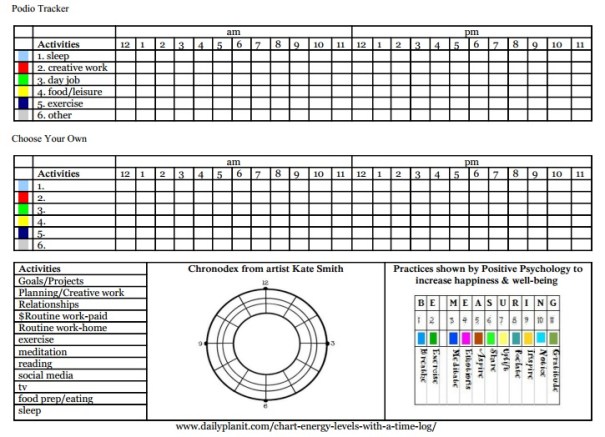
Use the Podio Tracker (pdf) to track your time use and compare it to the daily routines of Creative People chart above. This one includes a chronodex to color in from artist Kate Smith.

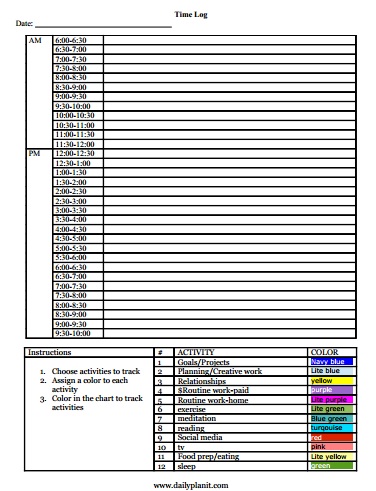
TimeLog

A Vertical Time Log (pdf) allows 1/2 hour increments

Does the idea of a routine sound boring as well? The most productive people follow a routine to make the most of their time. A flexible routine automates tasks to free attention for more important matters.

More Tools

Another way to look at it is Creative Routines from Infowetrust.com. The Muse provides a form to track your time use in this circular manner.

Paper Forms

Excel Options

Apps and software:

More Stuff

Chart Energy Levels

Our high energy time should be used for high priority tasks and projects that require creativity and thought. Notice patterns for physical and mental energy and how it varies throughout the day and week. Use this information when scheduling activities. Another way to look at your energy use is the Energy Level Gauge tool at How Are Your Energy Levels. It is an easy way to see which of twelve life areas need more attention.

Time and energy are limited resources. The opportunity to use today well is good only for 24 hours. Make the most of them!

Additional Reading: Activity Logs at Mind Tools, Time Logging from Right Attitudes,  Understanding Your Personal Energy Cycle by Laura Stack.

Tagged with: , , , , ,
Posted in productivity

Camp Wood

I was sixteen the summer I became a dishwasher at Camp Wood. I did not write much that summer, I was too busy living. It was only afterward that I longed to put it on paper, to try to hold on to the beauty before it slipped away into the detritus of ordinary life. I am in algebra class but in my memories I’m also far away, falling through the air after running off a cliff. I hit the cold water and fall through it too. Then I surface, thrilling to the fear, the smart of the impact, the coldness, and the pure audacity I possess. It’s something like love; a feeling so great, so important, you can never forget it. Yes, I’ll always remember the first time I saw the camp as it overflowed with beauty.

CWLake1

Green sloping hills and far horizons surround it. A steep rocky path leads from our cabin on top of a hill down to a lake with an island in the middle of it.

My friend Monica and I are the first of the employees to arrive, but are soon joined by others to fill more positions. After our work is done we swim to the floating dock and lay in the sun, or go and play with a new litter of kittens. Sometimes we play tennis or cards, watch fantastic sunsets and late night television movies. We have pillow fights, and listen to records as we go to sleep. There are skit nights, cookouts, sing-a-longs, jokes, counselor hunts, piggyback rides, shaving cream fights, watermelon feeds, and moonwalk jumps. I ride a horse across the rolling hills to round-up cattle.

One deserted weekend, Monica and I clean a long row of windows, then paint the dock green. When we get hot we jump off into the lake to cool off. Afterwards, I hike alone to Lookout Hill and look back at the camp as I rest, drinking in the beauty of the place.

Camp Wood sometimes seems so far away. I left with great reluctance, but summer must end. Look in a newspaper and you will see pain. But look inside yourself and you will see a camp with green sloping hills and far horizons full of laughter and joy. As time goes by I sometimes wonder if I imagined it all. But even so I never stop hoping I will find Camp Wood again.

Posted in personal development
eBooks

Enter your email address to follow this blog and receive notifications of new posts by email.

Archives
Blog Stats
  • 742,936 hits