
Today’s entry is from an Ann Landers column. The 15 words for husbands to keep their wives happy are: I love you. You look great. Let’s eat out. Can I help? It’s my fault. The 15 words for wives to keep their husbands happy are: You’re so sexy! Dinner is ready. I hate shopping. You’re a genius! Here’s the remote.
Organizing Recipes
Recipes are difficult to organize because they come in so many different sizes and shapes. I have two sizes of card files and also use a computer program and print out recipes to keep in a binder. It’s good to have a “recipes to try” file and select one to try each week. Keep only the ones that are really excellent.

An idea from the book “Totally Organized” by Bonnie McCullough is to make a recipe index by listing favorite recipes with the page number and name of the cookbook they are in. You could set up a database searchable by type of recipe or ingredients if you feel very ambitious, but even a simple wordprocessing document is helpful. A Cookbook Recipe Index is included in the Simply Dinner Cookbook.
See also: Household Binder Notebook and Free Printables @Pinterest: Household Binder Notebook – Meals
Posted in productivity
Dr Harley on Needs
My recent interest in the subject of needs led me to read the book “Give and Take” by Dr Willard Harley. It was an eye-opening experience. Besides talking about Love Busters and the ten most important emotional needs, he says there are two illusions. The first illusion is that care and protection in marriage should be given unconditionally. The reality is they are given when they are received. The second illusion is that spouses should love and accept each other as they are and shouldn’t try to change each other. The reality is that love and acceptance depend on the changes made to accommodate each other. “It is the epitome of selfishness to assume that we should be loved and cared for regardless of the way we treat others.” The policy of joint agreement is “Never do anything without an enthusastic agreement between you and your spouse.” The interests of both people are equally important. His Marriage Builders website is packed with useful information.
Posted in Books, love & relationships
To Get Clear on Goals, Look at Needs
Looking at what we need and want is a way to bring goals into focus.

Needs are essentials for survival, while wants are things that would be nice to have. As basic needs are met, higher needs become more important. Look at what you need and want from yourself and from others, as well as what others need and want. Identify needs and wants in all life areas.
| AREA: | POSSIBLE NEEDS & WANTS: |
| Mental (to learn) | Information, challenges, freedom |
| Spiritual (to grow) | Meaning, purpose, principles, character |
| Emotional
(to receive & to give) |
Recognition, respect, affection, support, understanding, kindness |
| Relationship (to share) | Appreciation, consideration, love, romance |
| Social (to connect) | Interaction with others, communication, friendship, family, belonging |
| Physical (to care for) | Food, shelter, rest, exercise |
| Financial (to work) | Contribution, achievement, security |
| Recreational (to enjoy) | Fun, new experiences |
Look at each area in the context of the other areas. A needs analysis will help you get clear on your needs in a relationship.
Posted in goals
Time Table
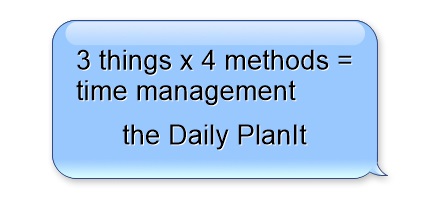
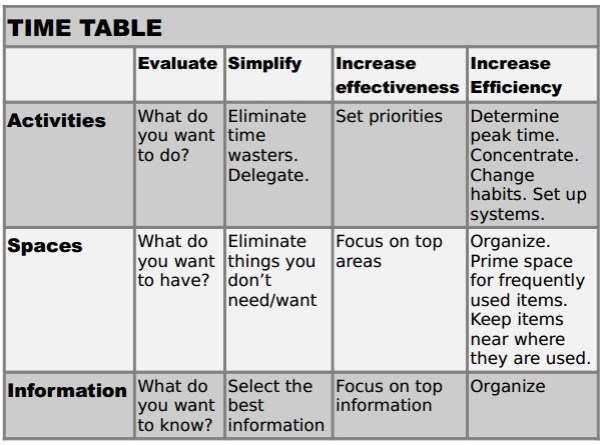
3 x 4 = Time management. Here’s how to manage three things: activities, spaces (home, office, desk and the objects within them) and information with four methods: evaluate, simplify, increase effectiveness, and increase efficiency.
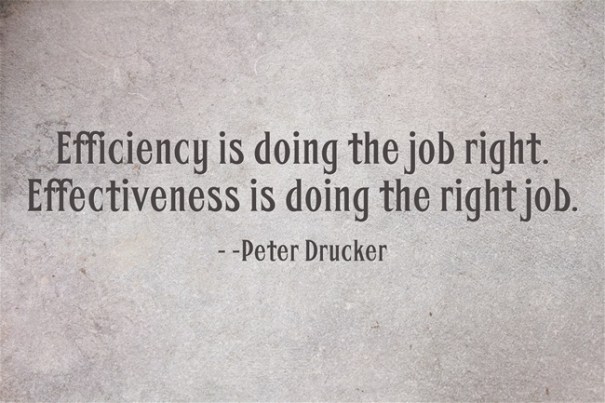
Peter Drucker said: “Efficiency is doing the job right. Effectiveness is doing the right job.
Evaluate
- Activities-What do you want to do?
- Space-What do you want to have?
- Information-What do you want to know?
Simplify
- Activities-Eliminate time wasters. Delegate. Learn how to say no.
- Space-Declutter to eliminate things you don’t want.
- Information-Select the best information.
Increase Effectiveness
- Activities-Set priorities. Do the most important things first.
- Space-Focus effort on the most important areas.
- Information-Focus on the most important information.
Increase Efficiency
- Activities-Determine peak time. Focus and concentrate. Change habits. Set up routines and systems.
- Space-Organize the things you do want. Use prime space for valued and frequently used items. Keep things near where they are used. Design an efficient workspace.
- Information-Organize the information you do want. Set up a file system.
Check out more ways to set priorities and find the sweet spot. See also the Productivity Board at Pinterest.
Posted in productivity
The joy of giving
Not so Random Acts of Kindness
Sharing is one of the building blocks of positive shift that have been shown to make us happier. It doesn’t have to be hard or complicated. Make it easy to remember to share with these simple gifts of appreciation that can be used for Random Acts of Kindness.

Download a printable copy of these tags for Gifts of Appreciation
Here are a few of my favorites:
- You always come through in a CRUNCH! Thank you! (with a Nestle Crunch bar)
- Just donut know what we would do without you! (with donuts)
- We love how you roll! (with cinnamon rolls or Rollos)
- You are Extra special! or Thanks for going the Extra mile! (with Extra gum)
- You are the bear-y best! (with gummy bears or Teddy Grahams)
- Have we told you Reese-ently how much we appreciate you? (with Reese’s peanut butter cups or Pieces)
- Congratulations! Egg-celent work! (with Cadbury egg)
- Thanks a latte for all you do! (with Starbucks gift card)
- You’re a lifesaver! Thank you very much (with lifesavers)
- You did a tea-rific job! or You are tea-rific (with assorted teas)
These profound lyrics from a Christmas song sum it up:
Giving (Santa’s Theme) by Johnny Mathis (on Youtube 1.55-)
In this whole world that we live in,
There is one pure joy that ev’ryone can share:
The joy of giving
To the people for whom we care.
When you give love in small ways,
You’ll know it’s always there.
To be giving and forgiving
Is to understand the joy of living.
What’s so hard about giving?
It’s a perfectly simple art.
The trick is to give with love from the start
And to give with an open heart…
More ideas at the Gifts of Appreciation Pinterest Board
Posted in personal development, positive shift
Blogger vs WordPress
I began blogging with Blogger, which is very easy to use. But I wanted categories. I wanted categories bad. As someone who likes their information organized this was important. I looked for something similar to searchenginewatch that would chart the features of different blog sites, to no avail. So when I stumbled across WordPress I was quite excited! They have categories! Yeah! You can even make new pages with tabs! Whee! But I discovered a few things in WordPress that are oddly not easy at all: Adding “Subscribe” buttons, lack of access to html page templates, inability to add a tagline to the page title. Or maybe it’s just that I’m still learning. Anyway, the plus of categories outweighs all else as I happily switch to WordPress. A happy ending, or a happy beginning?!
Posted in information management
Daily Planning
Planning is thinking, and the ability to plan is one of the skills employers want. Planning is an important skill for setting goals, planning and evaluating projects, and one of the elements of producitivty. Having a Weekly Plan and a Daily Plan will help you get off to a great start. (a free printable Planner Checklist can help.)
PLAN your TIME today!
- Plan for the day by reviewing your calendar, to do list, and weekly plan.
- Look at your value statement and guide your choices based on your values.
- Act on priorities. If there are extra moments, choose items from goal and project plans, work goals, and master list.
- Note your peak time and use it to get important stuff done. The Science of Productivity shows that for most people this is for about two hours an hour after waking. Try a time audit to see how you are actually using your time.
to
- Tend to focus.
- Include new incoming tasks in your system (see how below), and delete completed ones.
- Manage your energy with a regular routine and mindfully motivate.
- Examine progress:
- In the afternoon, check that all regular repeating tasks have been done. Check off completed daily goals on a habit chart.
- At close of day, celebrate what you have accomplished and plan for tomorrow. Make a daily to do list for the next day, adding items from your calendar and weekly plan.
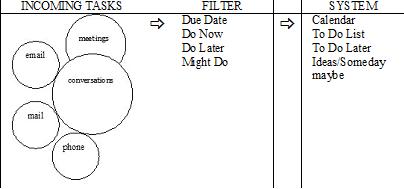
Incoming Tasks
Capture incoming tasks and add them to your system:
- Due date or deadline – calendar
- Act on now – to do today list. If it is more than one step, develop a project plan with action steps
- Tackle later – to do later list or a follow-up system
- Explore options – idea file or maybe someday list for GTD
Planning is also part of reviewing…
Morning Questions
- What’s on my calendar?
- What’s on my to-do list that must be done TODAY? Which are the Most Important Tasks?
- If I can only do ONE of these tasks, which should it be? Start with that one, then go to the next one.
- What is the best use of your time right now? (Alan Lakein)
- Which quadrant of Stephen R Covey’s time management matrix is this task in?
- What actions can be taken today to move a project or goal forward?
- Which actions are top priority?
- What’s the next action required? (David Allen) …learn more at GTD Essentials
- What activities am I not doing, that might help me reach goals if I did them? (Brian Tracy)
See also Time Management Questions and 10 Productivity Questions to Ask Yourself Every Day from timemanagementninja.com
Evening Questions:
- Did I begin the day with a plan for doing a few MITs?
- Did I choose the top priority one and begin with that one?
- How many tasks were accomplished today? How many were carried forward? How many were added?
- Did I use my high energy time for tasks that needed thought and creativity?
- Did I leave my workspace organized and ready for tomorrow?
- Have I reviewed my calendar, to do list, and weekly plan, and picked MITs for tomorrow?
- What interruptions and time-wasters were encountered? Could they have been avoided?
- Did I spend enough time with family and friends?
- Did I spend enough time on fitness, leisure and spiritual activities?
Everyday Reflections for Effective Time Management from rightattitudes.com
A book called “The Personal Efficiency Program” by Kerry Gleeson really gave me a better understanding of how planning works. (Affiliate link: I receive a small commission at no additional cost to you if you click through and make a purchase with an affiliate link. Thank you for your support!)
Studies have discovered:
- we can’t store much in our memory, and it drains energy if we try.
- Be aware of the Planning Fallacy: we tend to under-estimate how much time tasks will take.
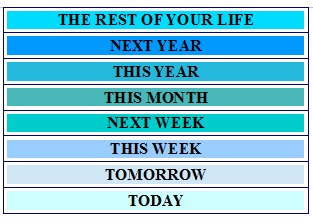
Learn more: This is part of the free Time Management 101 Tutorial | see also: Skills Employers Want #4: Planning | Optimize Your Day With the Science of Productivity
Tools for Planning | A paper planner tool for the weekly review | Set of a weekly planning form plus five daily planning forms (pdf)
Meeting needs with love
I’ve been reading two apparently disparate books that seem oddly connected, as they have related ideas about unexpected topics. A book about depression and one about energy both have interesting things to say about relationships and needs.
“Creating Optimism” by Bob Murray and Alicia Fortinberry is a seven step program for overcoming depression with a 94 percent success rate based on follow-up questionnaires. Step 1 is: Identify & defeat the inner saboteur, Step 2: Reconnect to your body, Step 3: Create Healing Relationships, Step 4: Elevate your self-esteem, Step 5: Uncover your competence, Step 6: Access the power of shared purpose, and Step 7: Deepen your relationship to the divine.
The book describes eight fundamentals of happiness: connection to others, autonomy, self-esteem, competence, purpose, connection to your body, connection to nature, and spirituality. As human beings are relationship-forming creatures, a large portion of the book is devoted to connection to others. The authors contend that a relationship is the mutual satisfaction of need.
Six actions for creating healing relationships are: 1. Discover your functional relationship needs in all areas of your life. 2. Prioritize needs and define your bottom line. 3. Give your needs to others. Find out their needs of you. 4. Negotiate needs and set consequences. 5. Create rules, roles, and rituals. 6. Expand your network of lasting, strong, and supportive friendships.
Functional needs are: 1. Action oriented: about doing, not about thinking or feeling. 2. Concrete and specific. 3. Appropriate: fitting and realistic. 4. Doable: possible to be met.
To communicate different priority levels of needs, think of a stoplight. Red means essential to survival, yellow needs are important but negotiable, and green are wants that would be nice to have.
In “The Energy Prescription,” Connie Grauds says fear and loss of self lead to disconnection from the limitless sea of energy we live in. We renew energy when we reconnect with eight gateways: mind/soul, breath, water, food, exercise, nature, relationship, and altruism or contribution. The final chapter has checklists to evaluate each gateway, along with prescriptions for increasing energy.
A shift in consciousness occurs when we pause, disconnect from fear and reconnect with the energy of life. Fear is a normal response to threat that can become a chronic habit even when threat is not present. When we bring awareness to our life experience, we can respond without unconsciously reacting from fear. We can choose thoughts that generate rather than deplete energy.
Fear only produces more fear. It distorts our perceptions, beliefs and behaviors, and complicates our relationships. It is the cause of all painful struggles, conflicts and misunderstandings. When we operate from fear, we struggle to get our own needs met, often with the opposite effect. As we shift awareness, love and energy overflows in kindness or helpful acts for others, and flows back to us. Intentions that come from love are of a higher level than those that do not.
Healthy relationships contribute to our happiness but are not the main source of happiness. When relationships are presumed to be the primary source of spirit energy, they are burdened with impossible demands to fulfill a need that only Spirit can fill. Love is giving and receiving spirit energy as kindness and presence without expectation, possessiveness, jealousy or attachment. Relationships are opportunities to magnify spirit energy through spiritual contact with others. When we connect with love, we are better able to meet the needs of others and ourselves.
See also: Do a Needs Analysis
Read more: MarriageBuilders
Posted in Books, love & relationships
Plan for Growth
You can plan for growth with a focus on a different life area each day, or by randomly choosing something to work on. Just as we can make a plan for increasing exercise, we can plan to increase personal qualities like courage, relationship skills and many other life areas.
For any area you want to improve, list:
- Where you are now
- Where you want to be
- What will get you there: what you will do, by doing what? When? How often? How many? How much?
- What could get in the way: what problems you might encounter and how you will deal with them?
In “The Power of Full Engagement” by Jim Loehr and Tony Schwartz (Affiliate link: I receive a small commission at no additional cost to you if you click through and make a purchase with an affiliate link. Thank you for your support!), the authors provide ideas for developing four sources of energy: physical, mental, emotional and spiritual. In the same way we can develop physical strength with exercise, we can develop strength in all areas. Here is an example plan from p. 104:
- Target: Increase realistic optimism
- Where I am: Negative thoughts hold me back.
- Where I want to be: I am a positive thinker.
- What will get me there: Each evening I will write down problems in a journal and change perspective to view them as challenges and opportunities. I will write down things I am thankful for.
- What could get in the way: Overcome pessimistic thinking with positive thinking. Negative thinking is likely when overly tired or discouraged by obstacles.
The Life Area Energy Level Gauge is a tool that makes it easy to see where to begin with areas that are low.
See also: A Weekly Personal Development Plan and Development Plans Are Not Just For Work
Posted in personal development


 Daily PlanIt