Learning about a Low Carb Diet

Diabetes entered our life in December, which has prompted us to learn more about eating a low-carb diet. I had of course heard of low-carb and the Atkins diet before, but found it all too confusing. I love bread, and don’t love too many veggies. Added to that I need to avoid MSG, another whole different issue. When I first began reading about all this, it was pretty overwhelming. I could not figure out the GI index and exchanges. I have now looked at cookbooks at the bookstore three times and still haven’t been able to choose one. I’d like to share some of what I learned in case it might be helpful to others. A low-carb diet has the additional benefit of weight control, and is generally a good choice for those looking for a healthy diet. First let me say that I am no expert and do not have all the answers. Plus, everyone is different in their tastes and the issues they face. Take what fits you from this!

NOTE: I finally found the book I was looking for! “Prediabetes: a complete guide” by Jill Weisenberger is wonderful. As far as cookbooks go, so far the one I’ve liked best is “Betty Crocker’s Diabetes Cookbook: Everyday Meals, Easy as 1 2 3.” I have now created an eBook with recipes designed for a low-carb diet. Check out Simply Dinner: the Game Plan!

One of the most helpful things I have done was go on a tour of the Hy-Vee Grocery store with the Hy-Vee Dietician, Jaime. We looked at a lot of food labels, she pointed out some good choices and gave me some great advice. I had read the Hy-vee brochure on diabetes, but after she explained it, it made a lot more sense. It’s a very smart move for Hy-Vee to provide this great service, and much appreciated.

For a low-carb plate, you fill half the plate with veggies, 1/4 with lean protein, and 1/4 with healthy carbs.

What are Carbs? Starches: bread, potatoes, rice and pasta. Sugars: sweet desserts like cakes, pies, and doughnuts. Fiber: cereals, grains, beans, fruits. Even dairy items like milk, yogurt, and cottage cheese have carbs.

Bad carbs, Good carbs. From Atkins.com: “Bad carbs are highly processed carbohydrates (refined breads, cereals and pastries) that raise blood sugar too high and too quickly. These refined carbohydrates are not only higher in sugar and significantly lower in nutrients and fiber than whole foods, but they also break down more rapidly into glucose and enter your bloodstream far faster than vegetables and other good carbs. So if you eat refined carbohydrate foods, you stay on the blood sugar roller coaster ride of highs and lows.”

The goal is to keep blood sugar even by eating a balance of foods at regular intervals, limiting bad carbs as much as possible, and watching the quantities of good carbs. This is why a diabetic diet is a low-carb diet. Jaime said our bodies need some of the good carbs, it’s a matter of how much and a balance with protein and veggies. She suggested flaxseed is beneficial, and an easy way to add it is to sprinkle a tablespoon of Hodgson’s Mill Ground Flaxseed on yogurt, salads, or oatmeal.

Carb Counting

Most people will aim for 45 – 60 grams of carb per meal, or 3 – 4 servings of 15 grams. To do this, you need to learn what 15 grams of carb looks like. There’s a nice pdf guide to carb counting at stanfordhealthcare.org and another chart from SparkPeople. One of the first things Jaime showed me was that size matters. A small apple or banana counts as 1 serving, while a large one would count as 2. You can download a 43 page carb counter at Atkins.com.

Reading Labels

Plan to go on a trip to the grocery store at a time when it is not very busy and you can spend a lot of time looking at labels. Usually we are busy and want to run into the store with our list, grab what we need and go. That is not this. In fact, you might not buy a thing on this trip. It can be hard to see the labels in a store, so it can be helpful to look things up online at Calorie Counter  (You can find nutrition labels for some brand names here.) First look at the serving size, then the grams of carb. I know it’s not much fun to read nutrition labels, but it’s essential. You will be amazed at how many carbs are in some things, and at the variation between brands.

After you do this awhile, you begin to look at every food and think either “carb” or “not carb.” Then I looked at my own dietary habits, and it went like this: For breakfast I usually had cereal (carb.) A fruit snack in the morning (carb.) Often yogurt and granola for lunch (carb.) I often went the whole day with only a serving of protein at dinner, and very rarely had veggies! And thought I was eating pretty healthy! I’m planning some changes. Some are easy: Greek yogurt is yummy and has protein, and Nature Valley protein bars are tasty. Others are hard: the Italian food I love is pretty much off the table.
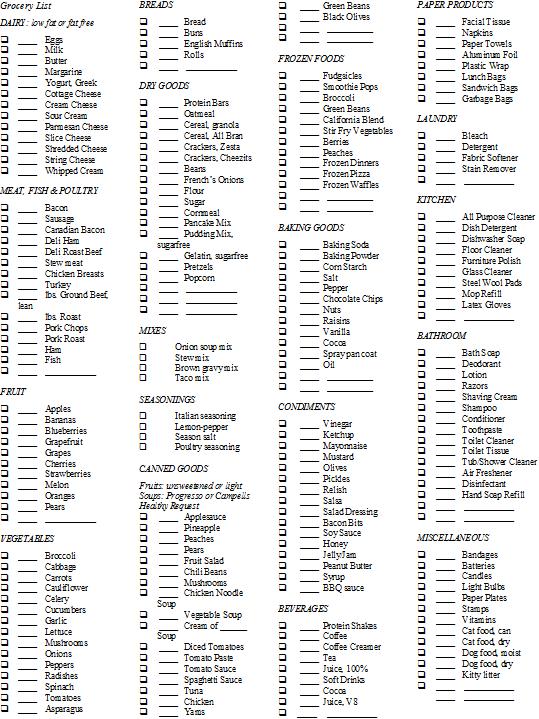
grocery list

I have customized a grocery shopping list, removing the things with carbs that we plan to cut out like potatoes and rice. There are still some things with carbs on there, because I just don’t think I can exist without crackers, and a few other things like cereal and salty snack foods. Other things like pancakes we might have rarely. Everyone has to make choices on what they can live without and what they can’t. You can usually have some carbs in small amounts, and you just have to decide which ones. You are welcome to grab this and customize it to your preferences.

Brands change all the time, and availability can vary. That said, here are some good choices I have found so far.

  • Bread: Nature’s Own 100% Whole Wheat (1 slice, 70 calories, 12 g carbs)
  • Salad Dressing: Kraft Zesty Italian (2 T, 50 calories, 2 g carbs)
  • Protein Shake: Premier Protein (30 g of protein, we get these at Costco) (160 calories/4 g carbs)
  • Protein Bar: Nature Valley- Chewy Peanut, Almond & Dark Chocolate ( 190 calories/14 g carbs)
  • Yogurt: Dannon Light & Fit Greek (80 calories/9 g carbs)
  • Delmonte Fruit Naturals Peach Chunks, no sugar added (50 calories/12 g carbs)
  • Hyvee Light Fudgsicle (45 calories/11 g carbs)

Some of the healthier choices cost more. For example, the greek yogurt is about twice as much as the other kind. Ask yourself, “Isn’t it worth it to add protein and lower carbs for a healthier diet?” Plus, you are saving money by no longer buying junk food.

More good snacks to have on hand:

  • Apples
  • Bananas
  • Carrots
  • Celery w/peanut butter
  • Rice cakes
  • String cheese
  • Cottage cheese
  • Nuts
  • Black Olives
  • Applesauce cups (natural, or unsweetened)

Vegetables

With a few exceptions, you can pretty much have all the veggies you want without counting. The few exceptions are: potatoes, corn, peas, and squash (acorn & butternut.)

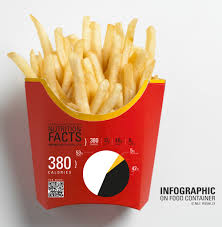
French Fries used to be my favorite vegetable, until I saw this nutritional facts infographic. I share this with you since this had the immediate effect of eliminating my desire for French Fries. That’s the power of information!
frenchfries

That’s 380 calories, 17 g fat, 48 g carbs, 4 g protein, or 42% fat, 53% carbs, 5% protein! WOW! A different infographic shows this also equals 35 minutes on a treadmill. Sort of makes you think twice, doesn’t it?

Since there are many vegetables I don’t enjoy, it will be a challenge to add more veggies to our meals.

I put together resources to organize my recipes and meal plans in my eBook “Simply Dinner: the Game Plan.” Check out Simply Dinner: the Game Plan! It has a blank recipe card template with four 3×5 cards on one page. Not to mention enough recipes designed for a low-carbohydrate diet for a month of menus. There are no fancy ingredients here, and please note they are not vegetarian.

I’m learning this is a process. A process of replacing high carb items in your pantry and fridge with healthier choices. A process of learning how to think about food differently, and making changes in how you prepare it. I hope this helps you begin the low-carb journey!

Posted in Ideas That Work

Game On! The Rules of Setting Goals

After my husband explained the rules of football, it became a lot more interesting. As he says, “If you know the rules, you understand the battle.” It got me thinking that setting goals is similar. You are much more likely to reach a goal if you know the rules.

GameOn!

In football, the goal is to make a touchdown. The team in possession of the ball has 4 chances to advance 10 yards toward their goal. If they make that, they get another 4 chances to advance another 10 yards.

footballfield

The other team is trying to prevent the advance toward the goal by tackling the player carrying the ball or by intercepting the ball when it is thrown. Players need to change course as they encounter obstacles. Breaking the rules can cause penalties and result in a loss of ground. A touchdown is worth 6 points, and the scoring team can gain an additional point if the football is kicked through the goal posts. A field goal is worth 3 points. The reward for getting the most points is winning!

Have a Game Plan

No matter what goal you choose, you need to have a game plan, and it helps to have targets along the way to the goal. Grab a copy of the Goal Shift Chart at Choosing Goals to create your game plan.

Here are rules for goal-setting:

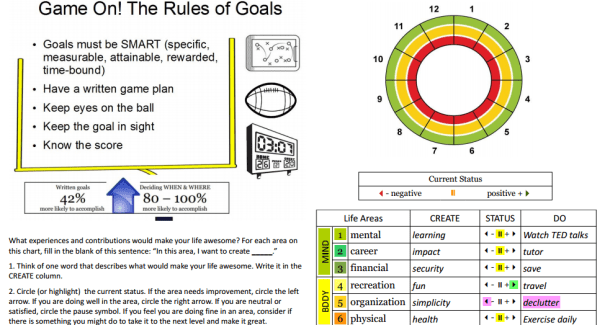
  1. Goals must be SMART (specific, measurable, achievable, rewarded, and time bound.)
  2. Goals must be written.
  3. Players must choose which strategies will likely gain the most points.
  4. Players must know the steps to take and have a game plan of action.
  5. Players must be prepared to make decisions and change direction when obstacles are encountered.
  6. Players must take action to advance toward the targets.
  7. The desire to achieve the goal must outweigh opposition.
  8. Players must keep the goal in sight, and always be aware of where the ball is on the field.
  9. Players must always know how much time is left on the clock and review progress regularly.
  10. Outstanding players develop skills and are determined to win.

Learn more with the Daily PlanIt eBook, “Get Goaling.”

Posted in goals

Keep Calm and Get Goaling

Worried about all you need to get done? Don’t know where to start?

KeepCalm

Begin with posts on how to choose goals, and make goals SMART. Learn more with the Daily PlanIt eBook, “Get Goaling!”

Posted in goals

Choosing Goals

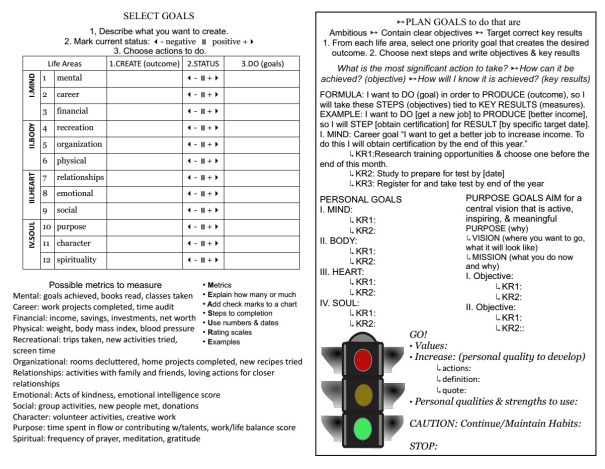
It is clear that having goals is important to our happiness. But how do you choose the right goals? There are so many options for goals! The method I use to choose personal goals during an annual review is an effective way to see which life areas need to be improved. It’s simple to: 1. Describe what you want to create (outcome) 2. Mark the current status as negative, positive, or neutral, and 3. Choose actions to do to improve the life areas with a negative status.

I then choose one personal goal from each life area of I. Mind II. Body III. Heart, and IV. Soul to focus on. For each of these I choose next actions to do that are tied to measurable key results. I include core values, a personal quality to develop, and strengths. There are habits that I want to maintain, and a place for things I want to stop or do less of. I also select and plan purpose goals that AIM for a vision that is active, inspiring, and meaningful. To plan personal goals, download the latest version of the Goal Shift Chart pdf with possible measures and examples of objectives and key results.

SelectPlanGoals

A previous version of The Goal Shift Chart pdf includes the Rules of Goals to help you create a game plan to reach your goals.

goalshiftchartColor

Here’s how to use the Goal Shift Chart:

Begin by asking “What will make my life awesome in this area?

What experiences and contributions would make your life awesome? Choose your most important and meaningful goals to focus on the shift you want to create. For each area on this chart, fill in the blank of this sentence: “In this area, I want to create _____.”

1.  Think of one word that describes what would make your life awesome. Write it in the CREATE column. This is simply an exercise to generate ideas, so don’t worry too much about where something fits or if you can think of a word for every area.

2. Circle (or highlight) the current status. If the area needs improvement, circle the left arrow. If you are doing well in the area, circle the right arrow. If you are neutral or satisfied, circle the pause symbol. If you feel you are doing fine in an area, consider if there is something you might do to take it to the next level and make it great.

3. For each area put a specific action to do that will create what you want in the DO column. There can be many different ways to achieve your goals, here are some ideas for goals. If your goal is to create strength in the Physical area, your DO might be weight lifting. Notice that these goals are not yet SMART.

4. Review the actions to do and highlight your top two or three priorities to focus on.

5. Take the actions that will create what you want to change the negative left arrows to positive right arrows.

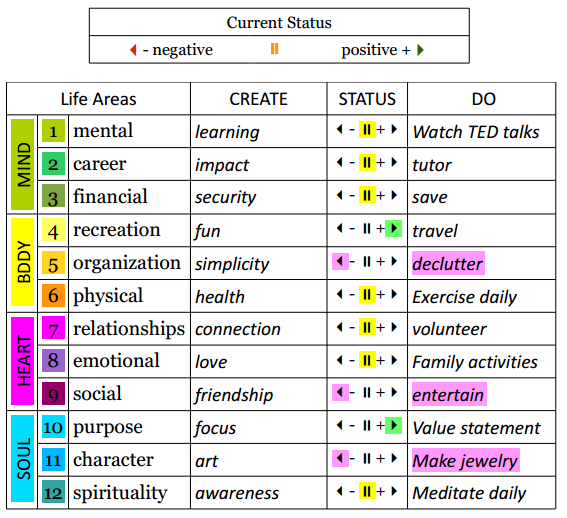
Here is an example:

goalshiftchartexample

There are several areas to maintain, and a few could be shifted from fine to great. But it’s pretty clear where to get started. The next step is to make your goals SMART. The video below describes this exercise, learn more at Map Your Values.

Download the Goal Shift Chart (pdf) and make positive shift happen!

For a more in-depth status report, check out the energy level gauge. To learn more about goals: review How to Set Goals, find ideas for goals at the Goal Plans tab, or consider getting my ebook, “Get Goaling: the simple guide to set and achieve your goals.”

Posted in goals, videos

Eight Reasons Why I Love Planet Fitness

https://i0.wp.com/www.pfstore.com/SiteData/Products/3_118391_151553_ilovepf-L.jpg

Reasons why I love Planet Fitnessplanet-fitness:

1. Convenience – It’s handy.

2. Price – pretty much flat-out unbeatable. They even gave me a t-shirt when I joined.

3. They made it easy to commit.

These first three are pretty basic things consumers always consider whenever they make a choice.

But they’ve gone beyond this to enhance the user experience.

4. There are rows and rows of great equipment. I’ve never had to wait for a machine yet. And I’m not too worried even with a likely influx of customers in January.

5. They have a cool water fountain that makes it easy to refill a water bottle.

6. With many of the machines, you can plug in earphones to listen to a channel of your choice on the rows of televisions. This has been a major motivator for me to keep pedaling, as I get involved in a show and want to see what happens. I love the HGTV channel which we don’t get at home, so it’s  built in motivation. Today, for the first time, they were having technical difficulties and the televisions were down. Oh, no! Well, I was going to listen to my mp3 player until I discovered the battery had died. OH, NO!! I was looking at an interminable 30 minutes of torture. (My goal is 30 minutes on the elliptical a day.) Never fear, all was not lost.

7. Planet Fitness has their own channel going, on a centrally located television. They play little tidbits about movies, reminders and ads for their upgraded service (which includes access to massage chairs among other things), but mostly they play music videos with a good beat to exercise to. In this way, I have learned about artists I might never had heard otherwise. Even while watching other channels, you can hear the Planet Fitness channel in the background and notice some really good music. I learned about the wonderful song “Brave” by Sara Bareilles this way. Today, my workout was saved by this channel which was still available, and I had to smile at the dancing chicken in “Dance Our Tears Away” by John DeSohn. (warning: there is a very brief view of what I think would be called twerking, hopefully not too offensive!)

8. Because Planet Fitness keeps me on target, I reap the benefits of a good workout. There’s something about getting the blood pumping that gets ideas flowing and keeps you feeling great!

What businesses do you love for the way they add value?

P.S. I do have an idea for Planet Fitness to consider. How about pay-per-use for a massage chair? Or even better, one free massage chair use after so many visits?!

Posted in Ideas That Work

Are Your Resolutions SMART?

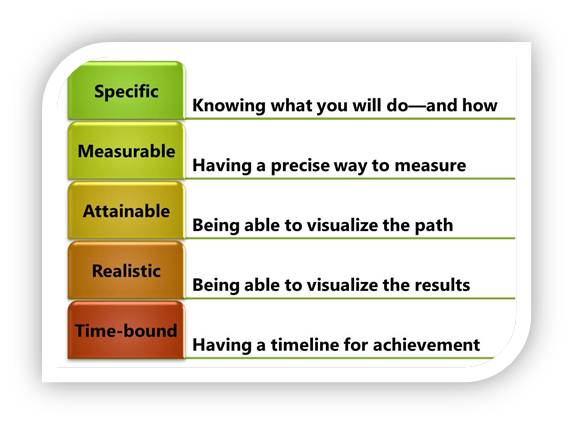
New Years Resolutions are usually not SMART. If you’ve read anything about goals at all, you probably have seen that they should be SMART: Specific, Measurable, Achievable, Realistic, and Time Sensitive.

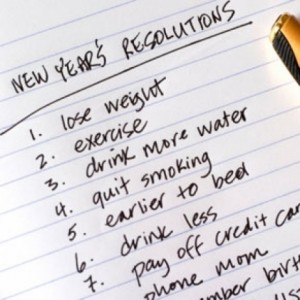
SMART-GoalsLook at a list of common New Years Resolutions, and you’ll see something like this:

  • Exercise more
  • Eat a healthy diet
  • Quit smoking

top-10-new-years-resolutions-300x300

Nope, they just aren’t SMART. They are not worded in a way that is specific and measurable. They provide no guidance, no concrete plan of action. It’s no wonder we so frequently fail to keep them! So how do you turn a vague resolution into a SMART goal?

Here’s an example of a formula to set a SMART goal for losing weight from the Daily PlanIt eBook, “Get Goaling.”

I will [do what] lose weight [how much] ____ lbs by doing [what] aerobic exercise [when] every morning [for how long] 30 minutes [measured by] target heart rate [by when] by target date of two months from today.

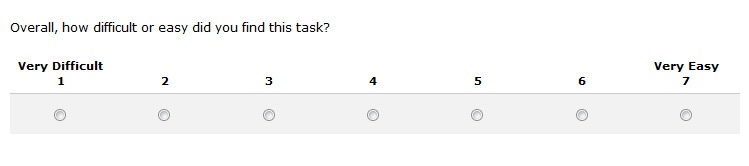
You can use this formula to make any goal SMARTer. Some goals are more abstract and downright hard to measure. Usually a rating scale can help.ratingscale

Top 10 New Year’s Resolutions from Nielson.com.

smokefree.govIf your goal is to quit smoking, check out smokefree.gov, which is packed full of detailed helpfulness, including apps and a texting service. It helps you with specific steps you need to take to accomplish the goal, like:

  • Choose a method to quit smoking
  • Buy any tools (nicotine patches, electronic cigarettes) you choose
  • Get rid of all cigarettes
  • Make a list of reasons you want to quit smoking
  • Avoid environments that will lead to cravings
  • Distract yourself w/other activities

Look for more ideas for Goal Plans and use the formula for making goals SMART from the Daily PlanIt eBook, you can be on your way to “Get Goaling.”

Habits

Many resolutions involve changing or establishing habits. Get habit trackers and learn strategies for habits at Make Good Habits Easy, and Bad Habits Hard.

Setting Resolutions is often a part of an Annual Review.

Learn more:

Posted in goals

Get Goaling!

GoaleBookI’ve gathered all the information you need to set and achieve your goals into my eBook “Get Goaling: the simple guide to set and achieve your goals.” This clear, concise, step-by-step guide gives you the tools to learn the skills and get goaling quickly.

Here’s the Table of Contents & what you will learn:

  1. Why Goals – why it is important to set written, measurable goals.
  2. Map Your Values – a simple exercise to map your values makes it easy to see where to begin.
  3. Goal Ideas – ideas for commonly chosen goals.
  4. Generate Ideas – ways to generate (and capture) ideas.
  5. Evaluate Goals – how to choose goals that will add value in each life area.
  6. Make Your Goals SMART – how to develop a plan to make goals SMART (specific, measurable, achievable, realistic, time sensitive) I’ll share a formula that makes creating SMART goals a snap. An example shows how to break big goals down into doable steps.
  7. Plan Goals and Projects – how to plan goals and projects, and make time to work on them.
  8. Rewards – how to choose a reward to match the size of your goal.
  9. Target Dates – The difference between long and short range goals, how to set target dates.
  10. Keep Goals Visual and Visible – ideas to keep goals visible and visual.
  11. Take Action and Maintain Motivation – tips to inspire you to get going on your goals. There’s even a goal music playlist.
  12. Monitor Progress – how to monitor progress with a weekly review, how to plan weekly and daily to make progress toward your goals.
  13. Setting Work Goals – how to set work goals.
  14. Develop Goal Skills – eleven Goal Skills to master.
  15. Conclusion – summary of the steps for setting goals.
  16. Appendix A – Goal Charts And Goal Master List-tools to track your progress and keep your goals visible.

timetargetAs the new year approaches, it’s the perfect time to review and plan. Get Goaling now!

Posted in goals

Personal Branding for a Purpose

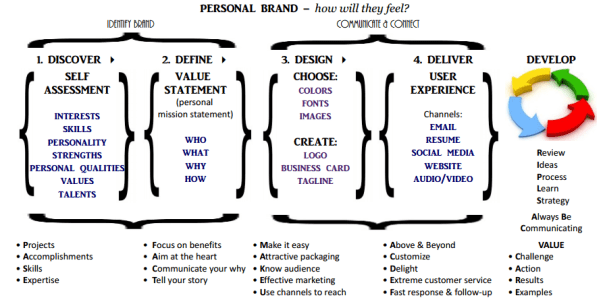
The process of discovering your personal brand clarifies what you are passionate about, how you want to add value, and how you will communicate that. Marketing U involves four steps:

  • Discover a compelling purpose
  • Define a clear promise
  • Design a creative personality
  • Deliver a consistent position

Download a pdf of the Personal Branding Process

Gain a clear understanding of the projects that are most important to you by investing the time and effort to reveal your personal brand. Read my article, “Personal Branding for a Purpose” at Productive Magazine to learn more about the process.productivemag

Learn more at the Brand and Purpose Toolkit and Personal Branding at Pinterest

Tagged with: , ,
Posted in goals, personal development, productivity

Free Printable Year of Personal Growth 2014 Calendar

Download a free printable calendar to start the year with weekly activities for a year of personal growth!
2014CalendarImage

Created with calendars from www.wincalendar.com/

Posted in personal development, productivity

On Batteries and Energy

My laptop computer battery was dead, and could not function without being plugged into current. I recently installed a new battery, for greater workflow functionality. If I forget I’m not plugged in and the battery wears out, my computer suddenly crashes without warning. How I wish it would give me even the smallest sign that it’s time to plug in and recharge, before the screen suddenly goes blank, leaving whatever I was working on somewhere out there! I know the importance of frequently saving work and ideas to avoid their permanent loss, but inevitably something vital falls into the void. A computer or cellphone with a dead battery just isn’t able to function when you may need it most.

It occurs to me that there are parallels in this story to the energy we all need to function well. How long does your battery last, and how do you re-charge? (the things we are thankful for often re-charge our energy) Do you have an early warning signal when your battery gets low?

Posted in personal development, productivity
eBooks

Enter your email address to follow this blog and receive notifications of new posts by email.

Archives
Blog Stats
  • 743,691 hits