Keep a Screen Time Log

Recreational – Activity: Keep a Screen Time Log

How much time do you spend watching television, at your computer, playing video games, or on a cellphone? How much of that time increases either productive use of your time or quality recreation? Sometimes screen time can add to our lives with educational or highly entertaining programming. However, it may be a surprise to discover how much of your time is spent on screen time, and what a small percentage of that time contributes to quality recreation.

Too much screen time can have a negative effect on:

  • productivity
  • quality recreation time
  • health

This week, I will keep a screen time log to track how much time I spend this way. I will evaluate this information, and next week reduce screen time and use that time for quality recreation.

This is one of the weekly activities for a Year of Personal Development.

Posted in Year of Personal Growth

Choose the Best Recreational Activities

Recreational – Activity: Choose the Best Recreational Activities

Recreation is an important part of a well balanced life. Be sure to use precious leisure time on activities that you most enjoy. This week, do this exercise to help you choose quality leisure activities. Then schedule time to do your top activity.

Sharing fun activities helps us stay connected and relate with others. One way to do this is to choose activities from a seasonal bucket list.

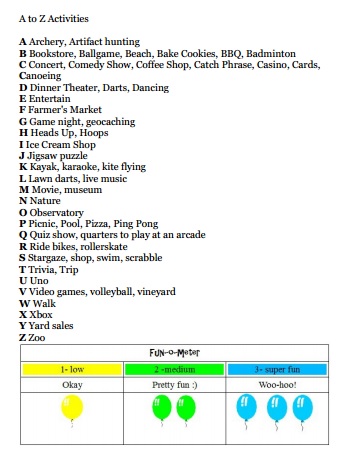
or a list of Activities from A to Z

A-ZActivities

Download the Seasonal Bucket Lists (pdf) with bonus A to Z Activity list & Fun-O-Meter. Another list of recreational activities at Quality Leisure. Learn more at the Positive Shift Happens Toolkit.

This is one of the weekly activities for a Year of Personal Development.

Posted in Year of Personal Growth

Develop Work Skills

Career – Activity: Develop Work SkillsTop 10 Skills and Qualities Employers Want

There are many skills that are important for work.

Four Steps to Explore Skills

This week, I will choose one work skill to improve, and set a goal for developing it.

Resources

Websites to Develop Work Skills

More from the Daily PlanIt

This is one of the weekly activities for a Year of Personal Development.

Posted in work skills, Year of Personal Growth

Set Work Goals

Career –  Activity: Set Work Goals

Planning goals for work adds meaning to an important part of our lives. There are ways that employees can take charge to shape their engagement at work, and a good way to do so is to set meaningful work goals. A lot of time is often spent at work, and work that is meaningful goes a long way toward increasing personal happiness.

Work goals provide:

  • Growth- choose goals with the right amount of challenge and stretch
  • Opportunities- goals open up opportunities for advancement
  • Autonomy- goals are a way to influence our work
  • Learning- include learning as one of your work goals
  • Skills- goals can develop work skills

To set work goals:

  1. Begin with a look at your job title (role) and job description (responsiblities and job duties) Find job descriptions at O*NET
  2. Review the mission statement of the organization
  3. Examine ideas for work goals that are STARS ↴
  4. Add learning activities to develop work skills for a development plan
  5. Decide on top priority goals ↴

Examine ideas for work goals that are STARS:

  • Select goals that align with the mission of the organization and your personal values
  • Tie in with motivation related to your Myers-Briggs Personality Type
  • Add high value by meeting the needs of the organization
  • Relate to the key results and tasks that need to be accomplished for your job
  • SMART – Specific, Measurable, Attainable, Relevant, and Time Bound

Decide on Top Priority work goals. The best work goals are HUGE! They:

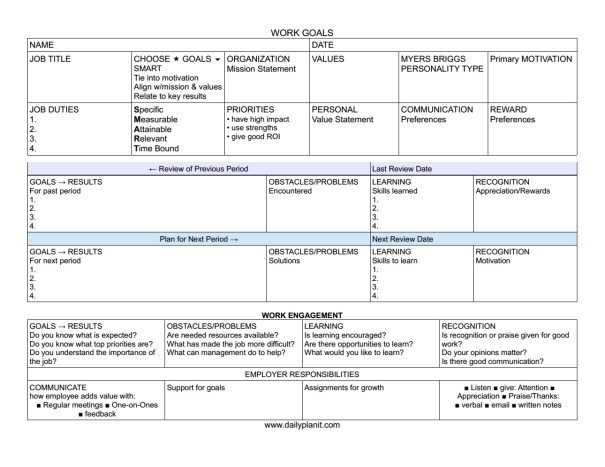
WorkGoals

Use the Work Goal form at the Daily PlanIt Shop or the free Work Goals form at Development Plans are Not Just for Work.

This week, I will set four measurable goals that will add value to my work with a Work Goal Form.

Work Engagement

Increase work engagement with work goals that provide antidotes to job misery. The opposite of work engagement is described in a book by Patrick Lencioni, “Three Signs of a Miserable Job,” which are:

  • Anonymity
  • Irrelevance
  • Immeasurement

Three Remedies to job misery are work that provides RECOGNITION, RELEVANCE and RESULTS. Setting work goals helps to meet most of the needs that require satisfaction for employee engagement.

RELEVANCE: Work goals that are relevant to the mission and goals of the organization, and align with personal values create a sense of purpose.

RESULTS: Include metrics to measure results.

RECOGNITION: The final key for an engaged employee is recognition, preferably tied to results, i.e. relevant goals achieved.

Employers can go a long way toward meeting needs for appreciation by simply providing praise for a job well done, or verbal or written thank-yous. Communication and Feedback are essential.

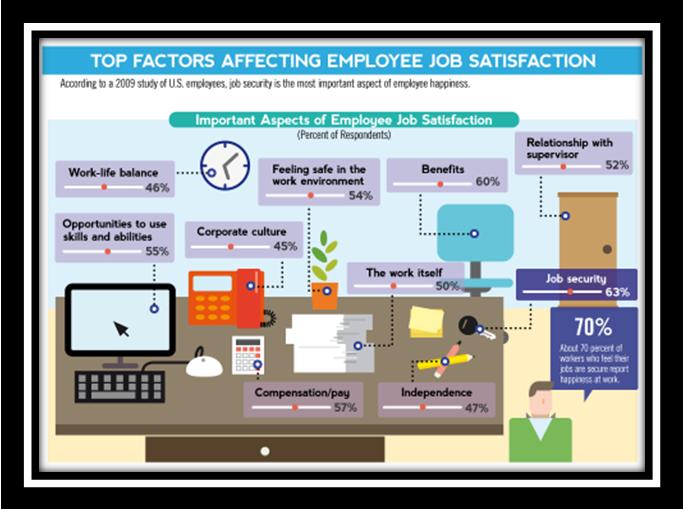
See also: What Employees Say They Want | Top 10 Things Employees Want | Career Goals Examples from the Udemy Blog.

More from the Daily PlanIt: Develop Work Skills | Development Plan | Work Engagement Board at Pinterest | Work Skills ToolkitWork Goals at the Daily PlanIt Stiky Wiki

This is one of the weekly activities for a Year of Personal Development.

Tagged with: ,
Posted in work skills, Year of Personal Growth

Write a Cover Letter and Prepare for Interviews

Career -Activity: Write a Cover Letter and Prepare for Interviews

A cover letter is an important tool in the career search process which allows you to introduce yourself and target your qualifications to the job opening.

Prepare for Interviews:

The day of the Interview:

Follow-up with a Thank You note.

This is one of the weekly activities for a Year of Personal Development.

Posted in Year of Personal Growth

Update Your Resume

Career  – Activity: Update Your Resume

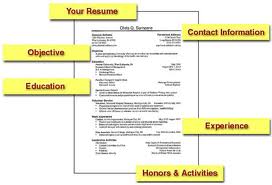
Knowing how to create a resume that will have the best possible positive impact in the search for a job is a career skill that is an important part of the career search process. This week, create or review your resume to be sure the content and appearance enhance your chances of obtaining a great job. A video from Illinoisworknet provides a good overview of what to do.

Appearance:

  • What format is the best choice? Make a decision between Chronological, Functional, or a combination. The Chronological format is generally preferred by employers.
  • Does it look good? Do you make good use of white space, fonts, bullets and lines to organize and emphasize? Is it good quality printing and paper? It’s usually best to keep resumes to one page.

Content: Gather information to type with a printable form from careerchoiceguide.com.

  • Many of the steps to Discover U provide helpful information to include in your resume: Identify your strengths, Explore your skills, Look at your values, and Uncover hidden talents.
  • Is all information current? Is everything spelled correctly?
  • Is information presented positively? Use action verbs, write clearly and concisely.

Outside the Box: Venturing beyond traditional advice is the visual resume (visualcv.com), or video resume.

Tools:

This is one of the weekly activities for a Year of Personal Development.

Posted in Year of Personal Growth

Do a SWOT Analysis

Career  – Activity: Do a SWOT Analysis

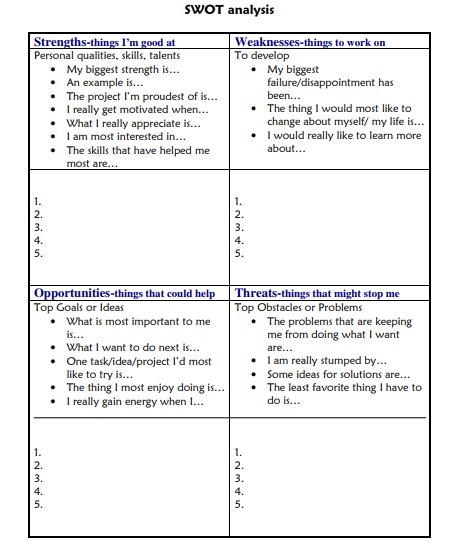
This week, do a personal SWOT analysis: A SWOT analysis is a tool to gain clarity by looking at strengths, weaknesses, opportunities, and threats.

SWOT

The Daily PlanIt SWOT form (pdf)

STRENGTHS

1. list your top five personal qualities (or character traits), skills and talents.

WEAKNESSES

2. then list five strengths you would like to develop.

OPPORTUNITIES

3. Next list your top five goals or ideas

THREATS

4. then the top five obstacles or problems you are facing.

More SWOT analysis forms:

Another similar tool is SOAR, which looks at strengths, opportunities, aspirations, and results.

More tools at Identify Strengths and Pinterest board on Strengths

Brand and Purpose Toolkit

This is one of the weekly activities for a Year of Personal Development.

Tagged with:
Posted in Year of Personal Growth

Save Money and Spend Wisely

Financial – Activity: Save money and spend wisely

If you have a savings account, use it to save money for goals. If you don’t, get one so you can. Calculate how much you need/want to save to reach your goal and use a chart to measure your progress. Look into ways you can save money. Simplify your life with ideas from Zen Habits to save money.

Understand the difference between wants and needs.

  • NEEDS = Basics for living
  • WANTS = Wishes beyond Basic Needs

Make a printable list of questions to ask before buying, keep it with you, and refer to it before spending money. (see this Pinterest Board) Research every major purchase before making a decision with resources at your local library like Consumer Reports, car value guides, etc.

Tools:

For Saving:

Financial Literacy Course and more at Money For Goals post

This is one of the weekly activities for a Year of Personal Development.

Tagged with:
Posted in Year of Personal Growth

Goal Master List

A Goal Master List is an important way to keep your goals visual and visible. I’ve created some different versions to choose from.

My current favorite is the Goal Shift Chart at Choosing Goals, which is a simple way to identify top priority goals.

The Goal Chart at Goal Worksheet includes actions and targets.

Metrics can be tracked with the goal charts below, a Seinfeld chart, habit tracker, or annual review metrics chart.

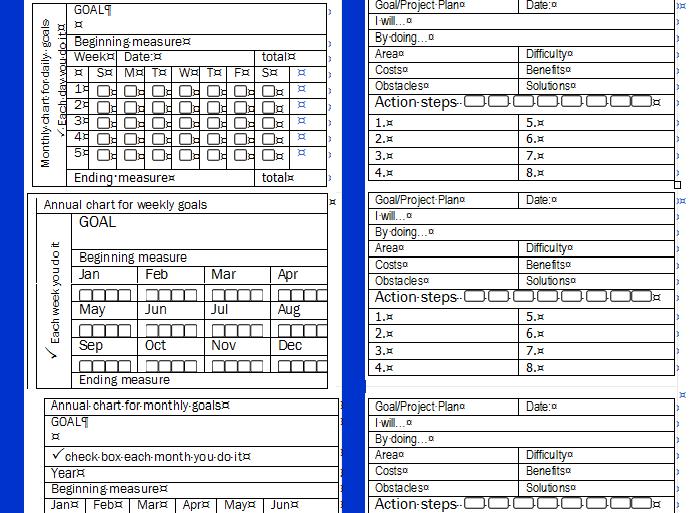
Is your goal daily, weekly, or monthly? Use the appropriate Goal Chart (pdf) to track your progress and keep your goals SMART and visible and visual.

goalchartcards

Examples of different goal frequencies:

  • daily: I will drink eight glasses of water every day.
  • weekly: I will increase time with family by spending at least 30 minutes each week one-on-one with each person doing an activity of their choice.
  • monthly/yearly: I will save $1200/year by making a $100 deposit in my savings account every month and track with a chart to reach the target date of twelve months from today.

Is it a resolution, a habit, or a goal?

The first two examples are resolutions, or habits. There is no end point, they are on-going actions you intend to continue. Once they become a habit, they are easier to maintain.

There are many habit tracker apps to choose from. You can also use a calendar or printable tool to follow Jerry Seinfeld’s Don’t Break the Chain Strategy.

The last example is a goal: it has a clear end point, and you know when it has been accomplished. The Goal Plans are a mixture of goals with an end point, and resolutions or habits.
GoalMasterList

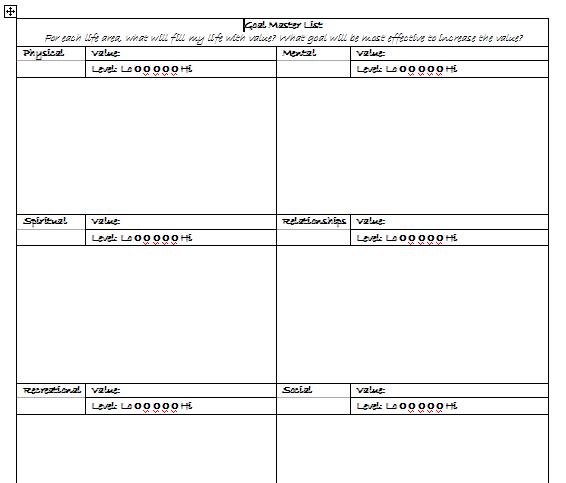
This Goal Master List (pdf) makes it easy to see what will add value in different life areas, which value levels are lowest (and therefore highest priority), and what goals will be most effective to increase value.

A 3 x 5 foldable version of the Goal Master List with goals plans to keep with you. (pdf)

Remember to do a regular review of goals.

Learn more about goals: review How to Set Goals, or consider getting my ebook, “Get Goaling: the simple guide to set and achieve your goals.”

Tagged with: ,
Posted in goals

Check Your Credit Report

Financial – Activity: Check Your Credit Report

It’s important to check to see if the information on your credit report is accurate, and monitor for identity theft. You are entitled to one free annual credit report per year. AnnualCreditReport.com is the only authorized source for a free credit report. It’s easy to do. If you haven’t done it this year, do it this week.

While you’re waiting for your report to arrive…

Learn more about using credit wisely:

Opt out of receiving credit card offers (which should always be shredded) at https://www.optoutprescreen.com

This is one of the weekly activities for a Year of Personal Development.

Posted in Year of Personal Growth
eBooks

Enter your email address to follow this blog and receive notifications of new posts by email.

Archives
Blog Stats
  • 742,842 hits