Goal Master List

A Goal Master List is an important way to keep your goals visual and visible. I’ve created some different versions to choose from.

My current favorite is the Goal Shift Chart at Choosing Goals, which is a simple way to identify top priority goals.

The Goal Chart at Goal Worksheet includes actions and targets.

Metrics can be tracked with the goal charts below, a Seinfeld chart, habit tracker, or annual review metrics chart.

Is your goal daily, weekly, or monthly? Use the appropriate Goal Chart (pdf) to track your progress and keep your goals SMART and visible and visual.

goalchartcards

Examples of different goal frequencies:

  • daily: I will drink eight glasses of water every day.
  • weekly: I will increase time with family by spending at least 30 minutes each week one-on-one with each person doing an activity of their choice.
  • monthly/yearly: I will save $1200/year by making a $100 deposit in my savings account every month and track with a chart to reach the target date of twelve months from today.

Is it a resolution, a habit, or a goal?

The first two examples are resolutions, or habits. There is no end point, they are on-going actions you intend to continue. Once they become a habit, they are easier to maintain.

There are many habit tracker apps to choose from. You can also use a calendar or printable tool to follow Jerry Seinfeld’s Don’t Break the Chain Strategy.

The last example is a goal: it has a clear end point, and you know when it has been accomplished. The Goal Plans are a mixture of goals with an end point, and resolutions or habits.

GoalMasterList

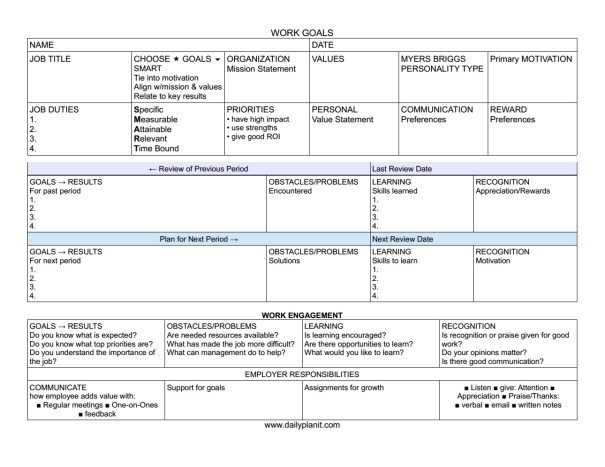
This Goal Master List (pdf) makes it easy to see what will add value in different life areas, which value levels are lowest (and therefore highest priority), and what goals will be most effective to increase value.

A 3 x 5 foldable version of the Goal Master List with goals plans to keep with you. (pdf)

Remember to do a regular review of goals.

Learn more about goals: review How to Set Goals, or consider getting my ebook, “Get Goaling: the simple guide to set and achieve your goals.”

Tagged with: ,
Posted in goals

Check Your Credit Report

Financial – Activity: Check Your Credit Report

It’s important to check to see if the information on your credit report is accurate, and monitor for identity theft. You are entitled to one free annual credit report per year. AnnualCreditReport.com is the only authorized source for a free credit report. It’s easy to do. If you haven’t done it this year, do it this week.

While you’re waiting for your report to arrive…

Learn more about using credit wisely:

Opt out of receiving credit card offers (which should always be shredded) at https://www.optoutprescreen.com

This is one of the weekly activities for a Year of Personal Development.

Posted in Year of Personal Growth

Set up a Bill Paying System

Financial  – Activity: Set up a Bill Paying System

Systems are a way to organize repeating tasks. One task that repeats a lot is bill paying!

  1. WhatSteps you will need to take?
  2. Where-Keep all the tools you will need for the task in one place.
  3. When-Decide on the best time to tackle the task and schedule it.
  4. How-Will you pay bills online or with a more traditional method?
  5. Why-Keep the end results in mind. Many of the goals we want to reach require the resource of money.

This week I will decide when and how I will pay bills. I will gather tools I will need in one place and set up reminders.

see also: Track Bills, Organize Files

This is one of the weekly activities for a Year of Personal Development.

Posted in productivity, Year of Personal Growth

Budget Money & Track Bills

Financial – Activity: Budget money & Track Bills

Choose a budget form or worksheet:

Track Bills with

This week, I will choose a budget worksheet or form, and begin to track bills as I pay them.

This is one of the weekly activities for a Year of Personal Development.

Posted in Year of Personal Growth

Emotional Intelligence


Emotional awareness involves knowing how to identify your own feelings and recognize the emotions of others. Emotional intelligence increases when we gain the skills to manage our emotions and to connect with others.

5 skills to increase emotional intelligence:

  1. self awareness
  2. self regulation
  3. self motivation
  4. social skills
  5. empathy

Self awarenessnotice what you are feeling, thinking, and doing, to gain clarity and identify emotions.

Self regulationunderstand emotions are connected to thoughts, learn to pause and engage coping skills.

Self motivation – understand personality and motivation.

• Mastery, Autonomy, Purpose
• Observable outcomes
• Valued contributions
• Engage interest and energy

Social skills – know how to relate, communicate, and listen well.

↳ RECOGNIZE
Listen to understand
• Empathy ↴
• Ask questions
• Respond with feedback
• Notice body language

Empathy – understand the feelings of others.

• Consideration
• Appreciation
• Respect
• Encouragement

↳ CONNECT
Communicate
• Aim attention
• Reach out and share
• Engaging experiences

Emotional skills are part of a Year of Personal Growth:

Learn more about Cognitive Behavior Therapies at Creating Clarity.

Since Daniel Goleman published the book “Emotional Intelligence” in 1995, many more resources have become available to increase these skills. His TED talk, Why aren’t we more compassionate.(Amazon affiliate links provide a small commission that helps support the Daily PlanIt at no additional cost to you with a purchase. Thank you for your support!)

TED Talks and books (more at the Psychology and Clarity pathways and TED Talk Book Discussion)

More videos:

More resources:

More at the Coping Skills Toolkit. Learn more about how to make Positive Shift Happen.

Tagged with:
Posted in positive shift, Year of Personal Growth

Choose Love

Emotional – Activity: Choose Love

This week, I will choose loving actions. Every evening I will review my actions during the day and ask myself: “Were my actions today based on love?”

Actions that convey love express: Actions that destroy love express:
Attention Neglect
Appreciation Criticism
Support Lack of support
Encouragement Discouragement
Honesty Dishonesty
Communication Lack of communication
Understanding Misunderstanding
Joy Unhappiness
Freedom Control & manipulation
Clear boundaries Unclear boundaries
Respect Disrespect
Trust Distrust & doubt
Commitment Disloyalty
Caring Hurtfulness
Kindness Unkindness
Thoughtfulness Unthoughtfulness
Fairness Unfairness
Patience Impatience
ALL must be present for love to grow If ANY are present love is damaged

Understand that you are loved.

To love ourselves, we need to fully realize that we are loved simply because we are alive. A higher power is one completely reliable source of unconditional love. When you love yourself, giving and receiving love becomes possible.

Understand the Different Kinds of Love

Books

This is one of the weekly activities for a Year of Personal Development.
Posted in Year of Personal Growth

Manage Anger

Emotional – Activity: Manage Anger

Anger is a normal emotion that can cause problems when it is not handled correctly. We feel anger when we perceive unfair treatment, or are threatened or prevented from reaching our goals. When we handle anger correctly, we correct unfair treatment without harming others.

Anger and the Brain

Watch: Emotions and the brain and How the Brain Works with Anger

  • The amygdala (primitive brain) has an instantaneous response to fear or anger
  • A flood of chemicals creates physical reactions: increased heart rate, fast breathing
  • When anger takes over, the thinking part of the brain is no longer accessible. Rational thought is not possible until chemical flooding subsides
  • The body takes about 20 minutes to return to normal after a full fight or flight response. Psychology Today

SOS

Ways to manage anger

  • Learn to recognize the physiological responses that come with anger. These can include: headaches, a clenched jaw, flushed face, tense shoulders, a fast pulse and racing heart, fast and shallow breathing.
  • Take a mental pause to insert thought: Stop – Observe – Shift
  • Practice coping skills like deep breathing, taking a break, or going for a walk before proceeding.
  • Be aware of the feelings that are underlying the anger. Dr. Phil says, “Anger is nothing more than an outward manifestation of hurt, fear, or frustration.”
  • Re-frame: look at problems as challenges, check the validity of assumptions, dispute irrational thoughts.
  • Use I statements if you choose to express your feelings.
  • Don’t take things personally (see the 4 agreements)
  • Strengthen your self-esteem.

20Minutes.png

REMEMBER – the body takes about 20 minutes to return to normal after a full fight or flight response. Psychology Today

When someone else is angry

Resources:

Books (Amazon affiliate links provide a small commission that helps to support the Daily PlanIt):

Learn more at the Power of a Pause for Positive Shift

This week if I feel anger, I will notice physiological changes and take a mental pause to understand what caused the anger and how to respond. I will practice deep breathing and other calming techniques. I will use a worksheet to analyze a situation when I was angry.

This is one of the weekly activities for a Year of Personal Development.
Tagged with:
Posted in Year of Personal Growth

Express Emotions with I Statements

Emotional – Activity: Express Emotions with I Statements

Just as we have choices about how to interpret an event, and how to label emotions, we also have options about how to express feelings. Take EXTRA TIME to express emotions appropriately.

ExpressEmotions

First, evaluate the situation:

  • Evaluate how important it is to you
  • Xamine the likely results: can something be changed?
  • Think about whether the likely results are worth speaking up for.
  • Rational response: are feelings based on rational beliefs and thoughts?
  • Appropriate: clarify what you heard the other person say.  Sometimes our initial perceptions and interpretations aren’t accurate.

If you do decide to communicate your feelings, consider:

  • Timing: both people need the energy and ability to focus.
  • I statements: use a communication style that focuses on the feelings or beliefs of the speaker.
  • Manage voice: use neutral volume and tone.
  • Environment: choose a private and quiet place.

There are five elements of an I Statement to consider:

  1. Observations – state the facts, describe the situation
  2. Feelings – describe your own feelings
  3. Thoughts – about the effects of the situation
  4. Wants – ask clearly for what you want
  5. Intentions – tell what you plan to do

Example: “When you keep your phone out at dinner, I feel unappreciated. I would prefer it if we give each other our full attention while we have a meal.”

Own the emotion. Say “I notice that I am feeling ____.” Not: “I am ____.” or “You made me ____.” Susan David writes about the importance of accurately labeling and communicating emotions in her book “Emotional Agility.”

Before you speak, THINK:

  • T is it True?
  • H is it Helpful?
  • I is it Inspiring?
  • N is it Necessary?
  • K is it Kind?

SMART goal:

This week, I will decide if expressing emotions is the best choice in situations that arise. If I choose to express my emotions, I will use I statements. I will print a Five Message Worksheet (pdf) and use it each day. 

Tools:

This is part of a series on emotional intelligence, and one of the weekly activities for a Year of Personal Development. Emotional intelligence is one of the building blocks of positive shift that have been shown by research to increase happiness.

Posted in Year of Personal Growth

Understand Emotions

Emotional – Activity: Understand Emotions

Rational Emotive Behavior Therapy (REBT) is a form of cognitive behavior therapy developed by Albert Ellis. Learn more about Cognitive Behavior Therapies at Creating Clarity. With this method we gain an understanding of how our beliefs about events lead to our emotions.

Activating Event Beliefs  Consequences +

  • Activating Event
  • Beliefs
  • Consequences

If our beliefs are based on irrational thoughts, consequences may be negative. But we can insert a mental pause with the SOS method to ask questions and choose more effective rational thoughts for a more positive outcome.

Ask Begin to dispute irrational thoughts  Choose effective rational thoughts +

Ask: Use the SOS technique to insert a mental pause to identify emotions and ask questions:

  • What are my feelings?
  • Am I seeing this clearly?
  • Is this a rational thought? Is it logical and reasonable?
  • Is it true? Is it accurate?
  • What are the facts? Is there evidence?
  • Am I exaggerating or over-reacting?
  • Am I mistaken to take this personally?
  • Is this an overly pessimistic view?

Begin to dispute irrational thoughts. Some common cognitive distortions:

  1. All-or-Nothing Thinking
  2. Overgeneralizing
  3. Discounting the Positive
  4. Jumping to Conclusions
  5. Mind Reading
  6. Fortune Telling
  7. Magnifying (Catastrophising) or Minimizing
  8. Emotional Reasoning
  9. Should Statements
  10. Labeling and Mislabeling
  11. Personalizing

Choose to substitute effective rational thoughts:

  • feelings are caused by beliefs and thoughts, not by events
  • not everyone will love me
  • nobody is perfect
  • there are reasons for behavior
  • the universe wasn’t created for me
  • worry is not helpful (but planning can be)
  • facing problems is better than avoidance and denial
  • learn from the past while moving forward
  • change is possible

This week, I will notice how my feelings, beliefs and thoughts are connected. I will print an REBT self help form and use it each day. I will replace irrational beliefs and thoughts with rational ones.

ABCirrational-rational

Download the ABCs of REBT worksheet (pdf) Watch a video about the ABCDE Model. (6:35)

Knowing what you are thinking is a part of Creating Clarity. One of the Four Agreements is to Be Impeccable With Your Words. Uplift yourself with honest self-talk using REBT.

learn more about understanding emotions:

This is one of the weekly activities for a Year of Personal Development and part of the series on emotional intelligence.

Posted in Year of Personal Growth

This Emotional Life

This Emotional Life information and series on PBS is a great resource on emotions.

Posted in Year of Personal Growth
eBooks

Enter your email address to follow this blog and receive notifications of new posts by email.

Archives
Blog Stats
  • 744,047 hits