

A Tutorial for Increasing Productivity

The System
- Select a calendar to manage your time, tasks, and lists.
- Your choice – choose what works best for you.
- Start with a To Do list and set priorities to complete the most important tasks. ↴
- Then add other lists that you need, and decide where you will keep them.
- Lists for the GTD system include: Next Actions, Maybe/Someday, Waiting For.
- Essential goals and projects to keep track of.
- Make lists of repeating tasks.
Possibilities:
- Some people simply use notebooks or other paper tools. Explore free printable tools here.
- Many productivity apps are available for smartphones and tablets.

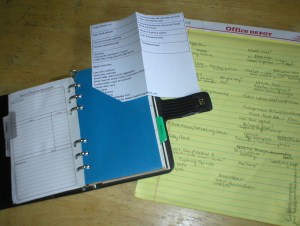
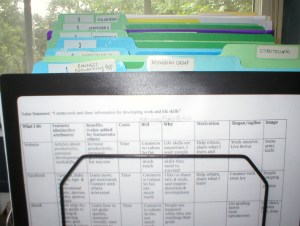
- The Daily PlanIt Keep It Super Simple (K.I.S.S.) System relies heavily on Google (plus a few apps) is accessible across platforms (computer, tablet, and smartphone) and allows printing lists. (here’s a look at my system and workspace)
- Systems vary from simple like Zen to Done, to the more complex Getting Things Done, or GTD.

The Focus
- Get enough rest to be alert and aware of how you are spending your time. Know the value of time and Make Today Count!
- Reach for significant goals that AIM for an Active, Inspiring, and Meaningful vision
- Access your strengths to gain motivation
- Explore creativity
- Target procrastination triggers
- Follow values to set priorities ↴
- Observe outcomes and notice the feedback.
- Concentrate and feel the flow
- Use routine ↴
- Stop external & internal distractions – eliminate or reduce time wasters like procrastination as much as possible. Set up a workspace that helps you focus as much as possible, and avoid multi-tasking.
• Adjust direction by embracing values
• Clarify what is important – gain direction with a value statement that pinpoints what you do and why (the power tool for purpose). It includes how you add value based on what your values are.
• Target GREAT priority tasks to say YES to:
- Give big impact
- Requirements that are urgent
- Extend high engagement
- Are important
- Target good return on investment
Four Fantastic Tools for Focus

The Plan
Use your system to:
-
- Plan for the day: schedule, add and delete tasks, review and plan for tomorrow.
- Look at your calendar and tasks, plan projects and goals and evaluate them.
- Act on top priorities to Get Important Stuff Done.
- Navigate peak time and energy
- Take time for a Weekly Review and Plan, Break large tasks down.
- Include a Monthly Review.
- Manage activites, spaces, and information with four activities: evaluate, simplify, increase effectiveness, and increase efficiency.
- Examine results during an Annual Review.

The Routine
- Follow a daily routine based on the Science of Productivity to automate things you do every day. Daily themes and time blocking can be helpful. Include music and inspiration in your routine to keep you motivated and happier.
- Do a time audit and use peak time for your most important tasks.
- Remind yourself of tasks with timers, alarms, and/or a tickler system.
- Manage your focus. Be aware of the Pareto Principle, and maximize your use of available free time. (more on focus above)
- Manage your energy. Take breaks in a rhythm that works for you: the Pomodoro technique has short breaks after 25 minutes, the 90/20 rule advocated by Tony Schwartz is based on Ultradian rhythms, or Peter Bregman’s 18 minutes with a short break each hour during the workday.
- Learn more to master skills at Productivity Levels, the Study of Productivity, & Learn about Productivity.
Get Organized
- Manage email.
- Organize the information you need in files.
- Set up a bill paying system and process paperwork.
- Set up a Household Notebook.
- Organize recipes and menus to plan meals.
- Eliminate clutter and unnecessary stuff.

Goals and Productivity are like peanut butter and jelly. To spend your time where it most matters to you, begin by setting goals that align with your value statement or Unique Selling Proposition. Learn how to set goals and achieve them with this free tutorial. Learn more with the Daily PlanIt eBook “Get Goaling”
“Efficiency is doing the job right. Effectiveness is doing the right job.”-Peter Drucker

Tools for Productivity (hint: see Free Tools)
Daily
- Calendar: appointments, meetings, special dates to remember-dates and deadlines
- Daily to-do List: items from calendar, repeating tasks, action steps from goals. Take action today
- Master list: things you need to do, remember, plan, discuss-no due date
- Idea File-to think about, possibly act on later
- Follow-up System: either a tickler file or calendar/holding file-future action required
Weekly
- Weekly Review: Gather information together
- Weekly Plan: items from calendar, repeating tasks, goal and project plans, schedule items from Master List
- Goal and Project Plans: action steps, target date, rewards, return on investment
- Goal Master List: top priority goal in each life area
 Learn about the study of productivity, with videos and courses
Master Productivity: Productivity Levels (pdf based on posts at The 2Time Mgt Blog)
MORE RESOURCES
- Successful Person’s Guide to Time Management (pdf) from University of Kentucky
- The Ultimate ADHD Guide to Time Management from the ADHD Nerd







 Daily PlanIt