
This message was sighted at a real church near me.

Amen.
Indexed is a blog made of index cards that often make me smile, created by someone with a quirky mind and sense of humor!
I’ve been reading “The Long Tail” by Chris Anderson, a fascinating look at how the Internet is changing the world. Before the Internet, products were confined by constraints of the physical world that created scarcity economics, a world where only the big hits were accessible. But now an abundance of products can be offered digitally at low expense, providing a huge amount of choice that leads to small but still productive sales to niche markets. We’ve seen this happen with Amazon.com, the online bookseller, and Netflix, which delivers movies to your home. No longer bound by the cost and constraint of a building or a geographic location, they can offer far greater choice, and people buy some of all of it. The amount of choice could be overwhelming, except they offer information that helps consumers make decisions.
Yet they still deal with physical products. Music is the area that has really been changing, as it can exist in digital form. Same thing with podcasts, which are simply audio files, and video podcasts which include video, that you can download. (Booked.tv has a helpful explanation of the differences.) Among other things, I’ve been exploring the possiblities of podcasts by listening to presentations by Tony Robbins at TED Talks, and a podcast about podcasting at Grasshopper New Media (I thought the jokes were great, Chris!) Lifehack.org has a post that says David Allen will be presenting Best Kept Secrets for Personal and Team Productivity, on Tuesday, October 10, 2006 1:00-2:00 PM EDT. It’s pretty exciting to have free access (at least in some areas) to many excellent online learning options that are available to you at your convenience, and the only travel involved is the trip from your kitchen for coffee to your desk.
With a personal computer and minimal equipment, anyone can make a book, video, or audio file. Many choose to do so, and some real talent shows up. In the introduction to the book, the following statistics made me sit up and take notice: most of the fifty best-selling albums of all time were recorded in the seventies and eighties, and none of them in the past five years. Hollywood Box-office revenue was down by more than 6% in 2005, despite a growing population. The top-rated TV shows are also from the seventies and eighties, as TV viewers scatter to cable or satellite channels, or spend their time on the Internet instead. TV produces more content than any other media industry, but it is limited by a 24/7 window and the number of available channels. Only a tiny fraction of this is available to you, even if you record some of it.
With social bookmarking tools like del.ic.ious.com, it’s possible for anyone to organize sites using the tags they choose with an unlimited amount of words. It’s far different in the physical world where there is only one predetermined space to place an item. In a world of abundance, with the tools to find what we are looking for, the options are many and time is an ever more precious commodity.
Here’s the original article from October 2004 in Wired Magazine.
Of all the skills involved in communication, one of the most critical is the ability to listen well. It is a vital element of both our work and personal lives, but it is not a skill that is often taught.
“We have two ears and one tongue so that we would listen more and talk less.” –Diogenes
We can listen at a faster rate (400 words per minute) than most people speak (about 125 words per minute), which makes it pretty easy for our attention to wander to other things. Add to that the many distractions that often exist, and it is no wonder that studies show that we’re distracted or preoccupied during about 75 percent of our conversations.
Many benefits come when you BEGIN to listen. Listening helps you to:
• Build relationships
• Excel at work
• Gain knowledge
• Increase enjoyment
• Navigate life
Be CLEAR to listen well:
• Concentrate attention
• Look to notice body language
• Evaluate emphasis in voice
• Ask questions to clarify
• Reflect and respond
“You cannot truly listen to anyone and do anything else at the same time.” –M. Scott Peck
Concentrate attention
Listening is focused attention. Think how well you would listen if someone was talking you through defusing a bomb! While it may not always be a matter of life or death, many mistakes are made through a lack of listening.
A large part of communication comes from body language and intonation.
“What you do speaks so loudly that I cannot hear what you say” – Ralph Waldo Emerson
Look to notice body language
The movements of our bodies convey meaning. Learn how to understand body language to interpret nonverbal messages communicated through posture • proximity • eye contact • expressions • gestures.
Evaluate emphasis in voice
The verbal part of a message includes both content (spoken words) plus voice (paralanguage) [clarity • rate • intonation • volume • pitch] Intonation can convey: Emotions, Attitudes, Sentence structure, or Exaggeration. To see how intonation can change meaning, read the following sentence repeatedly, each time emphasizing a different word: “I never said she bought that car.” For another example, “What a great idea,” said with a falling intonation is a compliment, with a rising intonation it is sarcastic.
Ask questions to verify understanding, reflect and respond:
• Reflect “how do you feel about that?” “So you feel…” “It sounds like you…”
• Ask “can you tell me more about that?” “do you mean…?”
• Paraphrase, summarize “let’s see if I understand what you’re saying.” “is that accurate?”
Practice active listening with a partner. Download the Listening Skills and Listening Report Card pdfs from the Daily Planit, then take turns discussing the topic “something I’m really proud of is…” First demonstrate ineffective listening, then effective listening. (one minute of each)

Book and TED Talk: I Want to Hear You by John Igwebuike, TED talk Strategies for active listening. (Amazon affiliate link provides a small commission that helps to support the Daily PlanIt)
More TED Talks: Conscious Listening, the sound of happiness, and 5 ways to listen better by Julian Treasure, The Power of Listening by William Ury, 10 Ways to Have a Better Conversation by Celeste Headlee
Watch videos: How to Improve Your Listening Skills from Litmos Heros (4:54) and a clip about active listening from Everybody Loves Raymond (3:00).
More places to learn listening skills:
Courses:
Learn more at the #1 Skill Employers Want: Communication.
Goal setting and time management belong together.
To achieve goals, it’s important to manage your time well. To manage your time well, you must know what your goals are. They are intimately inter-connected, yet few books address these two processes together.
Setting goals is the first step in time management. The next step is to figure out how to spend your time so that you are making progress toward your goals.
The nature of time.
Time is elusive. We attempt to measure it with clocks and watches, but cannot save it up for another day. Each day, we all receive the same amount of time. It can easily slip through our fingers despite good intentions, a treasure stolen away by procrastination, interruptions, and indecision.
Managing time is really about managing activities, spaces, and information. Spaces include physical areas like our homes, offices and desks and the objects within them. There are four ways to manage time:
Each day 24 hours is credited to our account. We all have fixed time expenses such as working, eating and sleeping. Usually there is some discretionary time each day as well, that we have more choice in spending. A well-balanced time budget includes time for yourself and time for those you love. You can monitor your time to evaluate if you are spending it well, and make adjustments if necessary. Learn more at Time Management 101, a tutorial for increasing productivity.
“The only true measure of what you believe is what you do, not what you say.” –Brian Tracy

Some of the ideas to make goals visual and visible inspired me to make the Sticky Wiki: a place for reusable “sticky notes” to move as needed into and out of daily tasks. You are cordially invited to edit pages if you want; the password is: today. I was looking for a plausible reason to make a ticket, and this is it!
Update: I continue to find more great sites and now add them in the sidebar links. Also, I’ve added a page of Personal Development Experts.
Here are my personal favorites for personal development:
Updated 1/14
A Tutorial for Setting and Achieving Your Goals

Setting goals and taking steps to achieve them is like setting the GPS for a trip; goals are like a map to get you where you want to be. View GPS for your life (slideshare).

This free printable Goal Roadmap (pdf) has the action steps to take to set goals effectively. Find it and lots more at the Goal Toolkit.
READY
Learn about setting goals with some great videos, TED talks, and books.
Keys to get started: Know Yourself. Discover U to uncover hidden talents and map your values.
Know your destination. Some goals are simply meant to improve life, while higher level goals pursue purpose and AIM for a vision to follow values. Both types of goals are important. Purpose planning will help to set goals that contribute to purpose. A value statement that targets what you do and why is like a compass that always points in the right direction.
SET
Fill ‘er up. Resources needed for goals include Time, Energy, Attention, Mind, and Money. Look at balance in life areas with the energy level gauge, a tool similar to a wheel of life.
Generate goal ideas and choose goals in different life areas. Find goal setting forms at the Goal Toolkit. Evaluate goals and choose top priority goals. End goals lead to a meaningful journey.
PLAN IT – Map your route
Write it down. The Science of Goals shows that written goals are 42% more likely to be accomplished. This is one of the Rules of Goals. Make goals SMART – Specific, Measurable, Attainable and Actionable, Relevant & Rewarded, Time-bound and Targeted.
GO!
Get in gear and act with agency. By definition, goals are challenging. The economy of goals means that the benefit of a goal must exceed the resources required to obtain it. Cultivate courage, confront fear, and choose a growth mindset. Know the procrastination triggers and ways to overcome them. Be clear about your objectives, the benefits of accomplishing them, and stay focused. Anticipate obstacles and solve problems. Manage time well, because goals and productivity are like peanut butter and jelly. The better you manage your time, the more you will have for reaching your goals.
STAY ON COURSE
Keep goals visual and visible. Post a goal master list of the top priority goal in each life area. Monitor progress with a regular review, and adjust steering as needed. Celebrate success when a goal is reached, and choose another goal.

Learn more:
Courses
TED talks and Books
Keeping goals visual and visible is an important step toward reaching them. It is so easy to get distracted by other things, and maintaining focus will make a huge difference in getting closer to the results you seek.
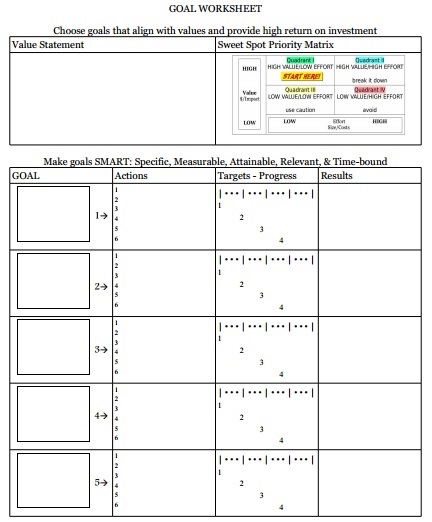
Post a Master List of your Goals – Use a Goal Worksheet, Goal Shift Chart, Annual Goal Chart, or other tools from the Daily PlanIt.
Here are some more ways to make goals visual and visible:
Tammy Cravit’s Post-It Portable Workspace
Write goal action steps on sticky notes to place between today’s date and the goal statement written on a piece of paper. -from the book “Time Management for the Creative Person” by Lee Silber.
David Seah’s Task Order-Up lines up action steps on a rail so you (and everyone else!) can see what’s next. You could also use index cards and magnets on a magnetic whiteboard.
Make or purchase a big whiteboard. Use it for a KanBan board.
Make your own visual thermometer. (video)
Make a chart to measure progress toward saving money or paying off a loan.
Make a treasure map of your goals from Mindtools.
Create a vision board.

Make a mind map with Mindmup
Make foldable goals to carry with you.
Daily PlanIt Goal Master List and Goal Charts
Print a Goal Master List from Buttoned Up.
Create a Wordle word cloud of your goal.
Set your top priority goal as a screensaver on your computer.
Make a video about your goal.
Write affirmations on your mirror with bar soap or washable window markers.
Planning and setting goals are like setting a gps for our life. With a regular review we take a look at how much progress we have made and if we are moving in the right direction.
Both Stephen R Covey (see Setting Priorities) and David Allen (author of Getting Things Done) advocate the importance of a weekly review. The weekly review is the way to monitor your progress towards acheiving goals and to take the time to plan. Choose a regular time for a weekly review that will work well for you.
Checklist for a Weekly Review

Download the Weekly Review Checklist pdf (see another weekly review checklist from Getting Things Done pdf)
10 Steps for a Weekly Review:
1. Review the past week – note major accomplishments and check for anything that needs to be followed up on. How does what actually happened compare to what you had planned? What went well? What didn’t go so well? Did you make the best use of your time?
2. Review your schedule for the upcoming week – What will you do next week? Look for room in your schedule to add tasks that will move your projects and goals forward, and add any repeating or recurring tasks that need to be done.
3. Review and update your to-do lists, keeping priorities in mind.
4. Review notes, whether in paper or electronic form
5. Empty voicemails and texts, delete or organize emails
6. Evaluate progress on your projects and goals – update and add more action steps as needed.
7. Review your value statement or unique selling proposition
8. Review ideas and decide if there are any you wish to take action on.
9. Clear desktop and other office areas.
10. File papers and back-up computer.
To recap:
Weekly Planning lets you see how the next week will look. You can see how busy it is, and quiet times where you can schedule additional tasks. The free printable Annual Planner at An Annual Review keeps you on track with forms to capture results of weekly and monthly reviews.
See also A Paper Planner Tool for the Weekly Review, the Weekly Plan, Planning is Thinking, and Planning.

Paper Planner Tool for the Weekly Review
Questions for the Weekly Review: Weekly Review Questions | Trigger Questions from Paauwerfully Organized (pdf)
Additional reading


 Daily PlanIt