All things phonics are moving to a new website: www.phonicspow.com…please join us there! The post that was formerly here can be found at Blends.

All things phonics are moving to a new website: www.phonicspow.com…please join us there! The post that was formerly here can be found at Blends.

All things phonics are moving to a new website at www.phonicspow.com…please join us there! The post that was formerly here is now at The 44 Sounds of English.

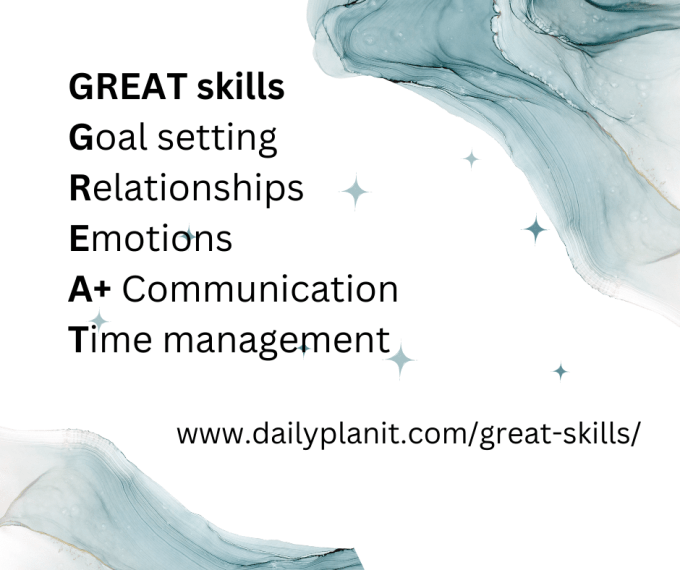
A gap commonly occurs when employers fail to find employees with the soft skills they are looking for in the workforce. Why? because the skills that are most in demand in the workplace are not often taught. We can change this! The GREAT skills I talk about are:
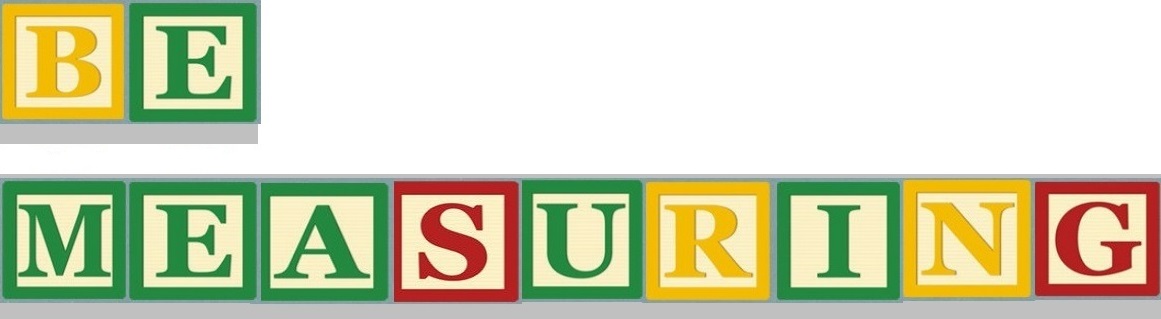
And I’ll tell you a secret. When you learn to follow the practices that research has shown will increase happiness and well-being, you also learn these great skills. Start with the building blocks of positive shift which spell BE MEASURING, and along the way you unlock potential and develop strengths to open doors to opportunity.
GREAT Skills Trading Cards:
Staying on top of cleaning chores can be quite a challenge. Finally I have a cleaning checklist that works for me. Inspired by this one from clean mama, this very simple routine (just the way I like it!) is customized the way that I wanted. Without further ado, here it is.
This image shows an example of how it works. Every day there are daily tasks, plus one weekly task to do. In the example, the first two weeks of the month of January have been completed, with daily tasks checked off. The first week the office was cleaned, and the second week, the guest room was cleaned. By writing the letter for the weekly task completed in the appropriate column, it is easy to see at a glance what was done when, and what will be next. For the other rooms Tuesday through Friday, ideally all of the tasks are completed, but the letters also work well with the monthly tasks.
Print the cleaning checklist (pdf) each month and you are ready to roll. I put mine in a Scotch display pocket and hung it with a magnetic clip on the refrigerator. Progress can be tracked with a dry erase marker. I love the way that tasks are spread out…not so overwhelming!
If you like this, you might like to check out resources at the Home Helper Toolkit and my Household Binder Notebook board at Pinterest.

While Performance Plans for work may be called a Personal Development Plan, work is only one small part of personal development. To make a plan for personal development, try the Life Area Energy Level Gauge to see which life areas can be improved. Find ideas for goals to set at the Goal Plans page and choose the most important and meaningful goals.
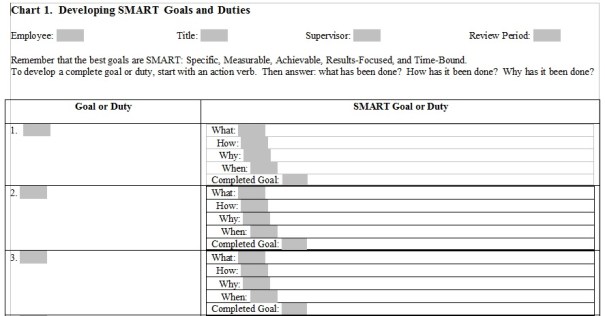
While going through some files, I found some forms from the Human Resources at the University of New Mexico. At this URL: https://hr.unm.edu/performance-evaluation there is a link to a 3 page fillable document called a Performance Evaluation and Planning (PEP) Form that includes goals. Another fillable document at this website is great for goal setting. While unable to find a link to it, the form can be found by Googling “Chart 1 developing SMART goals and duties.”
Here’s the link to it: Developing SMART Goals and Duties – UNM HR and here is what it looks like.

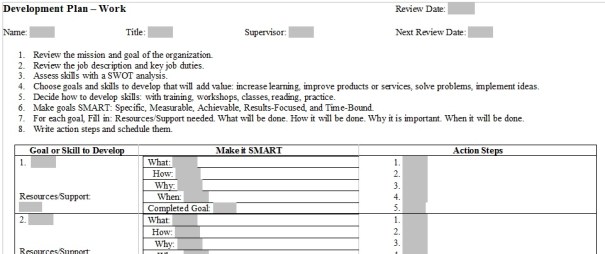
I couldn’t resist tweaking it a bit, and made two versions. The first one is for setting Work Goals

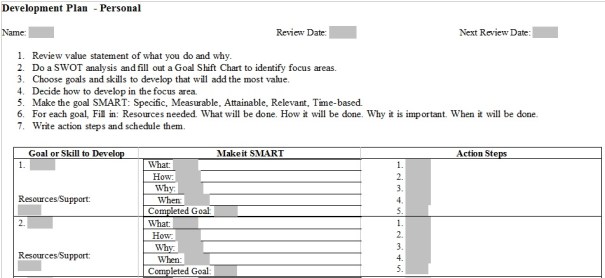
The other version is for Personal goals.

1. Review the value statement of what you do and why.
2. Do a SWOT analysis and fill out a Goal Shift Chart to identify focus areas. The Energy Level Gauge is a more detailed method.
3. Choose goals that will add the most value. Identify the sweet spot.
4. Decide how to develop in the focus area. There are lots of ideas for goals at the Year of Personal Development challenge and at Goal Plans.
5. Make the goal SMART: Specific, Measurable, Attainable, Relevant, Time-based.
6. For each goal, fill in: Resources needed. What will be done. How it will be done. Why it is important. When it will be done.
7. Write action steps and schedule them.
See also A Weekly Personal Development Plan, Set Work Goals, Learning Activities for Work Engagement, and the Work Skills Toolkit.

All things phonics are moving to a new website at http://www.phonicspow.com…please join us there! The post that was formerly here is now at The ABCs of Games for Reading.
All things phonics are moving to a new website at http://www.phonicspow.com, please join us there! Many of the links that were formerly here will soon be at Incentives for Reading.
Why reading 20 minutes a day is important
Students who read 20 minutes a day from Kindergarten through 6th grade score in the 90th percentile on tests, as the graphic below from edudemic illustrates. Read more on this Pivot Point at the Huffington Post.

Basically, reading makes you a Smartie!
There are many more benefits of reading too: It’s good for your brain, reduces stress, income is higher, and you even live longer. “Not all readers are leaders, but all leaders are readers.” – Harry Truman. “5 ways reading makes you a better leader” at michaelhyatt.com
I recently finished “Great at Work” by Morten T Hansen, who illustrates with examples and research 7 principles for working smarter. I was most interested in the first part of the book, which covers mastering your own work. The second part involves working with others, and a final part is about work/life balance. Here are my notes on the book.
Further Reading:

The Annual Review Toolkit contains 27 printable tools in a 30 page pdf to create a binder with everything you need to stay on top of regular reviews and on target with goals that align with your values. It includes Productivity Tools for a System & Routine, Goal Tools for Review, Brand & Purpose Tools for Focus. It gathers many of my best resources in one place together with the steps for an annual review.
An Annual Review Binder includes:
See the full contents of what is included. Available free for a limited time, grab yours now before this offer goes away!
I recently read “Mind Hacking” by Sir John Hargrave. I enjoyed this look at changing the mind from the viewpoint of a computer programmer with proven “geek” cred. Throughout the book there are mind experiments that virtually gamify mental change. In the spirit of open source and collaboration, the author provides the book free online as well as for purchase. There are links to both at www.gitbook.com/book/jhargrave/mind-hacking/details, plus a free app.
The hacking process includes:
Analyzing – We can change our mental loops. This section of the book is about becoming more aware of where the attention is, eliminating distractions, and retraining attention with meditation.
Imagining – This section talks about thought experiments and exploring the mind to expand what is possible. “Imagination is hard mental work” but everything that is created is imagined first.
Reprogramming – The author talks about the power of writing things down (“Until it’s on paper, it’s vapor”), and how mental simulations (aka vizualizations) can help athletes improve performance. He describes agile development, where a minimum viable product is released and then improved upon. He suggests using LASER subgoals that are: Limited, Achievable, Specific, Evaluated, and Repeatable for improved focus.
Many of the books that I read in the past year were Screen & Page Reads. I wrote one post referring to “The Code of the Extraordinary Mind,” by Vishen Lakhiani: End Goals Lead to a Meaningful Journey.
My favorite fiction book this year was by far “Last Days of Night” by Graham Moore. Set in the days of the discovery of electricity, and based on fact, this is the story of the competition between Westinghouse and Edison to be the dominant force. I found it fascinating!