Commencement Address by Jim Carrey, Maharishi University of Management, May 24th, 2014
Jim Carrey may be best known as a comedian, but his commencement address at the Maharishi University of Management on May 24th 2014 provides much to think about.
Yes, there are some laughs along the way. But it was lines like the following that I found moving.
“Fear is going to be a player in your life, but you get to decide how much. You can spend your whole life imagining ghosts, worrying about your pathway to the future, but all there will ever be is what’s happening here, and the decisions we make in this moment, which are based in either love or fear.”
After sharing that he discovered his purpose was to free people from concern, he says, “the effect you have on others is the most valuable currency there is. Everything you gain in life will rot and fall apart, and all that will be left of you is what was in your heart.”
Here are a few more highlights from the speech:
“Your need for acceptance can make you invisible in this world. Don’t let anything stand in the way of the light that shines through this form. Risk being seen in all of your glory.”
I’ve often said that I wished people could realize all their dreams of wealth and fame so they could see that it’s not where you’ll find your sense of completion. No matter what you gain, ego will not let you rest. It will tell you that you cannot stop until you’ve left an indelible mark on the earth, until you’ve achieved immortality. How tricky is the ego that it would tempt us with the promise of something we already possess.”
“Your job is not to figure out how it’s going to happen for you, but to open the door in your head and when the doors open in real life, just walk through it. Don’t worry if you miss your cue. There will always be another door opening. They keep opening. You are ready and able to do beautiful things in this world and after you walk through those doors today, you will only ever have two choices: love or fear. Choose love, and don’t ever let fear turn you against your playful heart.”
You can find the full speech and transcript here. For a video of the highlights, see here. I recommend watching the full version.
This week I also heard a song by musician Bradley Joseph. Here is “Feel” to inspire you to greet life with arms wide open this day, and every day.
Fear is an emotion that can prevent us from making a meaningful life. As human beings evolved, fear developed to protect us from possible threat or danger, triggering a physical response that shuts down the thinking part of the brain to react quickly to get to safety. While fear is helpful when we are in real danger, sometimes we react with fear when there is not a real threat. Since it is rare to encounter sabertooth tigers nowadays, in present times fears often come from perceived social threats to our well-being, such as fear of rejection. We may inaccurately predict the likelihood of risk, and underestimate our ability to handle it. We can counteract this by educating ourselves on the actual risk, challenging irrational thoughts, and practicing calming techniques to manage the physiological fight-or-flight response.
Fear is information to be learned from.
Listen to the fear. What is it telling you?
Examine the fear. Is there a real risk or is it unreasonable?
Acknowledge the fear. Recognize that the fear is present.
Re-frame fear as excitement. The physical sensations of both are similar.
It’s easy to identify what it is that you are avoiding right this minute, but do you know why you are avoiding it? The key to changing resistance into motivation may be contained within the answer to that question. We all have times when we fail to act and just can’t seem to get anything done. Often if you feel stuck and unmotivated, there is an underlying reason why. Understanding the reason is important if you want to overcome it. I like to think of this study of the causes and cures for procrastination as Procrastinology.
Avoiding Discomfort + Fear = Procrastination
Avoiding discomfort is one of the causes of procrastination, and many of the techniques for motivation are about overcoming this issue. (See the post Alex Vermeer on How to Get Motivated). While I’ve read a lot about procrastination, only recently have I begun thinking about fear as a root cause of procrastination, and how to deal with it.
What are you afraid of, and how can you overcome the fears that are stopping you?
There are many different fears that can cause procrastination:
FEAR OF
failure
success
vulnerability
rejection
the unknown
change
problems
hard work
discomfort
Are you afraid to fail? ASK: “What’s the worst that could happen?” REMEMBER: Failure is a part of success. SAY: “I will experiment until I succeed.” WATCH: Famous Failures at the Perils of Criticism.
Are you afraid to succeed? ASK: “What am I afraid of losing if I succeed?” REMEMBER: your why, the reason you believe what you want to do is important. Think of times when you were independent and strong. SAY: “I believe in what I do.”
Are you afraid to be vulnerable? ASK: “Do you want to live whole-heartedly?” REMEMBER: being vulnerable is necessary to live whole-heartedly. Be your authentic self. WATCH: Brene Brown’s TED Talk on vulnerability. SAY: “I choose to show up and be seen.”
Are you afraid of rejection, or what others might think? ASK: “Do you care more about your own opinion or the opinion of others?” REMEMBER: Your worth is not based on your skill level or what others think of you. SAY: “What other people think of me is none of my business!”
Are you afraid of the unknown or change? ASK: “How could this be fun?” THINK: New experiences can be a fun adventure. REMEMBER: exploring as a kid, times when you were pleasantly surprised by trying something new. SAY: “New experiences are an adventure.”
Are you afraid of problems? ASK: “What is a creative way to solve this?” THINK: Problems are challenges, like puzzles to be solved. REMEMBER: times you successfully solved a problem. SAY: “This is a challenge and I accept it.”
Are you afraid of hard work? ASK: “Are the results worth the hard work required?” THINK: Hard work is a necessary part of growth and learning. REMEMBER: times you worked hard to accomplish something, and how good it felt. SAY: “I choose to do the work because it is worth it.”
I joined a great Meetup group that gets together to talk about the ideas in non-fiction books. It is so inspiring to meet others interested in personal development and working toward goals.
Step One: The first step to being awesome is to follow Jon on Facebook. His posts are often seriously fun, like the one about the three person hot tub with a window in it next to the bed in his hotel room. Or thought-provoking, like this one: “If you could tell the 18 year old you, one piece of advice, what would you say?” I decided this would be my advice to me: “Be willing to step out of your comfort zone a little and try new things.”
Step Two: Do Summer. To promote his new book, “Do Over,” Jon offers a free worksheet for an email sign-up.
Illustrating his points with humor and stories, Jon describes five stages to awesome: Learning, Editing, Mastering, Harvesting, and Guiding in the book “Start.”
More Steps to Be Awesome:
Step Three: Remember that you already know how to be awesome! When we are kids, we’re awesome. We just forget that.
Step Four: Experiment! Blow things up, burn things down. Tinker, smash, mix. Scientists learn from their experiments, they don’t call them failures. (Learning)
Step Five: Ask yourself what brings you joy. (Editing)
Step Six: Get experience, do the work. (Mastering)
Step Seven: Don’t be a jerk, don’t get complacent. (Harvesting)
Step Eight: Use your strengths to help others and share what you’ve learned. Start again! It’s never too late. (Guiding)
I hate crushing cans. I would rather exercise, mow the lawn, scrub the toilet, pretty much anything other than crush cans. On the list of things I have to do, it would definitely rank on the bottom. It’s a task I would put off forever if I could, so I made it so I CAN’t avoid it. I added a constraint: we toss them into this bin, and when it won’t hold anymore, I’m forced to tackle the job. (As you can see, we are big fans of caffeine free Coke Zero!) I dread the day when the bin won’t hold any more cans, but then I grit my teeth and just do it.
Create a Rhythm
I won’t lie to you, I hate this task no matter what, and always will. But I’ve found it helps me get through it if I break it down. Sometimes this is called chunking. I line up six cans to crush at a time, before sweeping them off the counter into the bin that we keep the crushed cans in. With this system, I develop a rhythm that gets me through it. Listening to music while I do this task helps a bit too.
Reward Yourself When You’re Done
After I get the task done, I treat myself to a piece of candy for a reward. Luckily, my husband takes them to be recycled, so I don’t have to do that part! I’m reminded of the quote from Henry Ford: “Whether you think you CAN or you Can’t, you’re right.”
Is there a task you hate that you can compartmentalize? I’m never going to enjoy crushing cans, but these techniques help me to get it done.
Studies show that the ability to persevere in the face of challenges is pretty important to accomplish goals. External distractions are difficult enough to deal with, but mastering internal distractions may be even more challenging. Managing our own endless ability to distract ourselves is a key part of increasing productivity. As James Shelley says, “very often when we talk about the skill of “productivity” what we are really talking about is “self-control” — the disciplined ability to choose to do one thing at the cost of not doing another (perhaps more tempting thing).”
Angela Duckworth has developed a grit scale to test this ability. I’m afraid to take it. Personally, I can really identify with Greg Haffley in the Diary of a Wimpy Kid movies and books. If you’re wimpy like me, grit can definitely be a problem. So I was glad to see this is an ability that can be developed.
An excerpt from Jon Acuff’s book “Do Over” at Brazen Careerist outlines a Strategy to Embrace the Work Tasks You Hate. Acknowledge that there are tasks you hate to do with a Grit List, and if they must be done, commit to doing them anyway. Some say that it’s best to tackle those things first to get them out of the way.
In the spring, I always plant petunias in front of our house. It’s a sunny spot, and they thrive there and produce colorful blooms. This year I bought a few too many petunia plants, so I tried to plant some under a big tree on the side of the house. But it’s too shady, and the petunias aren’t happy there. Those petunias aren’t growing well, and rarely flower. The hosta and ferns growing under the big tree love shade, and they are flourishing there. But petunias love sun, and I’ve learned that it is important to plant things where they will grow best.
It’s the same with people-we flourish and grow the most when allowed to use the strengths that are natural for us. Sure, we can tackle other projects and ideas that don’t play to our strengths, but it will be a much harder struggle for us. The more we play to our strengths, the easier it is to grow. It’s just good sense to keep your strengths in mind when choosing the best ideas and projects to work on, when you’re looking for the sweet spot.
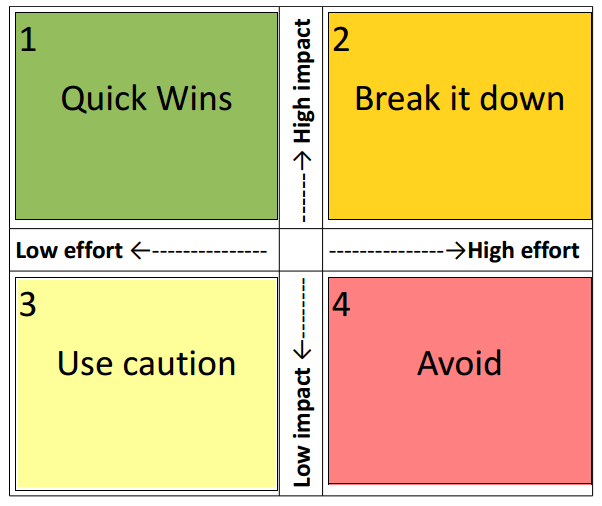
If you study productivity, you will learn about a key concept for setting priorities: Stephen R. Covey’s Time Management Matrix, also called the Eisenhower Matrix. The four quadrants show different possibilities for time use. But what happens if you remove the Urgent Quadrant from the equation? What if you had nothing urgent to worry about?
What would you do if you could choose anything? When I think about criteria for selecting the Most Important Tasks (or MITs) for daily planning, I’ve struggled with this. Out of all the possibilities, which are the best ones? I came across the Action Priority Matrix, which is helpful when it is time to choose priorities for tasks and ideas. The How-Now-Wow matrix at gamestorming.com is also an interesting concept. If you are Bill Gates, and have all the money you need or want, making money may not be a factor in your selection of high priority tasks to-do. However, for most of us, it is something that must be considered. [UPDATE: see the new Priority Flowchart post with the Effect Priority Matrix, which exchanges engagement for effort]
Where is the sweet spot?
The Sweet Spot is when tasks, projects, and ideas have high potential value and require low effort to accomplish.
High impact items are those with potential for gains in revenue, increase efficiency, align with values and advance goals, contribute to personal development or society, hold lots of appeal, add value or fulfill needs.
High effort projects may require lots of resources to accomplish. They may be costly, large and time consuming, or especially difficult, with many obstacles to overcome. They may require access to tools or collaboration with others. Learn more about Return on Investment at Setting Priorities.
Here are some criteria for selecting priorities, when nothing is urgent.
POTENTIAL VALUE
Quadrant I $ Value
Does this move business forward?
What is the potential financial benefit?
How big is the appeal?
How big is the market?
How big are the margins?
Is it easy to understand & communicate?
Quadrant II Contribution
Will it make a social contribution?
Will it contribute to personal growth?
How large are the likely benefits?
Will it allow me to use my strengths?
Does it fit my goals?
Does it fit my value statement of what I do and why?
RESOURCES
Quadrant III Difficulty
How big an investment is required?
Are the resources available?
Do you have the needed skills?
How many obstacles are there?
How big are they?
How hard to overcome?
Quadrant IV Size
How big a project/task is it?
How long will it take?
Is the time available to do something right now?
Is the energy available to do something right now?
If the difficulty and size of the task are small, it is more likely to fit the time and energy available. Too many ideas, projects, and tasks equals no focus. This Priority Matrix has helped me to see that some of my ideas for projects include big obstacles and uncertain appeal, so there may be others that would be better to focus on now. Of course, some worthwhile goals do require effort and even pain and sacrifice. Remember the Economy of Goals which means that goals are more likely to be accomplished if the benefits outweigh the resources that are required to obtain it.
When you aren’t sure what to work on next, it’s so easy to just check your email or Facebook, or some other mindless activity. It’s easier to avoid time wasters and default habits when you know what you need to do. However you choose priorities, it’s important to get started. If you’ll please excuse me, there’s something sweet on my list to do now.
I still have much to learn from all of this great information, but here is an outline that links to some of the resources at the Daily PlanIt that tie in.
To overcome procrastination (and get motivated) you can: Increase Expectancy, Increase Value, Decrease Impulsiveness, and/or Decrease Delay.
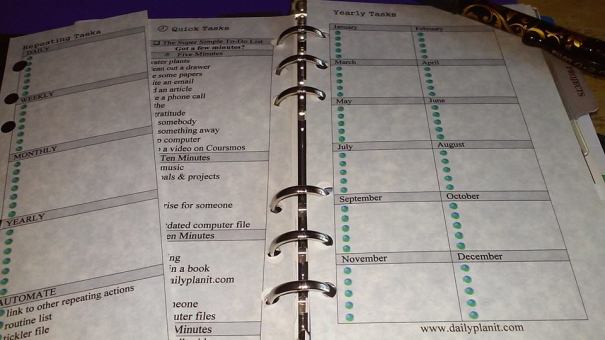
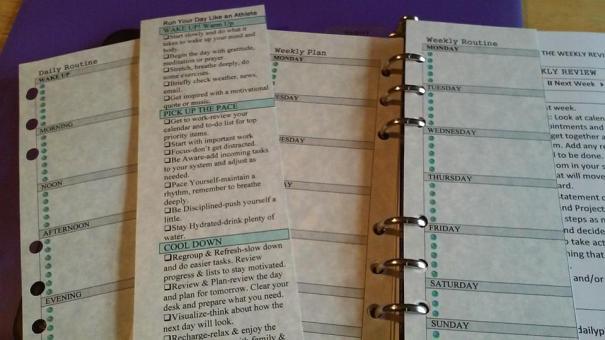
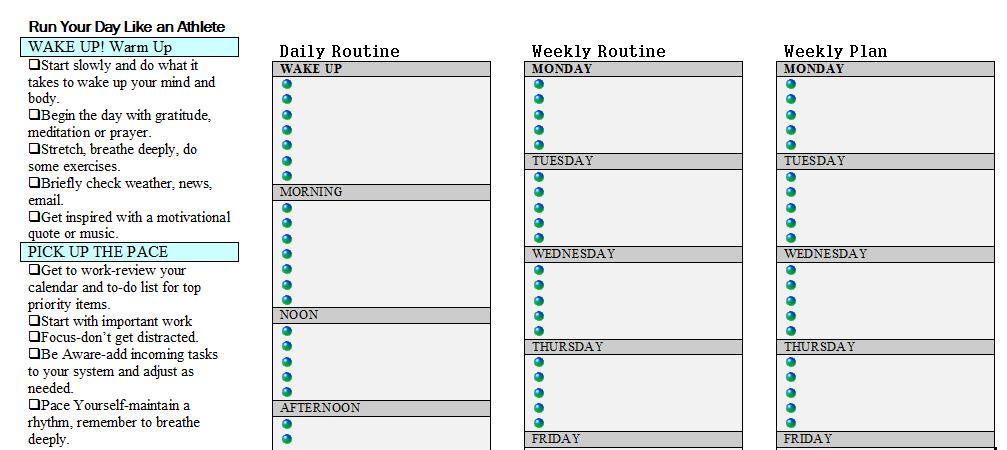
The planner inserts last week were so much fun, I was inspired to make a few more! This week’s installment includes a list for repeating or recurring tasks, and one for yearly tasks.
PLUS the Super Simple To-Do List of quick tasks to do when you have a few minutes.










 Daily PlanIt