…or is it? “Stumbling on Happiness” by Daniel Gilbert is a book about a long pondered puzzle-what happiness is, and how best to pursue it. Humans have many illusions about happiness, and the author sets out to explain the reasons for the regular mistakes we make in the pursuit of it. In the forward, he says: “No one can say how you will feel when you get to the end of this book, and that includes the you who is about to start it. But if your future self is not satisfied when it arrives at the last page it will at least understand why you mistakenly thought it would be.”
The author is a professor of psychology at Harvard, and in the first chapter, proposes that the human being is the only animal that thinks about the future. Imagination is the most important achievement of the human brain. While living completely for the future might not be best, neither is living completely in the present, as anyone with damage to the frontal lobe could tell you. Imagining pleasant future events is pleasurable, and imagining unpleasant future events can minimize their impact.
We want to know what is likely to happen so that we can do something about it. Making things happen is a source of joy and a fundamental need. We want to steer the direction of our boat toward the future that looks better. The truth is that when we arrive at the future it will look different than the future we think we see now. There are illusions of eyesight, of hindsight, and also foresight-and all are explained by the same basic principles of human psychology. Just as memory fills in details that didn’t happen and leaves out details that did, imagination fills in details that won’t happen, and leaves out details that will. Finally, he offers a remedy that is not acceptable for most of us.
Happiness is not easy to define, as different people have different reactions to events. However, by the conclusion of the book, the author proposes that we are not as unique after all as we think we are. The best way to predict our own happiness is to get information from someone who has had the experience we are contemplating. But we almost never choose to rely on this method.
We are always busily predicting the future at least a little bit. It’s a pity we aren’t better at it. We generally have the welfare of our future selves in mind when we make choices in the present. If we deny ourselves a donut now, it is with the belief that we will appreciate being in better shape tomorrow. However, our future selves are quite likely to be critical of our present choices.
Our brains make errors in logic that lead us to continually predict incorrectly what will make us happy. While we are stuffed with mashed potatoes and turkey it is impossible to imagine ever being hungry again, even though we know it will surely happen. After childbirth, the memory of pain is quickly forgotten, misplaced by the joy of parenthood. When events do not go the way we had hoped, we are adept at rationalizing our view to make it less painful. On the other hand, the things we think will make us happy, often fail to meet expectations. Adversity often comes complete with positive as well as negative outcomes.
Does awareness of the faulty logic we employ make us any happier? Unfortunately, no. It seems we are incapable of imagining accurately, and unwilling to be guided by the opinions of others.
I’ve been quiet for awhile as I’ve been dealing with television issues in one form or another. It all began when I finally decided to add local television stations to my satellite. I had postponed this for quite awhile, saving that extra 5 bucks a month. Well Hmmm. The only problem was it didn’t work. When I called DISH Network, a nice lady explained my satellite probably needed a free upgrade to receive them. (While on the phone with the nice lady I requested a new remote-more to follow as the saga continues.) Well, that sounded okay, so the guy came on Wednesday to switch it out. Said he hadn’t seen a satellite dish that old for awhile. Then he came inside to hook it up to the tv. Hmmm, that’s odd. No picture. I was puzzled as the tv had worked fine earlier. So I hauled down a small tv, and whadaya know it worked. Sadly, this meant my larger tv had coincidentally bit the dust. Dust, static electricity or just plain old age had brought to an end it’s years of faithful service. Meanwhile I was reduced to a small tv on the floor until I could go tv shopping.
That same day my new remote arrived. My old one had issues, you might say. The buttons were very difficult to push even with maximum effort, and the up arrow just flat-out quit a few years ago. That was the best 20 bucks I ever spent. Now I’m wondering what on earth took me so long to make the call.
So anyway, yesterday I enlisted the services of my son to go on a quest for a new tv. I needed his brawn to haul it and his brains to hook everything up. I found myself entranced by the elegance of the LCD tvs-so thin, so light-weight, so beautiful. I was smitten. We noticed a display model they were selling for 70 bucks less, so we took it home and spent a bit of time attempting to hook it up before conceding defeat and taking it back to the store and a huge line at the customer service desk. My poor son. Luckily the new one in the box we (meaning he) quickly ascertained had no problems and everything was clear skies and smooth sailing thereafter. I’ve spent most of today just admiring it.
The whole process did take some time. Lessons learned: a bargain isn’t a bargain if it doesn’t work. When things aren’t working well and don’t cost much to fix, for goodness sakes just do it! Making lasagna is a great way to thank son for hard work.
Work that engages us meets our needs for meaning, making a contribution with our strengths, and connection with others, according to the Gallup organization. Gallup surveys frequently show low levels of engagement at work. Since a large part of our time is devoted to work, finding a job that meets these needs contributes greatly to our happiness. The cost of low work engagement is high, but there are ways to increase work engagement.
• Self mastery with autonomy
• Take on important work
• Add meaning with impact
• Recognition of good work
• Target skills to develop
• Invite participation in growth opportunities
• Nurture interest and involvement
• Gain results with relevant work goals
Self mastery with autonomy. Determine your own DIRECTion.
Take on important work. To find work that really matters, look for your VIP AIMS: Very Important Pursuits that are active, inspiring, and meaningful solutions. Focus on these even if it may be difficult.
Add meaning with BIG impact. BIG = Bold change, Impressive influence, and Great movement. Learn more at the Priority Flowchart. See the impact of your work by choosing measures for goals and reviewing results regularly. This provides feedback which is important for flow.
Target skills to develop. Meaningful work often uses your strengths. When you develop skills, there are even more opportunities for engagement.
Invite participation. Include opportunities for growth with learning activities. A learning organization encourages learning with a system that allows advancement with approved learning activities. Individuals are responsible for their own development, and document progress with a plan for learning.
Nurture interest and involvement. Connection and communication with co-workers, teammates, and supervisors is important for work engagement. Create support groups and opportunities for interaction. Managers can coach development with one-one check-ins. Basics of Effective One-on-Ones pdf from Manager-Tools.com. It may be weekly, bi-weekly, monthly, or quarterly. Discuss employee preferences for frequency, take note, and schedule the next date in the calendar. Ask: “What things have made your job more difficult, and what needs to be done in the next year to increase productivity?” -Performance Management. Consider metrics such as KPIs, compare past performance to present.
Gain results with relevant work goals. Work goals that align with the mission of an organization and your personal values contribute to work engagement. Read more about work goals at Development Plans Are Not Just For Work.
Growth- choose goals with the right amount of challenge and stretch
Opportunities- goals open up opportunities for advancement
Autonomy- goals are a way to influence our work
Learning- include learning as one of your work goals
Relevance, Results, Recognition are antidotes to job misery and setting work goals goes a long way towards achieving these. For RELEVANCE – choose goals that contribute to mission, vision, and values. For RESULTS- see results with measures for goals, and performance reviews.
The MAGIC framework from decision-wise.com is a helpful way to look at five keys to engagement at work. The book is available at Amazon.
Meaning – work that has purpose and adds value
Autonomy – ability to shape the work and environment
Growth – opportunities for learning
Impact – seeing positive outcomes and results of the work
Connection- positive relationships add to a sense of belonging: caring managers, co-workers, and communication
Additional Reading on Work Engagement and Learning Organizations
Have you ever wondered whether something was a goal or a project? The difference between projects and goals is the time frame. Projects are the intermediate step between goals and daily actions. The process of planning them is the same. For the majority of projects and goals, knowing the next step (or the next action in GTD) is sufficient. Others may require more planning and evaluation.
I am now using Google Keep as a Kanban board for managing projects, together with a template for 2×2 sticky notes. This method is easy to set up and update. Projects are kept very visible in front of my project files.
Previously, I used a free online mindmaping website called mindmup to map out my projects. An image of the mindmap can be made into a background or screensaver on a computer, and can be added to Google Drive to access it anywhere.
Yellow legal pads are great for thinking and planning. You can simply list the name of the project on the left side, and the next step on the right side. These do tend to get a little messy.
This simple Polaroid Post It (pdf) is another option for a printable Project Master List to use with larger sticky notes.
Some projects have what I think of as dependencies. These may go on the “waiting for” list in GTD. For example, my garage project depends on good weather, and has therefore shifted to the back burner. Sometimes we may not be able to proceed until someone else has accomplished something, or we get a reply to an email. The key question becomes: “When should I look at this project again?” and then making a reminder entry in your calendar.
Some projects require more planning
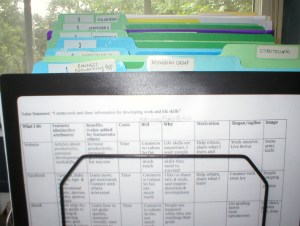
According to the Pareto Principle, it is likely that 20% of projects require further planning. Some Project plans can be simple, and a sheet of paper, a page in a planner or a 4×5 index card may be sufficient. Others may be more complex and require more detailed thought. Whatever format you use should allow enough room to think in as much detail as you need. A folder may be needed for larger projects to keep related materials together. I keep current project files in a wire step desktop holder.
Project File
Important skills for planning projects
Recognizing a project that is one of the 20% that require planning beyond the next action.
Recognizing a task that is too vague, and knowing how to make it specific.
Recognizing an incoming task, and knowing where to put it in your system.
Deciding what tools to use to capture ideas and manage projects.
It takes thought
To make decisions regarding email, paper, information.
I didn’t really think it would happen. But Legal Andrew tagged me for the “5 things you didn’t know about me” meme. Sorry, I’m a little bit slow…This is really difficult, as I’ve got to have the dullest life imaginable! OK, here goes:
1. My first job was washing dishes at a beautiful camp in the Flint Hills. Maybe you know that already, but it’s my most interesting thing!
2. I’m basically positive but have a dark side. I see tragedy and sadness and sometimes it gets to me.
Thank you to Andrew, and to all the wonderful people I’ve had the chance to meet and learn from this year. Thank you to all who stop by. You’ve been a beautiful gift.
Choosing which things are the most important to work on is a vital skill for productivity. The time management matrix is a well known method for setting priorities for day-to-day planning. To make a plan for the day, look at your calendar and select a few items from your to do list. Start with the urgent DAM CRAP that must be done, then consider which VIP AIMS contribute the most impact and best leverage your strengths.
Choosing priorities in longer range purpose planning involves looking for activities that have a BIG impact and engage strengths. The Effect Priority Matrix at the Priority Flowchart takes a closer look at these factors when choosing value based goals for pursuing a mission and vision.
We will start with the Time Management Matrix, then cover other methods for setting priorities after that:
Sweet spot matrix – compares impact and effort
Most Important Tasks (MITs) – from Leo Babauta at Zen Habits
ABC method – A=MUST do, B=SHOULD do, C=COULD do
Return on Investment and Rocks – big rocks (things that matter most) first from Stephen R Covey
The 80/20 or Pareto Principle and Target values – your guiding principles
Look for Very Important Priorities with UNITE:
Urgent: start with any DAM CRAP that must be done: Deadlines, Appointments, and Meetings, Crises, Required routine tasks, Agenda items, or Problems (Time Management Matrix) These are often Unpleasant “frogs” that have to be done (Brian Tracy says to Hop to It!)
Notable VIP AIMS that are Important: VIP AIMS are vital to values, increase well-being, and pursue purpose – things like building relationships and taking steps toward goals – remember to include them!
Increase Impact with activities that create: bold change, impressive influence, or great movement (Effect Matrix)
Target STAR strengths to engage Skills, Talents, Abilities, and Result in flow. HIGH engagement activities will: Harness strengths, Ignite imagination, Grow and develop skills, and Have intrinsic rewards.
Effectively meet needs for Contribution, Connection, Competence, and Choice.
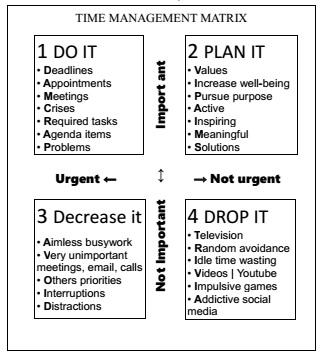
The time management matrix from the book “First Things First” by Stephen R Covey is a well-known tool to set priorities. It is sometimes called an Eisenhower Matrix.
Quadrant I (important and urgent): Start with the DAM CRAP: Deadlines, Appointments, Meetings, Crises, Required repeating tasks, recurring and routine tasks, Agenda items, or Problems – Do It!
Quadrant III (urgent but not important): AVOID Aimless busywork, Very unimportant meetings, emails, and calls, Others priorities, Interruptions, Distractions – Decrease It!
Quadrant IV (not urgent and not important): TRIVIA: Television, Random avoidance, Idle time wasters, Videos (TickTock, Youtube), Impulsive gaming, Addictive social media – Drop It!
1. Do It Now
Ask which tasks…
must be done right now?
will fit the amount of time available now?
will fit the amount of energy available now?
2. Plan It!
are VIP AIMS that are vital to values, increase well-being, or pursue purpose?
Your day has begun. How should you choose where to begin with your To Do List? A few more methods for choosing priorities:
Sweet spot matrix – compares impact and effort
Most Important Tasks (MITs) – from Leo Babauta at Zen Habits
ABC method – A=MUST do, B=SHOULD do, C=COULD do
Return on Investment and Rocks – big rocks (things that matter most) first from Stephen R Covey
The 80/20 or Pareto Principle, and Target values – your guiding principles
The Sweet Spotis the place where tasks have high impact and require low effort. They provide a quick win. Plan for tasks that have high impact but require high effort by breaking them down into smaller steps. Of course, some worthwhile goals do require effort and even pain and sacrifice. Remember the Economy of Goals which means that goals are more likely to be accomplished if the benefits outweigh the resources that are required to obtain it. [UPDATE: see the new Priority Flowchart post with the Effect Priority Matrix, which exchanges engagement for effort. Effort is included as a cost in considering Return on Investment]
Most Important Tasks (MITs) from blogger Leo Babauta at Zen Habits is the simplest way. Another simple method is The 1 – 3 – 5 Rule from the Muse: 1 big thing, 3 medium, 5 little.
The ABC method from Alan Lakein (or ABCDE from Brian Tracy):
A-important tasks that contribute to goals MUST do
B-moderately important SHOULD do
C-least important COULD do
Return on Investment. Weigh the time, energy, or other resources required vs. the benefits of accomplishment to decide whether it is an idea or task is worth doing. Julie Morgenstern’s Return on Investment considers: deadlines, estimated time, and steps to results. In the book “Wild Problems” by Russ Roberts, the author suggests going beyond consideration of costs vs. benefits to make decisions with the virtues of simplicity and becoming – thinking about what kind of person you want to become.
RESOURCES
Size – how big is it? How many steps are required? Are there many obstacles?
Time – how long will it take to complete? Is there a deadline? When to begin?
Energy – how much effort is needed? How much work will it be?
Access – does it require collaboration with other people? Tools or a workspace?
Money – how much will it cost?
RETURN
Gain – will it add growth, align with values and advance goals? increase efficiency or knowledge?
Revenue – will it generate a financial return?
Appeal – is it something you or others really desire?
Impact – will it make a large difference?
Needs met – will it add value by meeting needs?
Rocks – Stephen R Covey illustrates the importance of putting your big rocks (things that matter most) first in this video, (4:01) Big rocks include roles like family, work, community, etc.
Target Values
Perhaps one of the best ways to set priorities is to maintain a focus on the values that are your guiding principles with a value statement that clarifies what you do and why. Remember to include your goals and projects when it’s time to schedule tasks. A time audit shows how you actually are spending your time. Understand the value of time and plan to use it well.
The 80/20 rule (aka Pareto principle) – 80% of results come from 20% of actions.
Always use the time you have well. The Pareto Principle or 80/20 rule says that 80% of the output or results will come from 20% of the input or action. Jim Temme in the book “Productivity Power” says that we spend about 80 percent of our day working on job description activities (what I think of as repeating tasks) that yield only 20 percent results. The challenge is to use the remaining 20 percent of discretionary time on goal-related activities that yield 80 percent results. See more about the Pareto Principle at Measuring Productivity and the Pareto Principle Illustrated. Learn how to choose to say yes or no?
The Important can so easily get lost in the deluge of distractions in everyday life. Time squandered on the unimportant is lost forever, and no longer available for what matters most. Always Be Checking in with yourself if you are spending time on what you really think is important. Learn more about how to use time productively with the Time Management 101 tutorial.
GREAT priority tasks: Give high impact Requirements that are urgent Engage strengths Are important: VIPs = vital to values, increase happiness, and pursue purpose Target what really matters most
Once decisions have been made about selecting top priorities, it is Time to Act!
I spent an hour last night listening to an awesome webinar (slideshare here) featuring Jeffrey Schwartz (author of The Mind and the Brain) and David Rock (author of Quiet Leadership) as they discuss the neuroscience of leadership at strategy-business.com. It covered some very interesting ideas and I thought it was fascinating.
A couple of gems from it:
“A working definition of wisdom is prioritizing in ways that help you keep your eyes on the prize.”
We have the veto power to recognize distractions and focus our attention back on what’s important. Rather than think “focus, focus, focus” simply notice distractions and re-direct with “no, that’s not what I’m going to work on.”
Learn more about how to TEND to focus with Four Fantastic Tools for Focus. The Four Ps of positive shift are Power up, Pause, connect with People, and connect with Purpose. Focus is the power tool for Purpose. A tool to help with focus is a mission statement or value statement, sometimes called a Unique Selling Proposition (USP) or Unique Value Propostion (UVP).









 Daily PlanIt