12 Soft Skills for Success

Many of the top skills desired by employers are soft skills that involve purposeful work, personal qualities, and people.

PURPOSE
Planning
Problem solve
Look at tasks to achieve outcomes
Actively select important priorities
Next actions to schedule
Include time to think and review
Target key results and measures
DO: Map a mission, AIM for a vision that is active, inspiring and meaningful, plan purpose.

time management and priorities
Plan the day/week – review calendar
Look at priorities and make a to do list
Act – focus on one task at a time
Note peak time and use it well
Include incoming tasks in system
Take time to review progress
DO: Use a system to manage tasks and plan, follow a routine to manage energy, use peak time well, and focus on the important. Start with important priorities, include items with big impact and high engagement.
TED talk: the art of stress free productivity by David Allen

goal setting
Goals that WORK are:
Written
On target with values
Really SMART ⤍ Specific, Measurable, Attainable, Relevant, and Targeted
Keep you motivated
DO: write down goals with measurable objectives, review progress
TED Talk: Why the Secret to Success is Setting the Right Goals by John Doer

Motivation and focus
Master distractions
Observe outcomes
Values
Engage interest and energy
TED talk: the puzzle of motivation by Dan Pink
TED talk: how to get your brain to focus by Chris Bailey

PERSONAL QUALITIES
integrity
• Follow through on promises
• Always be honest
• Responsible and reliable
• Respectful
DO: be honest, consistent, and committed to values. Keep agreements and follow through.
DON’T: over commit
TED talk: Building Integrity – keeping promises by Erick Rainey

professionalism
DO:
• Use the greatness in you
• Engage the greatness in others
• Achieve and sustain extraordinary outcomes
Learn more and watch Susan Colantuono’s TED talk at Skills for Career Advancement

work ethic
Find DESIRE:
Discipline
Exercise willpower
Steady effort
Inspire flow
Remember purpose
Exclude distractions
DO: have high standards, go above and beyond, be fully engaged
Video: How to develop insane work ethic

critical thinking
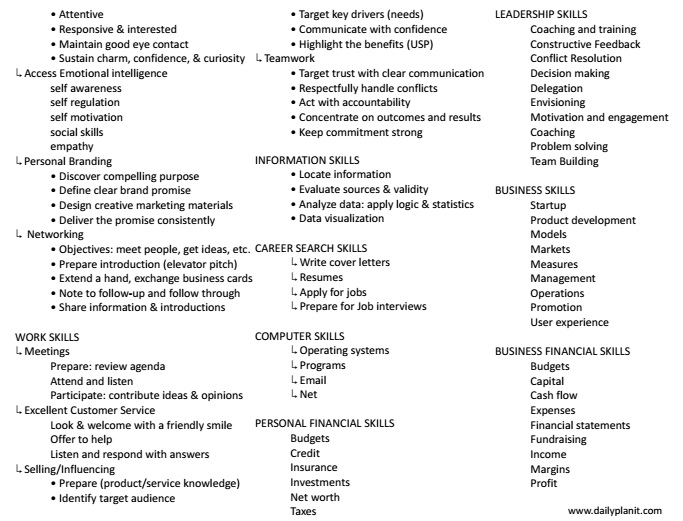
• Locate information
• Evaluate sources and validity
• Analyze: apply logic and statistics
• Data visualization
DO: find and evaluate information from multiple sources
DON’T: accept information without question
Video: BIG think

PEOPLE
communication
• Concentrate on being present
• Listen actively
• Observe responses
• Connect with empathy
• Know process and methods
DO: choose to be clear, concise, complete, considerate. Learn more about communication skills and watch the How to speak so people will want to listen by Julian Treasure

teamwork
• Trust: open, honest communication
Results: focus on outcomes
Accountability: clear expectations
• Conflict: handle with respect
Keep commitment
DO: be humble, hungry (hard working), and emotionally smart.
Learn more about teamwork and watch the TED talk: Are you an ideal team player? by Patrick Lencioni

emotional intelligence
• Identify feelings
• Manage emotions
• Understand emotions of others
• Respond with empathy
DO: pause, understand connection of thoughts and feelings
Learn more about emotional intelligence and resilience, watch a Big Think Video: Daniel Goleman

selling/influencing
Prepare: know the product
Identify the target audience
Target key drivers (needs)
Communicate with confidence
Highlight the benefits (always be communicating the value)
DO: balance familiar with novelty
Learn more about selling and personal branding. Watch the TED talk: the four letter code to selling anything by Derek Thompson

Download 12 Soft Skills free printable pdf. Try the Soft Skills Custom List at onetonline.org. Explore your skills, learn more about Work Skills and how to Develop Work Skills.

Tagged with: , ,
Posted in work skills

Meaningful Conversations

Have you ever wished for more meaningful conversations that develop deeper relationships? Our connections with others improve our happiness and combat loneliness. Conversation is a special communication skill to practice. The best communicators are present, observant, and provide feedback to verify understanding. They are excellent listeners and understand body language. They connect with appealing messages that are special, helpful, amusing, interesting, entertaining or exciting, and know how to ask good questions. Learn more at the CORE attributes of great communicators.

Skills to master the art conversation

ArtofConversationInfographic

BAKE the best conversations:

Begin with basic communication skills
Add appealing ingredients
Keep noticing and matching the type of conversation
Expand your skills with small talk, starters, and stories

Begin with basic communication skills

• Create a clear channel with a quiet environment.
• Listen with attention and ask good questions.
• Observe: look with good eye contact and notice body language.
• Connect with empathy: express consideration, appreciation, respect, and encouragment.
• Know the communication process and methods.

Add appealing ingredients to SHARE:
Special stories
Helpful information
Add exciting ideas
Really interesting news
Entertaining humor

Keep noticing and matching the type of conversation

Charles Duhigg describes three types of conversations in his book “Supercommunicators.” Recognize and match the three buckets: practical, emotional, and social.

Practical Conversations (what is this really about?)

• repeat: paraphrase what you heard
• explore the problem
• ask if you got it right
• decide on solutions together

Emotional Conversations (how do we feel?)

Ask: do you want to be…
• heard
• helped
• hugged

Social Conversations (who are we?)

• small talk
• starters
• stories

Expand your skills

Small talk

FORE topics for small talk to learn more about new aquaintances:

• Family and friends
• Occupation
• Recreation
• Education and events

Starters: Conversation Starters can lead to meaningful conversations.

Stories: Learn about the Power of Storytelling, and reveal moments of transformation.

SHARE to go deeper:

Share something about yourself
Have topics to talk about
Ask good questions  ↴
Respond in kind
Explore with curiosity

Values and beliefs
Opinions and thoughts
Ideas and imaginings
Creative concepts
Emotions and experiences

Ask Good Questions

Open ended
Positive
Elicit feedback
Nudge toward detail

Articles: How to Have More Meaningful Conversations at Time and psyche.co. Sketchnotes on Supercommunicators at qaspire.com. How to have a great conversation at wikihow.

Books and TED talks

Affiliate links to books at Amazon provide a small commission to support the Daily PlanIt.

See more TED talks by authors at the TED Talk Book Discussion

Posted in Ideas That Work, personal development

Skills for Career Advancement

The career advice you probably didn’t get” TED talk by Susan Colantuono describes three types of important skills for career advancement:

1. Use the greatness in you.
2. Engage the greatness in others.
3. Achieve and sustain extraordinary outcomes. (often the missing 33% for women)

Here are the skills you need:
DEMONSTRATE THE GREATNESS IN YOU with:

PERSONAL QUALITIES
↳ Integrity
• Follow through on promises
• Act consistently
• Responsible
• Reliably honest
Work ethic
• Willpower, discipline, and grit
• Awareness and commitment
• Determination and perseverance
• Effort and willingness to work hard

WORK SKILLS
Productivity
• Manage time
• Act on priorities
Planning
Set goals
Emotional intelligence
• Identify feelings
• Management
• Recognize emotions of others
• Respond with empathy

PURPOSE SKILLS
Personal branding
• Discover compelling purpose
• Define clear brand promise
• Design creative marketing tools
• Deliver the promise consistently
Planning
• Mission
• Vision
• AIMS
• Values

ENGAGE THE GREATNESS IN OTHERS

COMMUNICATION
• Choose to be: clear, concise, complete, considerate
Listen actively
• Observe responses
• Connect with empathy
• Know process and methods
TED talk: How to speak so people will want to listen by Julian Treasure

TEAMWORK
Trust: open, honest communication
Results: focus on outcomes
Accountability: clear expectations
Conflict: handle with respect
Keep commitments
TED talk: Are you an ideal team player? by Patrick Lencioni
DO: be humble, hungry (hard working), and emotionally smart.

LEADERSHIP & MOTIVATION
Listen and communicate well
Express appreciation and extend help
Act decisively and responsibly
Display emotional intelligence
↳ Encourage:
Mastery, Autonomy, Purpose
Observable outcomes
Valued contributions
Engage interest and energy

DO: share a vision with enthusiasm, match motivation with personality

ACHIEVE AND SUSTAIN EXTRAORDINARY OUTCOMES

BUSINESS KNOWLEDGE
↳ Basic business operations
Startup
Product development
Models
Markets: customer acquisition
Measures: KPI
Management
Promote, pitch, present, persuade
Sales: customer service
User experience

STRATEGIC KNOWLEDGE
↳ How the organization plans to achieve goals
Project planning
• long term objectives
• short term goals • Key results
Execution: focus on a wildly important goal, leverage lead measures with actions that drive results, create engagement with a compelling scoreboard, commit to accountability with a regular review.

FINANCIAL KNOWLEDGE
↳ Money management
Budgets
Capital
Cash Flow
Expenses
Financial statements
Fundraising
Income
Margins
Profit

Resources:

Tagged with:
Posted in work skills

Six Rs of Resilience

Mastering the skills of resilience helps us to navigate when the waters of life become choppy and we may begin to doubt our abilities to handle the challenges.

Six Rs of Resilience:
• Reflect: recognize feelings, thoughts and actions
• Reset: take a break, go for a walk or drive, take a shower
• Review: ask “is this helping or harming me?”
• Reframe: choose helpful thoughts and a growth mindset
• Redirect: focus on what you can change, choose helpful responses
• Reconnect
↳ with self: spend time on self-care and hobbies
↳ with others: spend time with family & friends, volunteer
⤍ GOAL: RESPOND choose to respond with helpful thoughts and actions

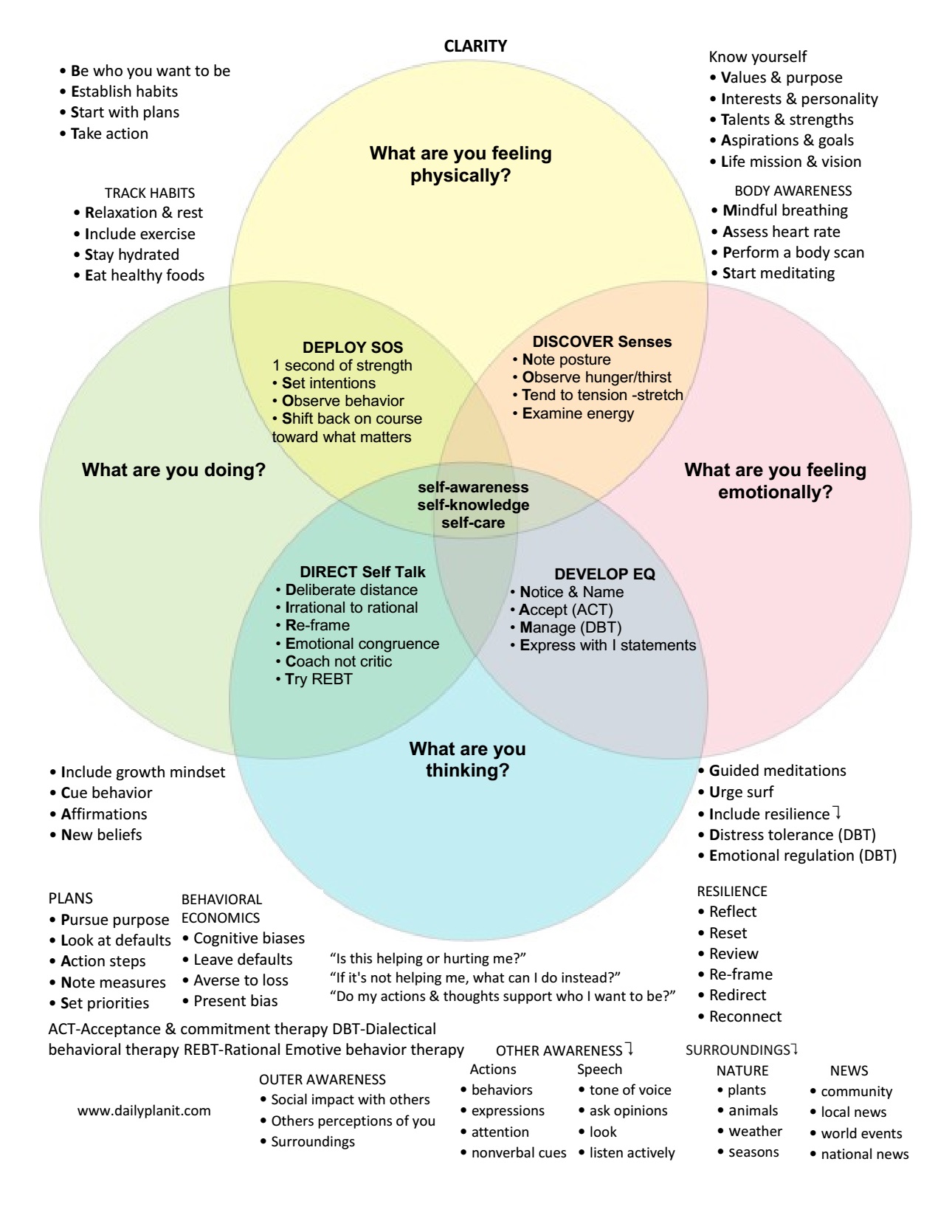
REFLECT “What am I thinking, feeling, and doing?”

Awareness of
↳ internal sensations in body
emotions
↳ thoughts
↳ focus
↳ actions

RESET “How can I change my focus?”
• Take a break
• Act: move your body
• Go for a walk or drive
• Take a shower

REVIEW “Is this helping or harming me?”
• Accept reality
• Adversity happens
• Life is uncertain
• Change is a part of life

REFRAME “What are more helpful thoughts, feelings, and actions?”
Rational thoughts
Growth mindset
• Helpful actions

REDIRECT “I choose to…”

• Focus on what can be changed
Plan purpose

RECONNECT

↳ with self
self-care (more about resilience)
hobbies and creative arts
learning and growth

↳ with others
spend time with family & friends
share
volunteer

RESPOND: choose to respond with helpful thoughts and actions
Breathe
Exercise
Meditate
Emotional intelligence… and more at the Building Blocks of Positive Shift

Download the Resilience and EQ pdf

Books and TED Talks (Amazon links to books provide a small commission to support the Daily PlanIt)

More resources:

Tagged with: , , , ,
Posted in personal development

Field Notes for Productivity

For my own task management system, I rely a lot on lists in Google Drive and Keep. As I try to drill down to what is truly important in the moment, it helps to have printed information about finding focus, combating procrastination, choosing priorities, and planning easily accessible at all times.

FieldNotesSystem

For those who prefer analog over digital solutions, there are many options. Field Notes are one popular paper option. These are small (3.5 x 5.5) notebooks that are pocket size and therefore very portable and easy to carry. If a calendar is desired too, an inexpensive Mead pocket planner (or most that are similar) is 3.5 x 6 inches, which allows for tucking a Field Notebook into the pocket of the front cover. Two packs of 3×3 post-it notes can fit into the pocket of the back cover, or whatever else you desire. (foldable inserts, anyone?!)

FieldNotesDailyLists

The first Field Note insert from the Daily PlanIt has space for daily and other lists, a weekly plan, repeating tasks and routines, and a reminder to include activities for self care and to make positive shift happen.

The next insert guides decisions with the Effect Priority Matrix, a list of values, strengths, talents, and skills, and a place for purpose, mission, vision, and a value statement. This helps to target priorities to focus on and make use of resources to act on them.

The third insert is all about finding focus, motivation, and combating procrastination to actually get things done.

The final insert has information for planning and reviews, including a place for goals.

With these four inserts as guides, a pocket system based on Field Notes can be highly effective.

Download the Field Notes Insert Set pdf

Posted in goals, productivity

Anti-Loneliness Actions for 12 Connections

Loneliness is an epidemic, and it has devastating effects. An article at Forbes called “The Neuroscience of Loneliness” provides twelve ways to combat loneliness from the book “Connect: 12 Vital Ties That Open Your Heart, Lengthen Your Life, and Deepen Your Soul” by Dr. Edward Hallowell. In his video on managing anxiety and worry he talks about “vitamin c,” the importance of connection for our health.

Here are some ideas for connecting with:

  1. Birth Family
    • Call or visit a family member. Plan a meal together. Celebrate birthdays and holidays.
  2. Immediate Family
  3. Friends & Community
  4. Work
  5. Beauty
    • Practice a creative art. Take an art class. Visit an art museum. Listen to uplifting music.
  6. Nature
    • Take a walk. Be aware and mindful. Look up, notice, pay attention, observe, smell the roses! Grow plants. Garden.
  7. History
    • Learn the history of your country, town, and culture. Read books and watch movies that are true stories. Read historical fiction and watch inspiring biographical movies.
  8. Pets & Animals
    • Adopt a pet. Visit a zoo. Watch videos about nature and animals.
  9. Organizations
    • Join a group or volunteer for a cause you believe in.
  10. Ideas & Information
  11. Spirituality
  12. Self

Download the Anti-loneliness Actions for 12 connections pdf

Learn more

Infographic of alone time from Rad Reads. Read more about the importance of weak ties. “Can Startups Solve the Loneliness Epidemic?” from Wall Street Journal. Learn more about positive shift.

Tagged with: , ,
Posted in love & relationships, personal development

Great Reads

Some books I have read have been life changing. If you are interested in learning and personal growth, here is a starter kit for fabulous non-fiction books and films by the authors.

A spreadsheet at the TED Talk Book Discussion page includes links to many talks and Amazon affiliate links to the books which provide a small commission to the Daily PlanIt that helps to maintain the website. Learn skills for twelve BE MEASURING practices that have been shown to increase happiness and well-being in four life areas with the following books and TED Talks.

PURPOSE | mind

POWER UP | body

PEOPLE | heart

PAUSE | soul

More books and videos for making good shift happen:

  1. “Your Brain at Work” by David Rock | TED talk Learning about the brain changes everything (14:54)
  2. “How of Happiness” by Sonja Lyubomirsky | Video: How of Happiness (38:49) [discussion guide]
  3. “Atomic Habits” by James Clear | Video: 1% Better Every Day (24:36)
  4. “Indistractable” by Nir Eyal | Video: Indistractable (23:38)
  5. “Drive” by Dan Pink | TED talk: The Puzzle of Motivation (18:36)
  6. “First Things First” by Stephen R Covey | Videos: book summary (11:28) time matrix ( 3:05) weekly planning (7:11)
  7. “18 Minutes” by Peter Bregman | TED talk The work buffet
  8. “The Six Pillars of Self-esteem” by Nathaniel Brandon | Video: Jim Carrey Speech (4:15) (2:10), Brene Brown TED talk (20:52)
  9. “How to Know a Person” by David Brooks | Video (50)
  10. “Life on Purpose” by Victor Strecher | TED Talk (26:00)
  11. “Thrive: Finding Happiness the Blue Zones Way” by Dan Buettner | TED Talk How to Live to be 100+ (22:11)
  12. “How to Begin” by Michael Bungay Stanier| Video: How to Begin (30:22)

Learn more about Great Reads at Screen and Page and find discussion questions for any non-fiction book at A Keep It Super Simple Book Discussion. Download a printable Core Great Reads Booklist. Find ideas for more at the Great Reads Pinterest board and see more Books for a Year of Personal Growth.

Posted in Books, Ideas That Work, personal development, videos

Procrastination Triggers

When procrastination happens, it helps to know what to do instead.

Procrastination is a failure to regulate yourself. The limbic system of the brain has an automatic response to avoid anything unpleasant or painful, often seeking pleasure for a hit of dopamine instead. To overcome this automatic response, engage the thinking brain to accomplish tasks that are important but difficult or unpleasant.

There are many who profit from taking advantage of the desires of the limbic system and build in the reward of increased dopamine to make our phones and devices addictive. Be aware of this, and create distance to reduce distractions and focus.

Recognize the feelings that indicate a procrastination trigger, understand the reason for the behavior, and choose to seek better solutions instead of the avoidance response.

Procrastination triggers – that can create an automatic avoidance reaction.

When a task is…

• difficult
• frustrating
• unclear
• boring

We may feel

• overwhelmed
• defeated
• anxious
• unmotivated

and engage in an automatic avoidance response to reach for escape with…

• food or drink
• social media
• videos
• games

INSTEAD, intervene with the thinking brain to seek better solutions with…

• simplicity [break it down]
• focus [four fantastic tools for focus]
• clarity [planning is thinking]
• meaning [purpose planning]

Download the free Procrastination Triggers pdf

Fear can often be at the root of procrastination – seek courage…

• challenge assumptions
• emulate heroes
• choose grit [the wimpy person’s guide to grit]
• follow values [map your values]

Practice choosing courage and develop the strength to tackle the hard tasks!

Read more at

Posted in productivity

Yes or no?

In the movie “Yes, man,” Jim Carrey’s character decides to say yes to everything, and it leads to some amusing situations. Sometimes saying yes to opportunities can lead to expanding your comfort zone and some pretty amazing things. However, saying yes to everything does not always work out well!

When we say yes to one thing, we are saying no to other things. Our time and energy are limited resources, and we simply can’t do it all. Choose wisely to say yes to what matters most. A TED article by author Ryan Holiday reminds us that every “yes” to one thing is a “no” to something else. Watch his TED talk (20:37) and read more about the angst guide to motivation.

So how do we decide whether to say yes or no to something?

Take NOTE:

  • Notice the request and ask questions for clarity.
  • Offer appreciation “thanks for thinking of me”
  • Take time “I’ll think it over and get back to you tomorrow”
  • Examine options – take STOCK

Take STOCK – does this fit?

  • Strengths and abilities
  • Time and energy
  • Other VIP AIMS: very important pursuits that are Active, Inspiring, Meaningful Solutions
  • Commitments and obligations
  • Key values

ASK: Will saying yes to this mean saying no to another priority? Will it take away from something else that is important? Will it over-extend you? An article at Fast Company provides three questions to ask yourself before saying yes or no to anything.

person doing thumbs up

Photo by Donald Tong on Pexels.com

Say YES to:

Say No To:

  • PASS on requests that don’t fit your priorities, abilities, strengths, or schedule.
  • Activities that provide low returns or NO returns! those that…
  • Sap your energy and suck up too much time, or are…
  • Simply stupid time wasters and distractions.

If your decision is no, communicate clearly and respectfully:

  • Not now or never
  • Offer alternatives – other ways or someone else
  • Politely decline
  • Explain reasons

Some possible responses:

  • “I have other plans.”
  • “My schedule just won’t permit it.”
  • “I have too many other commitments.”

Once a decision has been made, it is Time to Act! Read more at How to Say No from Lifehack.org, Practice Saying No from Christine Carter, and 20 ways to say no at onlineorganizing.

Posted in goals

PLANS for an Annual Review

This year, my PLANS for performing an annual review incorporate new things that I have learned organized in an efficient outline view. (The information at An Annual Review is also still helpful and relevant. You can download a free Keep It Super Simple Annual Review form pdf there)

PLANS for an Annual Review

Purpose Planning
Look at priorities
Assess VIP AIMS- are they still:
➸ relevant, productive, meaningful, significant?
Note effectiveness of productivity elements
Set new goals

1. Perform Purpose Planning [purpose planning]
• Mission
• Vision [create a vision board] find Very Important Pursuits that are Active, Inspiring, & Meaningful Solutions
• Values
• Goals

2. Look at priorities [priority flowchart]
↳ Assess VIP AIMS [how to choose VIP AIMS] are they:
• Relevant
• Actually advancing progress
• Making a major difference
• Producing real change
• Significant

3. Note effectiveness of productivity [perform a time audit]
• System [Choosing a Time Management System]
• Plan & Review [Planner Checklist]
• Routine [A Daily Routine] & workspace [Design Your Ideal Workspace]
• Focus [Four Fantastic Tools for Focus]

4. Set new goals [How to Set Goals]
• Personal [Choosing Goals] & purposeful [contribute to VIP AIMS]
• Lead to desired outcomes
• Outline measurable objectives
• Produce Key results

Download a free one page Annual Review PLANS pdf

Tagged with:
Posted in goals, productivity
eBooks

Enter your email address to follow this blog and receive notifications of new posts by email.

Blog Stats
  • 733,453 hits
Archives