Then, plan your day: review your calendar and tasks, and use a to-do list. Remember to add incoming tasks to your system as they arrive.
SMART GOAL
I will [do what] plan weekly [how] during a weekly review [when] every Sunday morning [for how long] 10 minutes [measured by] an annual chart for weekly goals [by when] by target date of a year from today. I will [do what] plan daily every morning at 7am.
Desire is the key to motivation, but it’s determination and commitment to an unrelenting pursuit of your goal – a commitment to excellence – that will enable you to attain the success you seek. -Mario Andretti
We must expect to encounter obstacles in our path as we reach for goals. Do you know the story behind the name of a very successful product called WD-40? It took 40 tries to get the water displacement formula correct.
Got inspiration? Watch the inspiring movie Rudy about a determined young man pursuing his dream in spite of many obstacles and set-backs. See 40 inspirational speeches in two minutes at the Angst Guide to Motivation.
Keep it SMART (Specific, Measurable, Achievable, Realistic, Time Sensitive) with wording created using this formula:
I will [do what] lose weight [how much] ____ lbs by doing [what] aerobic exercise [when] every morning [for how long] 30 minutes [measured by] target heart rate [by when] by target date of two months from today.
Measure progress with goal charts to measure progress on quantifiable goals with numbers and abstract goals with a rating scale from 1 to 5.
Many apps for productivity are available to help you manage your tasks.
A calendar is the starting point for any task management system. Google calendar is a clear standout in this area in my opinion. In fact, Google is the go-to productivity tool in my system. I love how I can access and update it anywhere. The Keep It Super Simple System is a completely free system that combines the benefits of both electronic and paper methods.
For other lists, I use Google Docs in Google Drive for more permanent information, and Google Keep for more frequently changing lists, for temporary notes, and to capture ideas. Evernote is another popular option for lists.
Individuals often have a preferred way of learning that can aid the absorption, processing, and retention of information. Some people are visual learners, while others learn better by listening. (Auditory) Some prefer learning through reading and writing, and others like hands on experience. (Kinesthetic) Knowing your learning style can help you learn more effectively.
There’s something about a picture that can bring purpose to life and inspire emotions to drive us to move forward and accomplish important goals. For a powerful vision board, AIM for a vision that is Active, Inspiring, and Meaningful.
Download the Vision Board template and begin thinking about what you want.
Choose Goals
Download the Goal Chart at Choosing Goals and watch the video. List words for what you want to CREATE in each life area and actions you will DO to make it happen. Choose one important goal in each life area (Mind, Body, Heart, and Soul) to write on the Vision Board template. Ask yourself:
Mind – LEARN! What do I want to learn? How will I learn it?
⌚ DO! What do I want to do? What are my strengths and how will I use them? Write your DO words on the crystal ball.
Body – DEVELOP What habits will I build?
✈ SEE! Where do I want to go? Write trips you would like to take on the globe.
Heart – CONNECT! How will I connect with others?
☸ BE! Who do I want to be? What are my values? Write three under the compass rose. Choose one that you want to develop and write a quote to inspire you.
Soul – ❂ AIM! What is something meaningful and inspiring I actively believe in?
✎ CREATE! What do I want to create? Write your CREATE words on the coffee cup ring.
Your VIP AIMs – Purpose and your why
Setting personal goals is a great way to start, but taking it further to consider purpose provides bigger motivation. VIP AIMS are Very Important Pursuits that are Active, Inspiring, and Meaningful Solutions.
• Active – something that you can do to make a difference, that is sustainable.
• Inspiring – something that will motivate you to take action.
• Meaningful – something that you deeply care about.
Having a central AIM goes beyond knowing what you want for yourself to knowing what you want for the planet. Your why or purpose is a problem that you want to solve, a change you want to make. To find an AIM, look for big ideas in the clues to purpose that may have a common theme. An important AIM often benefits the world, like a cause that you believe in. Goals that align with purpose point to a central AIM.
What is Your “Just Cause?”
Simon Sinek describes vision as a “just cause,” one that is so important you are willing to sacrifice for it.
He says there are 3 Things That Make a Meaningful Vision: 1. It is resiliant, able to withstand change. 2. It is inclusive, an invitation to all to contribute to it. 3. It is service oriented, the primary benefit is to others.
Goals that align with values and purpose will focus your soul attention on what matters most to you. With the information you have gathered, you can begin to create a vision board.
A vision board is a collage of pictures, words, and quotes that brings goals and aspirations for the future to life and keeps them visual and visible. This is a great activity to do during an annual review.
Visualize – picture what the world looks like when you succeed in achieving your goals. Inspire – a vision board will inspire you to action! Set in future – a vision board shows where you are going. Images & words – include pictures that illustrate your goals and quotes that motivate you! Objectives & goals – describe the goals you choose in various life areas in a SMART way. Needs of the world – have an AIM for the planet.
Images – look for pictures that capture the ideas, either in magazines or at an online site like Pixabay.
Words – use words that are: positive, present tense, personal, and purposeful. Find quotes to use for your board.
For a physical version, choose a board: posterboard, a whiteboard with magnetic clips, or whatever you like. Gather supplies like index cards, post-it notes, glue sticks, and markers. Look for pictures you can print and the quotes you want to include. Get inspired by The Important Stuff in Life from Frank Sonnenberg. Learn about how to how to make a collage of images that make your purpose visual from Christine Kane.
For a virtual version, there are online tools available at Canva and Picmonkey. Learn more about creating an online vision board at famleeoffour. Here’s a picture of the one that I made with Canva…you can use this design as a template, sign in is required.
Book and TED talk [Amazon affiliate link to book provides small commission that helps to support the Daily PlanIt. More TED talks by speakers who are also authors at TED Talk Book Discussion] The Non-Obvious Guide to Drawing Your Future by Patti Dobrowolski, TED talk Draw your future
However you make a vision board, it will provide inspiration and motivation! Be sure the goals you choose are important to you and align with your values and purpose. Learn more about how to set goals and check out the Brand and Purpose Toolkit. You might also like to try some visualization exercises to warm up creativity.
Purpose – Activity: Define a Clear Promise in a value statement
A value statement pinpoints what you do and why. It is sometimes called a personal mission statement or unique selling proposition. I like to call it a value statement, because it is about the value you add based on what you value.
Your value statement is the power tool for purpose.
A value statement provides clarity on direction and purpose, and purpose is one of the Four Ps of Positive Shift that organizes the 12 practices that have been shown by positive psychology to increase happiness. When you create a value statement, you gain incredible focus. It targets how you will use your time on what is most important to you and keeps you on track. A value statement will also help you to choose goals that are aligned with your purpose.
Your value statement communicates your unique value.
In the business world, companies talk about a Unique Selling Proposition, or USP, sometimes known as a Unique Value Proposition. You are unique, and including the unique benefits you provide in your own statement makes it especially captivating.
Your value statement will help you in interviews and networking.
When networking or at a job interview, two questions often come up: “What do you do?” or “Tell me about yourself?” Be prepared with a clear, concise, creative, and compelling answer.
Your value statement should lead with the most important information.
In journalism, stories lead with the most important information, with more detail that follows. The goal is to hook interest so you continue reading. In a similar way, with a value statement you want to lead with:
I [what you do] to help [target audience] to [how you help] so they can [have these values/benefits]. I provide [product/service] with [how you do it] so it will look like [vision] because I believe in [this purpose/values].
The Daily PlanIt Value Statement
I teach skills for positive shift to help students to realize potential so they can have well-being. I provide courses and information with engaging and compelling design so students are prepared with life skills because I believe in the importance of education.
Convert your value statement into an elevator speech.
An elevator speech is a brief version of your value statement. Imagine that someone you would like to work with enters an elevator with you to ride to another floor in the building. Quick! You have 30 seconds to introduce yourself and communicate who you are, what you do, and how you could help each other. If they express interest and a desire for further conversation, be prepared to elaborate in more detail.
Start with the basics:Inspire Interest:
Focus on the benefits you provide. People want to know what’s in it for them.
Aim at the heart. You might use a colorful metaphor that describes the benefit, process, or result of what you do.
Communicate your why. Simon Sinek, the author of “Start With Why,” says “People don’t buy what we do, they buy why we do it.” (his TED Talk) They are also most interested in our why, so know your purpose and share it.
Tell your story. Describe how you first became interested in what you do or a time that you made an impact.
Be prepared to expand with:
an image that captures and communicates the idea.
a project you are working on
features and benefits of the product or service you provide
statistics regarding the problem you solve
your vision for what the future will look like when you solve the problem
Crafting a value statement is not an easy task, and it is an ongoing process, but it is the best tool for finding focus.
Next Steps:
Practice. Videotape yourself and watch it. Practice it some more!
Put your business card in a nametag holder for a conversation starter.





 There’s something about a picture that can bring purpose to life and inspire emotions to drive us to move forward and accomplish important goals. For a powerful vision board, AIM for a vision that is Active, Inspiring, and Meaningful.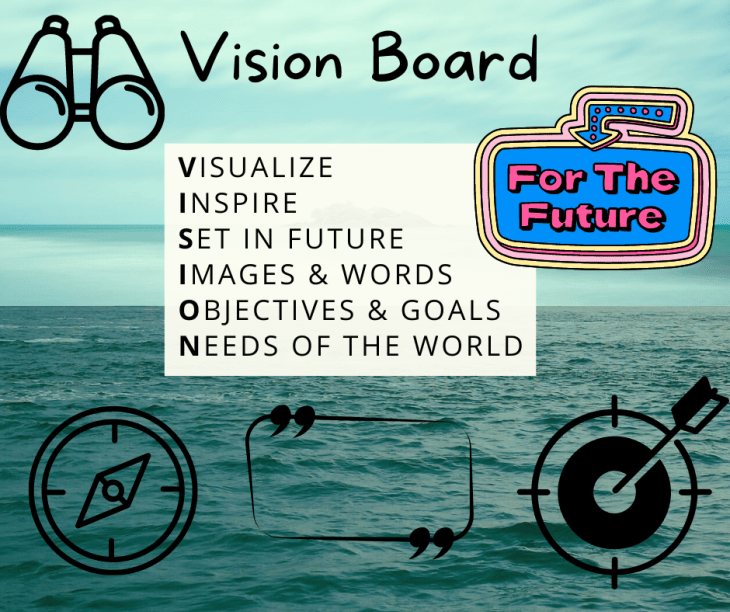



 Daily PlanIt