Goals and Productivity are like peanut butter and jelly

Goal setting and time management belong together.peanut-butter-jelly

To achieve goals, it’s important to manage your time well. To manage your time well, you must know what your goals are. They are intimately inter-connected, yet few books address these two processes together.

Setting goals is the first step in time management. The next step is to figure out how to spend your time so that you are making progress toward your goals.

The nature of time.

Time is elusive. We attempt to measure it with clocks and watches, but cannot save it up for another day. Each day, we all receive the same amount of time. It can easily slip through our fingers despite good intentions, a treasure stolen away by procrastination, interruptions, and indecision.

Managing time is really about managing activities, spaces, and information. Spaces include physical areas like our homes, offices and desks and the objects within them. There are four ways to manage time:

  • Evaluate – assess the value
  • Simplify – delete, decrease, declutter
  • Be more effective – do the right job
  • Be more efficient – do the job right

Each day 24 hours is credited to our account. We all have fixed time expenses such as working, eating and sleeping. Usually there is some discretionary time each day as well, that we have more choice in spending. A well-balanced time budget includes time for yourself and time for those you love. You can monitor your time to evaluate if you are spending it well, and make adjustments if necessary. Learn more at Time Management 101, a tutorial for increasing productivity.

“The only true measure of what you believe is what you do, not what you say.” –Brian Tracy

Posted in goals, productivity

Sticky Wiki

ticket

Some of the ideas to make goals visual and visible inspired me to make the Sticky Wiki: a place for reusable “sticky notes” to move as needed into and out of daily tasks. You are cordially invited to edit pages if you want; the password is: today. I was looking for a plausible reason to make a ticket, and this is it!

Posted in productivity

Top Ten Personal Development Sites

Update: I continue to find more great sites and now add them in the sidebar links. Also, I’ve added a page of Personal Development Experts.

Here are my personal favorites for personal development:

  1. StevePavlina – Personal Development for Smart People
  2. Scott H Young – Get the most out of your life!
  3. Zen Habits – Smile, breathe and go slowly
  4. Craig Harper – a tell-it-like-it-is Aussie Coach
  5. Personal Development Ideas – Dare to discover yourself
  6. The Change Blog – a community blog on personal change
  7. The Ripple Revolution– work for positive change with Curt Rosengren
  8. Manifest Your Potential – Find Your Gifts and Talents, Discover Your Dream Job, Career or Business
  9. Dr. Phil – He tells it like it is to help you “Get Real”
  10. Oprah – Live Your Best Life

Updated 1/14

Posted in personal development, Top Ten Sites

How to Set Goals

A Tutorial for Setting and Achieving Your Goals

GoalTutorial

Setting goals and taking steps to achieve them is like setting the GPS for a trip; goals are like a map to get you where you want to be. View GPS for your life (slideshare).

goalroadmap

This free printable Goal Roadmap (pdf) has the action steps to take to set goals effectively. Find it and lots more at the Goal Toolkit.

READY

Learn about setting goals with some great videos, TED talks, and books.

Keys to get started: Know Yourself. Discover U to uncover hidden talents and map your values.

Know your destination. Some goals are simply meant to improve life, while higher level goals pursue purpose and AIM for a vision to follow values. Both types of goals are important. Purpose planning will help to set goals that contribute to purpose. A value statement that targets what you do and why is like a compass that always points in the right direction.

SET

Fill ‘er up. Resources needed for goals include Time, Energy, Attention, Mind, and Money. Look at balance in life areas with the energy level gauge, a tool similar to a wheel of life.

Generate goal ideas and choose goals in different life areas. Find goal setting forms at the Goal Toolkit. Evaluate goals and choose top priority goals. End goals lead to a meaningful journey.

PLAN IT – Map your route

Write it down. The Science of Goals shows that written goals are 42% more likely to be accomplished. This is one of the Rules of Goals. Make goals SMART –  Specific, Measurable, Attainable and Actionable, Relevant & Rewarded, Time-bound and Targeted.

GO!
Get in gear and act with agency. By definition, goals are challenging. The economy of goals means that the benefit of a goal must exceed the resources required to obtain it. Cultivate courage, confront fear, and choose a growth mindset. Know the procrastination triggers and ways to overcome them. Be clear about your objectives, the benefits of accomplishing them, and stay focused. Anticipate obstacles and solve problems. Manage time well, because goals and productivity are like peanut butter and jelly. The better you manage your time, the more you will have for reaching your goals.

STAY ON COURSE
Keep goals visual and visible. Post a goal master list of the top priority goal in each life area. Monitor progress with a regular review, and adjust steering as needed. Celebrate success when a goal is reached, and choose another goal.

lifeareas

Learn more:

Courses

TED talks and Books

Tagged with:
Posted in goals

Keep Goals Visual and Visible

Keeping goals visual and visible is an important step toward reaching them. It is so easy to get distracted by other things, and maintaining focus will make a huge difference in getting closer to the results you seek.

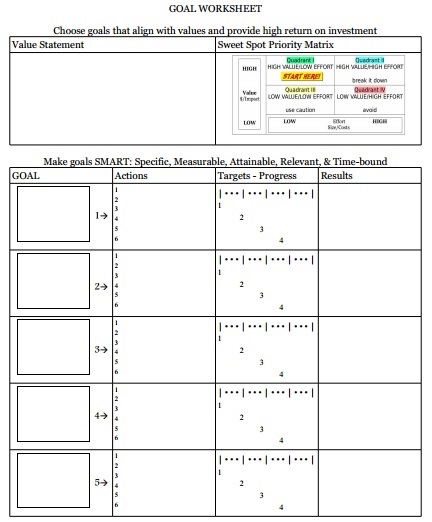
GoalWorksheet

Post a Master List of your Goals – Use a Goal Worksheet, Goal Shift Chart, Annual Goal Chart, or other tools from the Daily PlanIt.

Here are some more ways to make goals visual and visible:

Tammy Cravit’s Post-It Portable Workspace

Write goal action steps on sticky notes to place between today’s date and the goal statement written on a piece of paper. -from the book “Time Management for the Creative Person” by Lee Silber.

David Seah’s Task Order-Up lines up action steps on a rail so you (and everyone else!) can see what’s next. You could also use index cards and magnets on a magnetic whiteboard.

Make or purchase a big whiteboard. Use it for a KanBan board.

Make your own visual thermometer. (video)

Make a chart to measure progress toward saving money or paying off a loan.

Make a treasure map of your goals from Mindtools.

Create a vision board.

Life Map

Make a mind map with Mindmup

Make foldable goals to carry with you.

Daily PlanIt Goal Master List and Goal Charts

Print a Goal Master List from Buttoned Up.

Create a Wordle word cloud of your goal.

Set your top priority goal as a screensaver on your computer.

Make a video about your goal.

Write affirmations on your mirror with bar soap or washable window markers.

More Ways to Make Goals Visual & Remind Yourself

Posted in goals

Weekly Review

Planning and setting goals are like setting a gps for our life. With a regular review we take a look at how much progress we have made and if we are moving in the right direction.

Both Stephen R Covey (see Setting Priorities) and David Allen (author of Getting Things Done) advocate the importance of a weekly review. The weekly review is the way to monitor your progress towards acheiving goals and to take the time to plan. Choose a regular time for a weekly review that will work well for you.

Checklist for a Weekly Review

WeeklyReviewChecklist

Download the Weekly Review Checklist pdf (see another weekly review checklist from Getting Things Done pdf)

10 Steps for a Weekly Review:

  • Calendar

1. Review the past week – note major accomplishments and check for anything that needs to be followed up on. How does what actually happened compare to what you had planned? What went well? What didn’t go so well? Did you make the best use of your time?

2. Review your schedule for the upcoming week – What will you do next week? Look for room in your schedule to add tasks that will move your projects and goals forward, and add any repeating or recurring tasks that need to be done.

  • Lists

3. Review and update your to-do lists, keeping priorities in mind.

  • Notes

4. Review notes, whether in paper or electronic form

  • Cellphone & Email

5. Empty voicemails and texts, delete or organize emails

  • Projects & Goals

6. Evaluate progress on your projects and goals – update and add more action steps as needed.

  • Value statement

7. Review your value statement or unique selling proposition

  • Ideas (someday/maybe list in GTD)

8. Review ideas and decide if there are any you wish to take action on.

  • Office & Desk

9. Clear desktop and other office areas.

10. File papers and back-up computer.

To recap:

  • Review progress
  • Explore options
  • View schedule and tasks
  • Important work #1
  • Examine priorities
  • What’s next?

Weekly Planning lets you see how the next week will look. You can see how busy it is, and quiet times where you can schedule additional tasks. The free printable Annual Planner at An Annual Review keeps you on track with forms to capture results of weekly and monthly reviews.

See also A Paper Planner Tool for the Weekly Review, the Weekly Plan, Planning is Thinking, and Planning.

Paper Planner Tool for the Weekly Review

Paper Planner Tool for the Weekly Review

Questions for the Weekly Review: Weekly Review Questions | Trigger Questions from Paauwerfully Organized (pdf)

Additional reading

Tagged with: ,
Posted in goals, productivity

Time to Act

After-all-is-said-and

Life is about making choices, and the choice to act means knowing what you think is important, how you want to make a significant impact, and how you will make ideas happen. To make a choice: generate ideas, evaluate them, and choose top priorities that are meaningful. Decide whether to say yes or no to projects and goals,  Make a written plan so that goals are SMART with specific action steps, measures, and target dates set. Finally comes the hardest and most critical part: taking action on your ideas and goals.

Ideas without action are unfulfilled dreams.

Autonomy is one of the factors that influences motivation. You are the one who DIRECTS your actions.

Decide
Invest in independence
Reach for reasonable risk
Execute with agency
Confront fear
Take action
Start to MOVE

Decide. Make choices about what you think is important, about what you want to do, how to make a significant impact, how to meet needs. Get clear about purpose, set priorities, find focus, and increase flow.

Invest in independence. Your life is what you make of it. It is all up to you. Own your life. “If not you, who? If not now, when?”-Hillel. Channel your inner adult to apply grit and determination.

Reach for reasonable risk. Move beyond your comfort zone and take a considered risk. Comfort zones are familiar and safe but you don’t learn and grow there. What’s the worst that could happen? How big is the risk? Helen Keller said “Life is either a daring adventure, or nothing at all.” Read more inspiring quotes about taking a risk.

Execute with agency. Agency is the ability to act intentionally. Motivation comes from movement, not the other way around. Work a process with small steps towards success that are rewarding. Read more about “The Motivation Myth” by Jeff Haden, TED talk The most successful person in the world.

Confront fear. The biggest obstacle we face is ourselves. Fear can cause procrastination and inaction. Challenge yourself to cultivate courage, conquer fear, and embrace the possibility of failure. Mark Twain said “Courage is resistance to fear, mastery of fear, not absence of fear.” Read more inspiring quotes about courage.

Take action. Start with one small step. What actions can you take today to move you closer to your goals? Remind Yourself by keeping your goals visual and visible with a goal master list of the top priority goal in each life area. Understand the Economy of Goals, and focus on the benefits of accomplishing your goal. Remember that time is valuable, and it is short!

Start to MOVE:

Keep Learning. The more we learn and grow, the more we are able to direct our actions to accomplish the important. Gain mastery and develop strengths to get going. Understand why we procrastinate and counteract procrastination triggers. Set up a process to follow and make it a habit. Getting started is the hard part, but if you commit to five minutes you just might keep going. Know how to manage your time well to make the most of it.

Books and TED Talks:

1. Focus on the Wildly Important: Narrow your focus and identify what needs to be done.
2. Act on the Lead Measures: Track the most important actions to take to reach the goal.
3. Keep a Compelling Scoreboard: Highly visible measures motivate progress.
4. Create a Cadence of Accountability: Review progress weekly.

Additional reading:

Posted in goals, productivity

You’ve Got the Music in You

What are five things you can’t live without?

One of my answers to this question was: music. Now music is important to lots of people, but until that answer popped into my head, I hadn’t realized precisely how important it was to me, and I’ve made a point of listening more often.

Websites like Pandora and Last.fm let you find music that you never would have known you might like. Instead of passively taking in music that others have chosen, you have the power to actively select the music you like.

As I’ve looked for just the right mix of music to listen to, I’ve learned about how to use music as a soundtrack for the day, and created a motivational music playlist at youtube.

  • Lyrics to “You’ve Got the Music in You” by New Radicals.
  • dMarie time capsule: enter a date, and it lists top songs (as well as headlines, tv shows, and more!)

Upbeat Songs

  • Chesney Hawks-I am the one and only
  • Alannah Myles-Black Velvet
  • Pointer Sisters-Jump
  • Van Halen-Jump
  • Katrina and the Waves-I’m walking on sunshine
  • Carly Simon-Let the river run
  • Monkees-Daydream Believer
  • Steve Martin-King Tut
  • England Dan and John Ford Coley-Love is the answer
  • While You See a Chance-Steve Winwood
Posted in personal development

A Cat with Attitude

My cat has the right attitude.

When she is relaxed, she is either stretched out with complete and utter enjoyment, or curled up and the cutest thing you can possibly imagine. When she is in a loving mood she is completely present with you. Her purr is not loud, but you can feel it. When she wants to be left alone, you know that too.

Her size is small, but her feistiness is BIG. She will stand up to anything that is silly enough to confront her. On the rare occasions when something refuses to back off, she is smart enough to recognize it and moves fast to a safer place. When she wants something she is extremely determined and persistent. Extremely. There’s a lot I could learn from my cat.

Posted in personal development

Making Goals SMART

SMART-goals

Science has shown that goals should be SMART, which often (but not always) stands for:

Specific
Measurable
Attainable
Relevant
Time Bound

Download a free SMART goals printable worksheet to make your goal SMART:

tapemeasure

  1. Specific – Use a helpful formula at How to Make Goals Specific & Measurable.
  2. Measurable – Gain feedback on progress with metrics.
  3. Attainable (or Actionable) – Break goals down into action steps. Goals should be just the right size, with a bit of challenge and stretch, but not so out of reach as to be unrealistic.
  4. Relevant (and Rewarded) – Choose goals that are meaningful to you, and rewards for progress.
  5. Time Bound (or Targeted) – set target dates based on the size & difficulty of the goal.
  6. Even SMARTER goals are also Evaluated & Reviewed. –  Evaluate goals to be sure they align with your values and that you are still excited by them. Keep your goal master list visible and visual. Monitor progress with Reviews: weeklymonthly, and an annual review.

Types of Goals

Resolution

A resolution is a firm decision to do or not to do something. Usually a resolution is a habit you want to create and maintain indefinitely. There is no end point, as they are on-going actions that you intend to continue. Once they become a habit, they are easier to maintain and require less attention. Are Your Resolutions SMART?

timetargetA goal is an aim or desired result with a clear end point, so you know when it has been accomplished.

Examples of different goal frequencies:

  • daily: I will drink eight glasses of water every day.
  • weekly: I will increase time with family by spending at least 30 minutes each week one-on-one with each person doing an activity of their choice.
  • monthly/yearly: I will save $1200/year by making a $100 deposit in my savings account every month and track with a chart to reach the target date of twelve months from today.

Choose a habit tracker or goal charts for tracking progress according to frequency.

Learn more about How to Set Goals and find lots of free printables at the Goal Toolkit.

I like this take from Cal Wick that describes the process of setting goals in the book “The Learning Edge”:

Select a goal
Map out the work required
Act on the plan
Review and evaluate
Target the next goal

I’m also liking the HARD goals idea from Mark Murphy:

H – Heartfelt: Connect to your why.

A – Animated: Keep Goals Visual and Visible.

R – Required: goals that are important and necessary.

D -Difficult: goals that push the boundaries of our comfort zones provide the right amount of stretch.

These are all elements that aid us in achieving flow.

Read more about SMART Goals:

Posted in goals
eBooks

Enter your email address to follow this blog and receive notifications of new posts by email.

Archives
Blog Stats
  • 742,933 hits