Behavioral Economics and Weight Loss

Behavior change is hard, as anyone who has ever tried to create a new habit knows. The field of Behavioral Economics shows that we often fail to make rational choices. Below are a few human tendencies to be aware of:

  • Cognitive biases -often unconscious tendencies that are irrational
  • Likely to leave defaults -pre-selected options are often left as is
  • Averse to loss and risk -losses loom larger than gains
  • Present bias -we tend to favor present rewards over long-term gains
  • Social norms -we tend to follow the behavior of others

Learn about Behavioral Economics The Behavior Change 101 guide from Decision Lab is a great place to start. Learn more with the following books and TED talks. Amazon affiliate links to books in the post below provide a small commission that helps to support the Daily PlanIt.

Start with “Predictably Irrational” by Dan Ariely. He is an engaging speaker with several books and TED talk presentations:

Books and TED talks to learn more – (find links to TED talks by speakers who are also authors at the Behavior Change Pathway):

Websites:

Life Style Change for Weight Loss

Changing behavior for weight loss is insanely difficult. Willpower is challenging – learn more at the Science of Willpower from the Science of People. An article from Psychology Today suggests that behavioral economics alone is not enough, and a focus on forming new habits is essential. See helpful tips at Behavior Modification ideas for weight management, and follow the Health pathway at Pinterest.

Increasing awareness of eating habits and knowledge about what works is crucial. Learn more with the following books and TED talks about foods and diets that work, plant based diets, and exercise.

Plant based diet

Exercise

See more about eating and exercise for the brain.

Helpful Tips

  • Redefine yourself as the person you want to be. “I am a person who…” If one choice is that you are a person who doesn’t eat sugar, tell yourself and others “I don’t eat desserts.”
  • Expect to achieve your intentions with consistent small steps.
  • Describe specifically what you will do (or stop doing) when, and where to achieve your goal.
  • Use a commitment contract: deposit money in an account that will be donated to a cause if you fail to follow through. (if it is a cause you don’t agree with there is even more motivation)
  • Social partnerships can support your efforts and help you follow through.
  • Engineer environmental cues and make it as easy as possible with Visual strategies to master motivation.

Explore more TED talks by speakers who are also authors at TED Talk Book Discussion.

Tagged with: , , ,
Posted in personal development

The Simple Way to Create a Compelling Talk

Have you wondered what makes a great TED Talk so effective? I watched some of the best presentations while exploring hundreds of TED Talks by speakers who are also authors of books for the TED Talk Book Discussion list. I’ve learned that to be compelling, the content of a speech must be clear, remarkable, engaging, authentic, tantalizing, and explanatory. There are nine ways to capture interest, and six simple steps to deliver a compelling talk.

CREATE Content that is Clear, Remarkable, Engaging, Authentic, Tantalizing, and Explanatory.
➸ Clear
• compelling promise: tell the audience what helpful insight they will discover and the benefit of doing so.
• organized structure: outline with the OPEN method below, and watch Nancy Duarte’s TED talk, The secret structure of great talks.
• right length and amount of detail
• easy to understand
➸ Remarkable – the main idea is original; a new, impactful insight that is helpful, inspiring, memorable, and exciting. Learn The surprising habits of original thinkers in Adam Grant’s TED talk.
➸ Engaging – with nine ways to capture interest…

• Quintessential quote
• Unusual statement
• Entertaining humor
• Surprising fact
• Thoughtful question
• Inviting interaction
• Original observation
• Notable visual
• Satisfying story

➸ Authentic – be yourself, use conversational language and share relatable stories from your life. Brene Brown’s TED talk The power of vulnerablity is the perfect example.
➸ Tantalizing – capture attention with the title, tell why is it important to them?
➸ Explanatory – illustrate the main points with reliable supporting statistics, data, studies, and evidence. Learn how to to present The best stats you’ve ever seen in Hans Rosling’s TED talk. Include helpful visual illustrations like drawings, photos, or video clips. Martin Epler says Want to give a great presentation? use ugly sketches in his TED talk.

All of the methods of engagement add to a compelling speech, but perhaps the two most effective (and also the most challenging) are humor and storytelling. Learn how to tell stories at the The Power of Telling Stories post, and how to develop the skill of humor with Andrew Tarvin’s TED talk. For A TED talk that has both, watch David Nihill on Standing up to fear.

KEEP THE DELIVERY SIMPLE
• Start with an attention grabber – What do you have to share that others need? Jess Ekstrom TED talk The Secret to Great Public Speaking
• Invite audience involvement with an engaging activity
• Make it memorable – Yasir Khan TED talk How to Speak so People Remember
• Perform with passion How will you share what is most significant and meaningful to you?
• Logically lead through main points, illustrating them visually How will you show what you mean?
• End with recap and a call to action. What is the big idea you want them to take away? What would you like them to do?

Remember to STREAM appeal for a memorable talk with something that is:

• Surprising
• Thought provoking
• Rare
• Emotional
• Amusing
• Meaningful

Outline with the method described by Philipp Humm in an Analysis of the Best TED Talks at power-of-storytelling.com.
• Opening hook:
• Promise: You’ll discover…
• Explain 2-3 main points. Engage interest by illustrating each point with a story, statistic, or activity.
1. Point:
Illustrated with:
2. Point:
Illustrated with:
3. Point:
Illustrated with:
• Next wrap up: recap with 2-3 takeaways, and end with a statement that inspires action.
Takeaways:
Call to action:

Learn more about communication and presentations.

Learn more about TED talks:

Tagged with: ,
Posted in communication

Work Skills List

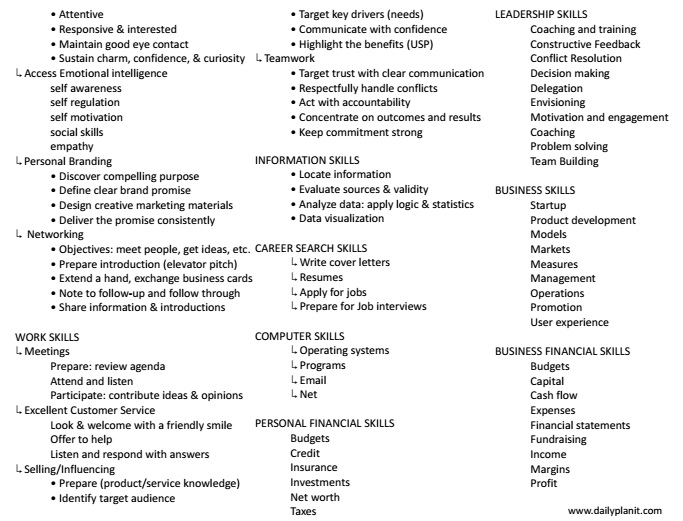
Skills are the tools we need to design and build a beautiful life. Skills help both to advance a career and to make positive shift happen. Assess your skills, explore the links below and download the List of Work Skills that can help you get important things accomplished.

WorkSkills1

PURPOSE SKILLS
↳ Manage time
↳ Act
↳ Plan
↳ Priorities
↳ Plan strategically (long term)
↳ Set goals
↳ Select key results

SELF MANAGEMENT SKILLS
↳ Focus
↳ Adopt a growth mindset
↳ Self-discipline
↳ Self-motivation

PERSONAL QUALITIES
↳ Work ethic
↳ Integrity
↳ Courage

PEOPLE SKILLS
↳ Communication
↳ Likability
↳ Emotional intelligence
↳ Personal Branding
↳ Networking

WORK SKILLS
↳ Meetings
↳ Excellent Customer Service
↳ Selling and Influencing
↳ Teamwork

INFORMATION SKILLS

CAREER SEARCH SKILLS

COMPUTER SKILLS

PERSONAL FINANCIAL SKILLS

LEADERSHIP SKILLS

BUSINESS SKILLS

WorkSkills2

Learn more at the Work Skills Toolkit, Develop Work Skills, Soft Skills for Success, Skills for Career Advancement, and Top Skills employers want

Posted in work skills

12 Communication Skills

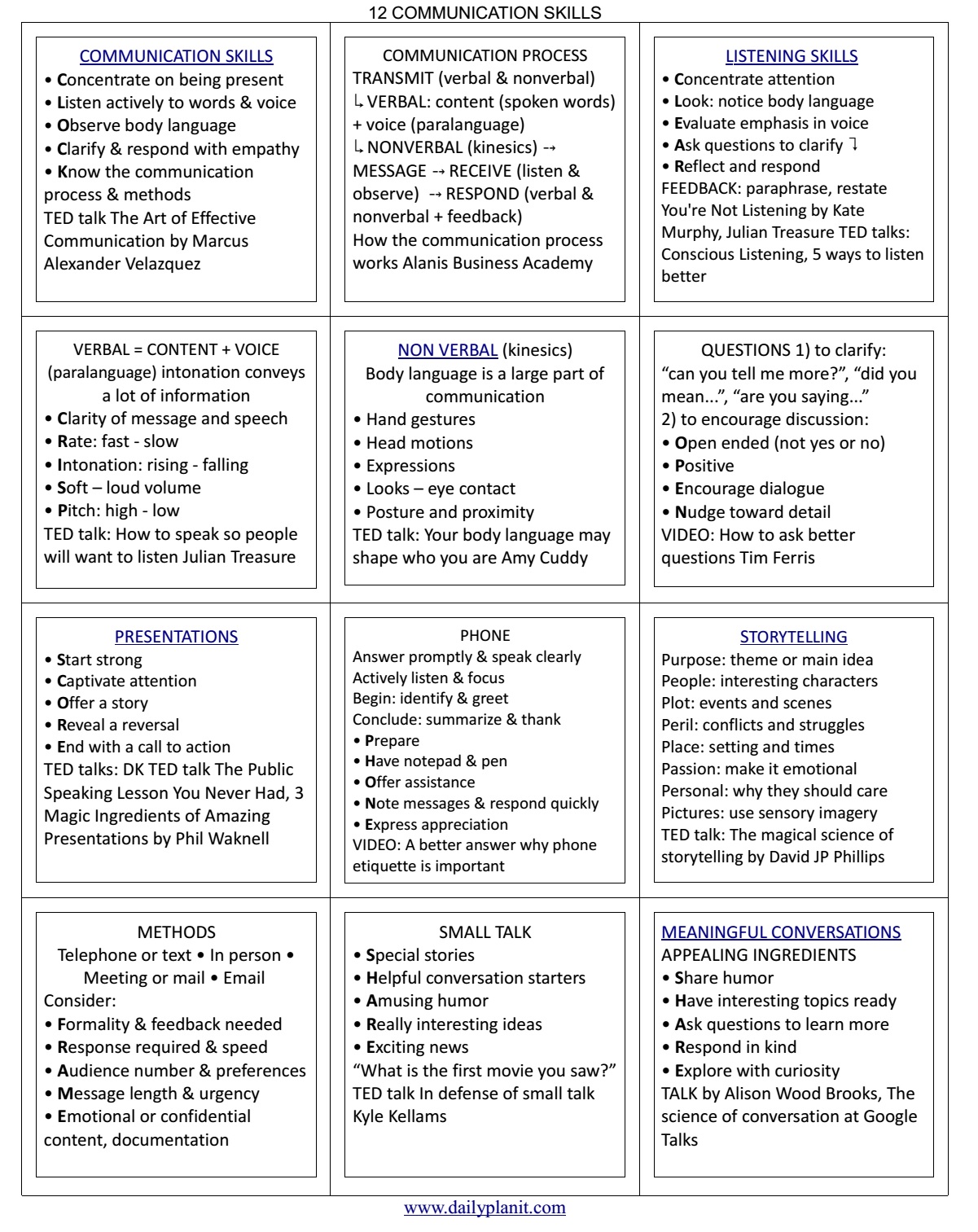
Verbal communication is like playing ping pong while juggling and jumping on a trampoline. There is far more going on than just bouncing back and forth between a speaker and listener! A speaker must choose words and transmit them with both voice and body language. A receiver of a message must listen to hear both the words and the voice, observe body language, interpret the meaning of all of it, and then respond with feedback to ensure understanding. Practice these 12 communication skills for better communication.

1. BASIC COMMUNICATION SKILLS

• Concentrate on being present
• Listen actively to words and voice
• Observe body language
• Clarify and respond with empathy
• Know the communication process

TED talk “The art of effective communication” by Marcus Alexander Velazquez

2. Know the COMMUNICATION PROCESS
TRANSMISSION (verbal & nonverbal)
↳ VERBAL: content (spoken words) plus voice (paralanguage) [clarity • rate • intonation • volume • pitch]
↳ NONVERBAL (kinesics): [hand gestures • head motions • expressions • looks: eye contact • posture & proximity] A large part of communication comes from intonation and body language.
MESSAGE [encoding (to transmit) and decoding (to receive) meaning]
⤍ RECEPTION (listen & observe)
⤍ RESPONSE (verbal & nonverbal plus feedback)

How the communication process works Alanis Business Academy

3. LISTENING SKILLS – listen actively to words and voice, be CLEAR:
• Concentrate attention
• Look to notice body language
• Evaluate emphasis in voice
• Ask questions to clarify
• Reflect and respond
FEEDBACK: paraphrase, restate in your own words
“You’re Not Listening” by Kate Murphy. TED talks: Conscious Listening, the sound of happiness, and 5 ways to listen better by Julian Treasure, The Power of Listening by William Ury

4. NONVERBAL (body language, kinesics)

• Hand gestures
• Head motions
• Expressions
• Looks – eye contact
• Posture and proximity

TED talk: Your body language may shape who you are by Amy Cuddy (21.02)

5. VOICE (paralanguage)

• Clarity of message and speech
• Rate: fast – slow
• Intonation: rising – falling
• Soft – loud volume
• Pitch: high – low

TED talk: How to speak so people will want to listen by Julian Treasure

6. Ask QUESTIONS to clarify:
• Reflect “how do you feel about that?” “So you feel…” “It sounds like you…”
• Ask “can you tell me more about that?” “do you mean…?”
• Paraphrase, summarize in your own words: “let’s see if I understand what you’re saying…” “is that right?”
to encourage discussion:
• Open ended (not yes or no)
• Positive
• Encourage dialogue
• Nudge toward detail
Watch: How to ask better questions Tim Ferris (5.29) Why asking questions is important (5.07) Questioning techniques from MindTools (3.20).

WORK communication skills ↴

7. PRESENTATIONS
• Start strong
• Captivate attention
• Offer a story
• Reveal a reversal
• End with a call to action
Plan • Practice • Perform with passion. It’s About the audience, Begin w/bang, Caution w/bullets. TED talks: DK TED talk The Public Speaking Lesson You Never Had, 3 Magic Ingredients of Amazing Presentations by Phil Waknell. See more at The Simple Way to Create a Compelling Talk

8. PHONE
Answer promptly and speak clearly, Actively listen and focus, Begin: identify and greet, Conclude: summarize and thank.
• Prepare
• Have notepad and pen
• Offer assistance
• Note messages and respond quickly
• Express appreciation
texts and messages: concise, clear, check!

A better answer why phone etiquette is important (1.56)

9. STORYTELLING
Purpose: theme or main idea
People: interesting characters
Plot: events and scenes
Peril: conflicts and struggles
Place: setting and times
Passion: make it emotional
Personal: why they should care
Pictures: use sensory imagery
Pixar’s Secret to Storytelling, TED talks: The magical science of storytelling by David JP Phillips, Business Storytelling Made Easy by Kelly Parker, Why Storytelling Matters by Garr Reynolds

More work interpersonal communication skills: Assertiveness, Branding, Conflict management, Difficult conversations, Meetings, Networking, Performance reviews, Teamwork. More non-verbal communication skills:

10. Know communication METHODS – Telephone or text ♦ In person ♦ Meeting or mail ♦ Email
• Formality and feedback needed
• Response required and speed
• Audience number and preferences
• Message length and urgency
• Emotional or confidential content, documentation

11. SMALL TALK
• Special stories
• Helpful conversation starters
• Amusing humor
• Really interesting ideas
• Exciting news
“What is the first movie you saw?”
TED talk In defense of small talk Kyle Kellams
“What exciting work are you doing?”
“Do you have any trips planned?”
”Has something good happened today?”
TED talk: You are Contagious by Vanessa van Edwards (18.16)

12. MEANINGFUL CONVERSATIONS – include appealing ingredients:
• Share humor
• Have interesting topics ready
• Ask questions to learn more
• Respond in kind
• Explore with curiosity
TALK by Alison Wood Brooks, The science of conversation at Google Talks
TED talks: How to skip the small talk by Kalina Silverman (19.41), 10 ways to have a better conversation by Celeste Headlee (11.45)

Amazon affiliate links to books provide a small commission to help support the Daily PlanIt. More TED talks by speakers who are also authors at TED Talk Book Discussion.

Download the 12 Communication Skills pdf.

Communication Youtube Playlists: DailyPlanIt, LearnFree, ABC Life Literacy Canada, Latimer Group

Tagged with: , , ,
Posted in communication, personal development, work skills

Understanding Body Language

“What you do speaks so loudly that I cannot hear what you say” – Ralph Waldo Emerson
A large part of communication comes from body language. A listener must understand the nonverbal part of a message, and a speaker needs to match body language with what they are saying.
Here are some helpful tips for understanding body language:
• Hand gestures – like stop, okay, a firm handshake, thumbs up. Watch Gestures around the world (2.45)
• Head motions – Tilts: curiosity or puzzlement, Other positions: chin lift confidence or determination, Nods for agreement, Shakes for disagreement.
• Expressions – facial expressions often reveal emotion. See the seven universal facial expressions. A genuine smile is conveyed by crinkles at corners of the eyes.
• Looks – eye contact conveys trust, interest, confidence. 4-5 seconds at a time, 50 % of the time while speaking and 70% of the time while listening.
• Posture – good posture is straight (upright), open, approachable, and relaxed.
• Proximity – maintain a proper distance of physical closeness and personal space.
Contexts and Cultures
The information communicated through body language varies depending on Contexts:

• Cultural – Read about cultural differences at businessballs.com and skillsyouneed
• Relational – closeness of the relationship
• Individual – skills of the individual
• Social – norms and rules of a group
• Physical environment – location such as a church, a school, or a bar

Learn more about body language

• Try a body language quiz from scienceofpeople, or from the guardian.
• Find exercises for improving posture at this Wakelet.
• Non-verbal communication Pinterest Board
Videos:
TED talks: Your body language shapes who you are by Amy Cuddy (21.02), You are Contagious by Vanessa van Edwards (18.16), and  The Power of Non Verbal Communication by Joe Navarro (12:55).
Articles:
How to read body language from verywellmind
Body language from helpguide
Body language at scienceofpeople
Power of Body Language from gcfglobal.org
Body language at businessballs.com
Non-Verbal communication from skillsyouneed
The Power of Body Language from Toastmasters
Books:
• The Definitive Book of Body Language by Barbara and Allan Pease
• The Dictionary of Body Language: A Field Guide to Human Behavior by Joe Navarro
• Cues: Master the Secret Language of Charismatic Communication by Vanessa Van Edwards
Posted in Ideas That Work

12 Soft Skills for Success

Many of the top skills desired by employers are soft skills that involve purposeful work, personal qualities, and people.

PURPOSE
↳ Planning
• Problem solve
• Look at tasks to achieve outcomes
• Actively select important priorities
• Next actions to schedule
• Include time to think and review
• Target key results and measures
DO: Map a mission, AIM for a vision that is active, inspiring and meaningful, plan purpose.

↳ time management and priorities
• Plan the day/week – review calendar
• Look at priorities and make a to do list
• Act – focus on one task at a time
• Note peak time and use it well
• Include incoming tasks in system
• Take time to review progress
DO: Use a system to manage tasks and plan, follow a routine to manage energy, use peak time well, and focus on the important. Start with important priorities, include items with big impact and high engagement.
TED talk: the art of stress free productivity by David Allen

↳ goal setting
Goals that WORK are:
• Written
• On target with values
• Really SMART ⤍ Specific, Measurable, Attainable, Relevant, and Targeted
• Keep you motivated
DO: write down goals with measurable objectives, review progress
TED Talk: Why the Secret to Success is Setting the Right Goals by John Doer

↳ Motivation and focus
• Master distractions
• Observe outcomes
• Values
• Engage interest and energy
TED talk: the puzzle of motivation by Dan Pink
TED talk: how to get your brain to focus by Chris Bailey

PERSONAL QUALITIES
↳ integrity
• Follow through on promises
• Always be honest
• Responsible and reliable
• Respectful
DO: be honest, consistent, and committed to values. Keep agreements and follow through.
DON’T: over commit
TED talk: Building Integrity – keeping promises by Erick Rainey

↳ professionalism
DO:
• Use the greatness in you
• Engage the greatness in others
• Achieve and sustain extraordinary outcomes
Learn more and watch Susan Colantuono’s TED talk at Skills for Career Advancement

↳ work ethic
Find DESIRE:
• Discipline
• Exercise willpower
• Steady effort
• Inspire flow
• Remember purpose
• Exclude distractions
DO: have high standards, go above and beyond, be fully engaged
Video: How to develop insane work ethic

↳ critical thinking
• Locate information
• Evaluate sources and validity
• Analyze: apply logic and statistics
• Data visualization
DO: find and evaluate information from multiple sources
DON’T: accept information without question
Video: BIG think

PEOPLE
↳ communication
• Concentrate on being present
• Listen actively
• Observe responses
• Connect with empathy
• Know process and methods
DO: choose to be clear, concise, complete, considerate. Learn more about communication skills and watch the How to speak so people will want to listen by Julian Treasure

↳ teamwork
• Trust: open, honest communication
• Results: focus on outcomes
• Accountability: clear expectations
• Conflict: handle with respect
• Keep commitment
DO: be humble, hungry (hard working), and emotionally smart.
Learn more about teamwork and watch the TED talk: Are you an ideal team player? by Patrick Lencioni

↳ emotional intelligence
• Identify feelings
• Manage emotions
• Understand emotions of others
• Respond with empathy
DO: pause, understand connection of thoughts and feelings
Learn more about emotional intelligence and resilience, watch a Big Think Video: Daniel Goleman

↳ selling/influencing
• Prepare: know the product
• Identify the target audience
• Target key drivers (needs)
• Communicate with confidence
• Highlight the benefits (always be communicating the value)
DO: balance familiar with novelty
Learn more about selling and personal branding. Watch the TED talk: the four letter code to selling anything by Derek Thompson

Download 12 Soft Skills free printable pdf. Try the Soft Skills Custom List at onetonline.org. Look at 87 soft skills from Simplicable. Explore your skills, learn more about Work Skills and how to Develop Work Skills.

Tagged with: , ,
Posted in work skills

Meaningful Conversations

Have you ever wished for more meaningful conversations that develop deeper relationships? Our connections with others improve our happiness and combat loneliness. Conversation is a special communication skill to practice. The best communicators are present, observant, and provide feedback to verify understanding. They are excellent listeners and understand body language. They connect with appealing messages that are special, helpful, amusing, interesting, entertaining or exciting, and know how to ask good questions. Learn more at the CORE attributes of great communicators.

Skills to master the art conversation

ArtofConversationInfographic

BAKE the best conversations:

• Begin with basic communication skills
• Add appealing ingredients
• Keep noticing and matching the type of conversation
• Expand your skills with small talk, starters, and stories

Begin with basic communication skills

• Create a clear channel with a quiet environment.
• Listen with attention and ask good questions.
• Observe: look with good eye contact and notice body language.
• Connect with empathy: express consideration, appreciation, respect, and encouragment.
• Know the communication process and methods.

Add appealing ingredients to SHARE:
• Special stories
• Helpful information
• Add exciting ideas
• Really interesting news
• Entertaining humor

Keep noticing and matching the type of conversation

Charles Duhigg describes three types of conversations in his book “Supercommunicators.” Recognize and match the three buckets: practical, emotional, and social.

Practical Conversations (what is this really about?)

• repeat: paraphrase what you heard
• explore the problem
• ask if you got it right
• decide on solutions together

Emotional Conversations (how do we feel?)

Ask: do you want to be…
• heard
• helped
• hugged

Social Conversations (who are we?)

• small talk
• starters
• stories

Expand your skills ↴

Small talk

FORE topics for small talk to learn more about new aquaintances:

• Family and friends
• Occupation
• Recreation
• Education and events

Starters: Conversation Starters can lead to meaningful conversations.

Stories: Learn about the Power of Storytelling, and reveal moments of transformation.

SHARE to go deeper:

• Share something about yourself
• Have topics to talk about
• Ask good questions  ↴
• Respond in kind
• Explore with curiosity

• Values and beliefs
• Opinions and thoughts
• Ideas and imaginings
• Creative concepts
• Emotions and experiences

Ask Good Questions

• Open ended
• Positive
• Elicit feedback
• Nudge toward detail

Articles: How to Have More Meaningful Conversations at Time and psyche.co. Sketchnotes on Supercommunicators at qaspire.com. How to have a great conversation at wikihow.

Books and TED talks

Affiliate links to books at Amazon provide a small commission to support the Daily PlanIt.

See more TED talks by authors at the TED Talk Book Discussion

Posted in Ideas That Work, personal development

Skills for Career Advancement

“The career advice you probably didn’t get” TED talk by Susan Colantuono describes three types of important skills for career advancement:

1. Use the greatness in you.
2. Engage the greatness in others.
3. Achieve and sustain extraordinary outcomes. (often the missing 33% for women)

Here are the skills you need:
DEMONSTRATE THE GREATNESS IN YOU with:

PERSONAL QUALITIES
↳ Integrity
• Follow through on promises
• Act consistently
• Responsible
• Reliably honest
↳ Work ethic
• Willpower, discipline, and grit
• Awareness and commitment
• Determination and perseverance
• Effort and willingness to work hard

WORK SKILLS
↳ Productivity
• Manage time
• Act on priorities
• Planning
• Set goals
↳ Emotional intelligence
• Identify feelings
• Management
• Recognize emotions of others
• Respond with empathy

PURPOSE SKILLS
↳ Personal branding
• Discover compelling purpose
• Define clear brand promise
• Design creative marketing tools
• Deliver the promise consistently
↳ Planning
• Mission
• Vision
• AIMS
• Values

ENGAGE THE GREATNESS IN OTHERS

COMMUNICATION
• Choose to be: clear, concise, complete, considerate
• Listen actively
• Observe responses
• Connect with empathy
• Know process and methods
TED talk: How to speak so people will want to listen by Julian Treasure

TEAMWORK
• Trust: open, honest communication
• Results: focus on outcomes
• Accountability: clear expectations
• Conflict: handle with respect
• Keep commitments
TED talk: Are you an ideal team player? by Patrick Lencioni
DO: be humble, hungry (hard working), and emotionally smart.

LEADERSHIP & MOTIVATION
• Listen and communicate well
• Express appreciation and extend help
• Act decisively and responsibly
• Display emotional intelligence
↳ Encourage:
• Mastery, Autonomy, Purpose
• Observable outcomes
• Valued contributions
• Engage interest and energy

DO: share a vision with enthusiasm, match motivation with personality

ACHIEVE AND SUSTAIN EXTRAORDINARY OUTCOMES

BUSINESS KNOWLEDGE
↳ Basic business operations
Startup
Product development
Models
Markets: customer acquisition
Measures: KPI
Management
Promote, pitch, present, persuade
Sales: customer service
User experience

STRATEGIC KNOWLEDGE
↳ How the organization plans to achieve goals
• Project planning
• long term objectives
• short term goals • Key results
• Execution: focus on a wildly important goal, leverage lead measures with actions that drive results, create engagement with a compelling scoreboard, commit to accountability with a regular review.

FINANCIAL KNOWLEDGE
↳ Money management
Budgets
Capital
Cash Flow
Expenses
Financial statements
Fundraising
Income
Margins
Profit

Resources:

Tagged with:
Posted in work skills

Six Rs of Resilience

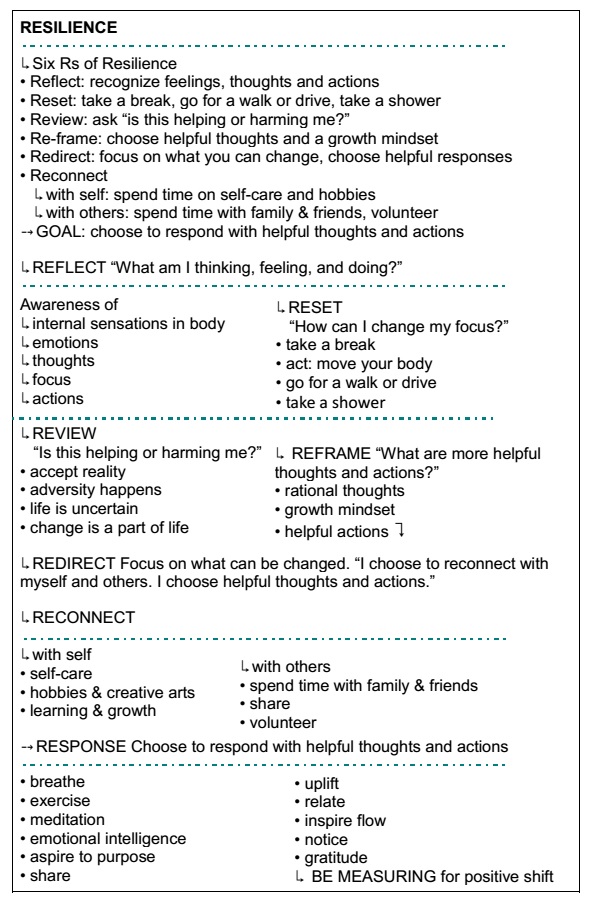
Mastering the skills of resilience helps us to navigate when the waters of life become choppy and we may begin to doubt our abilities to handle the challenges.

Six Rs of Resilience:
• Reflect: recognize feelings, thoughts and actions
• Reset: take a break, go for a walk or drive, take a shower
• Review: ask “is this helping or harming me?”
• Reframe: choose helpful thoughts and a growth mindset
• Redirect: focus on what you can change, choose helpful responses
• Reconnect
↳ with self: spend time on self-care and hobbies
↳ with others: spend time with family & friends, volunteer
⤍ GOAL: RESPOND choose to respond with helpful thoughts and actions

↳ REFLECT “What am I thinking, feeling, and doing?”

Awareness of
↳ internal sensations in body
↳ emotions
↳ thoughts
↳ focus
↳ actions

↳ RESET “How can I change my focus?”
• Take a break
• Act: move your body
• Go for a walk or drive
• Take a shower

↳ REVIEW “Is this helping or harming me?”
• Accept reality
• Adversity happens
• Life is uncertain
• Change is a part of life

↳ REFRAME “What are more helpful thoughts, feelings, and actions?”
• Rational thoughts
• Growth mindset
• Helpful actions ↴

↳ REDIRECT “I choose to…”

• Focus on what can be changed
• Plan purpose

↳ RECONNECT

↳ with self
• self-care (more about resilience)
• hobbies and creative arts
• learning and growth

↳ with others
• spend time with family & friends
• share
• volunteer

↳ RESPOND: choose to respond with helpful thoughts and actions
• Breathe
• Exercise
• Meditate
• Emotional intelligence… and more at the Building Blocks of Positive Shift

Download the Resilience and EQ pdf | Learn more at the Psychology Pathway | The Coping Skills Toolkit

Books and TED Talks (Amazon links to books provide a small commission to support the Daily PlanIt)

More resources:

Tagged with: , , , ,
Posted in personal development

Field Notes for Productivity

For my own task management system, I rely a lot on lists in Google Drive and Keep. As I try to drill down to what is truly important in the moment, it helps to have printed information about finding focus, combating procrastination, choosing priorities, and planning easily accessible at all times.

FieldNotesSystem

For those who prefer analog over digital solutions, there are many options. Field Notes are one popular paper option. These are small (3.5 x 5.5) notebooks that are pocket size and therefore very portable and easy to carry. If a calendar is desired too, an inexpensive Mead pocket planner (or most that are similar) is 3.5 x 6 inches, which allows for tucking a Field Notebook into the pocket of the front cover. Two packs of 3×3 post-it notes can fit into the pocket of the back cover, or whatever else you desire. (foldable inserts, anyone?!)

FieldNotesDailyLists

The first Field Note insert from the Daily PlanIt has space for daily and other lists, a weekly plan, repeating tasks and routines, and a reminder to include activities for self care and to make positive shift happen.

The next insert guides decisions with the Effect Priority Matrix, a list of values, strengths, talents, and skills, and a place for purpose, mission, vision, and a value statement. This helps to target priorities to focus on and make use of resources to act on them.

The third insert is all about finding focus, motivation, and combating procrastination to actually get things done.

The final insert has information for planning and reviews, including a place for goals.

With these four inserts as guides, a pocket system based on Field Notes can be highly effective.

Download the Field Notes Insert Set pdf

Posted in goals, productivity
eBooks

Enter your email address to follow this blog and receive notifications of new posts by email.

Archives
Blog Stats
  • 752,385 hits