Procrastination Triggers

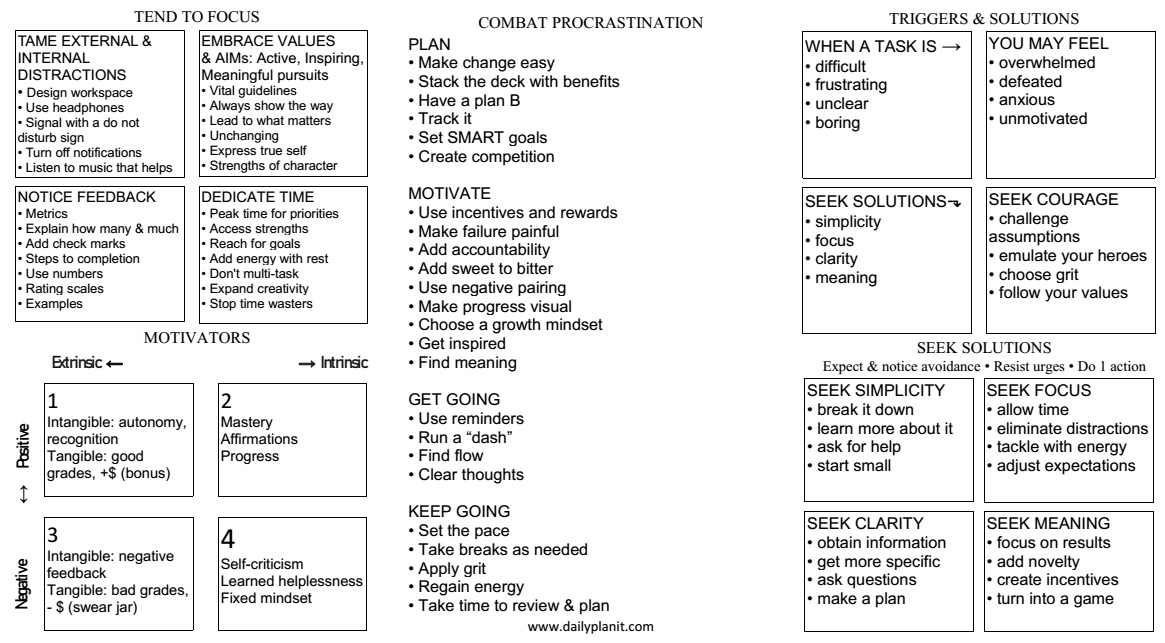
When procrastination happens, it helps to know what to do instead.

Procrastination is a failure to regulate yourself. The limbic system of the brain has an automatic response to avoid anything unpleasant or painful, often seeking pleasure for a hit of dopamine instead. To overcome this automatic response, engage the thinking brain to accomplish tasks that are important but difficult or unpleasant.

There are many who profit from taking advantage of the desires of the limbic system and build in the reward of increased dopamine to make our phones and devices addictive. Be aware of this, and create distance to reduce distractions and focus.

Recognize the feelings that indicate a procrastination trigger, understand the reason for the behavior, and choose to seek better solutions instead of the avoidance response.

Procrastination triggers – that can create an automatic avoidance reaction.

When a task is…

• difficult
• frustrating
• unclear
• boring

We may feel

• overwhelmed
• defeated
• anxious
• unmotivated

and engage in an automatic avoidance response to reach for escape with…

• food or drink
• social media
• videos
• games

INSTEAD, intervene with the thinking brain to seek better solutions with…

• simplicity [break it down]
• focus [four fantastic tools for focus]
• clarity [planning is thinking]
• meaning [purpose planning]

Download the free Procrastination Triggers pdf

Fear can often be at the root of procrastination – seek courage…

• challenge assumptions
• emulate heroes
• choose grit [the wimpy person’s guide to grit]
• follow values [map your values]

Practice choosing courage and develop the strength to tackle the hard tasks!

Read more at

Posted in productivity

Yes or no?

In the movie “Yes, man,” Jim Carrey’s character decides to say yes to everything, and it leads to some amusing situations. Sometimes saying yes to opportunities can lead to expanding your comfort zone and some pretty amazing things. However, saying yes to everything does not always work out well!

When we say yes to one thing, we are saying no to other things. Our time and energy are limited resources, and we simply can’t do it all. Choose wisely to say yes to what matters most. A TED article by author Ryan Holiday reminds us that every “yes” to one thing is a “no” to something else. Watch his TED talk (20:37) and read more about the angst guide to motivation.

So how do we decide whether to say yes or no to something?

Take NOTE:

  • Notice the request and ask questions for clarity.
  • Offer appreciation “thanks for thinking of me”
  • Take time “I’ll think it over and get back to you tomorrow”
  • Examine options – take STOCK

Take STOCK – does this fit?

  • Strengths and abilities
  • Time and energy
  • Other VIP AIMS: very important pursuits that are Active, Inspiring, Meaningful Solutions
  • Commitments and obligations
  • Key values

ASK: Will saying yes to this mean saying no to another priority? Will it take away from something else that is important? Will it over-extend you? An article at Fast Company provides three questions to ask yourself before saying yes or no to anything.

person doing thumbs up

Photo by Donald Tong on Pexels.com

Say YES to:

Say No To:

  • PASS on requests that don’t fit your priorities, abilities, strengths, or schedule.
  • Activities that provide low returns or NO returns! those that…
  • Sap your energy and suck up too much time, or are…
  • Simply stupid time wasters and distractions.

If your decision is no, communicate clearly and respectfully:

  • Not now or never
  • Offer alternatives – other ways or someone else
  • Politely decline
  • Explain reasons

Some possible responses:

  • “I have other plans.”
  • “My schedule just won’t permit it.”
  • “I have too many other commitments.”

Once a decision has been made, it is Time to Act! Read more at How to Say No from Lifehack.org, Practice Saying No from Christine Carter, and 20 ways to say no at onlineorganizing.

Posted in goals

PLANS for an Annual Review

This year, my PLANS for performing an annual review incorporate new things that I have learned organized in an efficient outline view. (The information at An Annual Review is also still helpful and relevant. You can download a free Keep It Super Simple Annual Review form pdf there)

PLANS for an Annual Review

Purpose Planning
Look at priorities
Assess VIP AIMS- are they still:
➸ relevant, productive, meaningful, significant?
Note effectiveness of productivity elements
Set new goals

1. Perform Purpose Planning [purpose planning]
• Mission
• Vision [create a vision board] find Very Important Pursuits that are Active, Inspiring, & Meaningful Solutions
• Values
• Goals

2. Look at priorities [priority flowchart]
↳ Assess VIP AIMS [how to choose VIP AIMS] are they:
• Relevant
• Actually advancing progress
• Making a major difference
• Producing real change
• Significant

3. Note effectiveness of productivity [perform a time audit]
• System [Choosing a Time Management System]
• Plan & Review [Planner Checklist]
• Routine [A Daily Routine] & workspace [Design Your Ideal Workspace]
• Focus [Four Fantastic Tools for Focus]

4. Set new goals [How to Set Goals]
• Personal [Choosing Goals] & purposeful [contribute to VIP AIMS]
• Lead to desired outcomes
• Outline measurable objectives
• Produce Key results

Download a free one page Annual Review PLANS pdf

Tagged with:
Posted in goals, productivity

How to Choose VIP AIMS

Very Important Pursuits are Active, Inspiring, Meaningful, Solutions. To truly focus on what matters most requires thoughtful choices. “We make our choices, then our choices make us.”

PLANITmatrix

What are VIP AIMs?

If you are familiar with the Time Management Matrix for setting priorities, VIP AIMs fall into the Important but not Urgent quadrant. They are often the things that matter most, that unfortunately can easily be neglected when we are distracted by the unimportant.

Values
Increase well-being
Pursue purpose
Active
Inspiring
Meaningful
Solutions

↳ Follow the VALUES that are your guiding principles [see map your values]
Variable personal values
Always point the way
Lead to what matters
Unchanging core values
Express authentic self
Strengths of character

Increase well-being with 12 practices that create positive shift [see the Positive Shift Happens Toolkit]

SEARCH for connection with others [Don’t Wait, Relate]
Sharing
Emotional intelligence
Authentic connection
Relationship building
Communication
Helping others

Pursue purpose by AIMing for a vision that is Active, Inspiring, and Meaningful [see purpose planning]
Awareness
Spirituality
Plan goals
Inspire flow
Renew energy
Expand growth

Active pursuits to AIM for a vision [see Create a Vision Board] are:
Doable actions
Repeatable
Effective
Achievable
Make a BIG impact
Sustainable

Inspiring pursuits [see Press Play for an Appealing Brand Message] are often:
Surprising
Emotional
Amusing
Rare
Clear
Helpful

Meaningful Pursuits [see Setting Priorities] are:
• Relevant
• Actually advancing progress
• Making a major difference
• Producing real results
• Significant

↳ SUCCESSful Solutions [Goal Skills – Problem Solving]:
Solve problems
Useful
Clear measures
Create change
Engage interest
Smart
Simple

AIMSmatrix

Choose Objectives and Key Results (OKRs – see Learn About Goals for more information)

Objectives are shorter term goals designed to reach longer term goals that aim for a vision and mission. Objectives are tied to Key Results, the metrics that measure progress toward the objective. To choose objectives for VIP AIMS, ask: “What is the desired outcome, and how can it be achieved?” and “What is the most significant thing that can be done?”

Google’s central VIP AIM:
• Vision- to provide access to the world’s information in one click.
• Mission- to organize the world’s information and make it universally accessible.

↳ Goal 1. Google calendar for smart scheduling ↳ Goal 2. Google drive for quick access ↳ Goal 3. Google chrome for accurate internet search.

A central AIM may be general, but the goals to reach them must result in objectives that target actions that are specific and measurable. The key results show if the objective is being reached. An example of an OKR for Google Chrome: Build the best web browser as measured by numbers of users.

↳ Goal 3. Google chrome for accurate internet search.

• Objective: build the best web browser
↳ Key Result: measured by # of users

Measurable Key Results

Choose key results that are measurable to know if progress is being made toward an outcome. Ask “How will I know that this outcome has been achieved?”

Metrics
Explain how many or much
Add check marks to a chart
Steps to completion
Use numbers
Rating scales
Examples

See more at How to Make Goals Specific and Measurable.

Meet outcomes
Explain evidence of accomplishments
Target key drivers of change
Reveal results
Include sensory descriptions
Contain clear and simple language

Read more about OKRs below, and don’t miss the TED talk from John Doerr at Learn About Goals.

Download the Annual Review and VIPAIMS outline.

With goals set, use the Planner Checklist to use your time well and act on the most important priorities.

Tagged with: , ,
Posted in goals, productivity

Learn about goals

Six TED talks to help you set goals

Goal setting is such an important skill in life and work, because goals make it possible to focus on what matters most. The TED talks below, plus a few more videos and books have helped me learn about setting and reaching for goals. To aspire is one of the practices that increase happiness and well-being. Learn more at the post How to Set Goals, the Goal Toolkit, and with my book “Get Goaling.”

Goals that WORK include:

  • WHY? purpose and passion reflected in action
  • Objectives are WHAT you will do to go in the right direction
  • Reflect values
  • Key Results are HOW you will achieve the goal

John Doerr talks about Objectives and Key Results (OKRs) in his TED Talk Why the secret to success is setting the right goals (11:51) Read more in his book “Measure What Matters .” OKRs work for both business and personal goals.

“Goals” by Brian Tracy – video (32:15)

“Your Best Year Ever” by Michael S Hyatt – summary (9:42)

Tony Robbins – goal setting video (42:16) Bonus: TED talk “Why We Do What We Do” (23:12) Tony emphasizes connecting SMART goals to vision and purpose for laser focus.

This video talks about the importance of knowing why you want to achieve the goals you have chosen. Goals that are meaningful are powerful. See End Goals Lead to a Meaningful Journey. Next, you need to know how you plan to achieve them, because the science of goals shows that specific and written goals are far more likely to be accomplished. Planning and making goals measurable are some of the vital skills for setting goals. Learn more about planning at Skills Employers Want #4 – Planning.

Bonus books, TED talks and video (Amazon affiliate links provide a small commission to help support the Daily PlanIt)

aspiredefinition

To aspire is to direct one’s hopes or ambitions toward achieving something. Learn how to take six actions toward reaching your aspirations with ideas from the books and videos below, which include five TED talks.

  • Act on purpose
  • Set your mindset
  • Pick priorities
  • Inspire motivation
  • Resolve to apply grit
  • Establish habits

Act on purpose

Read Victor Strecher’s “Life on Purpose” and watch his TED Talk (26:09)

Goals that AIM toward a vision that is Active, Inspiring, and Meaningful have built in motivation. Read more about Purpose Planning at the Daily PlanIt.

Set your mindset

Read “Mindset” by Carol Dweck. Watch “Developing a Growth Mindset,” (9:37) and see more resources. Determination and persistence are important to accomplish goals.

Pick priorities

Stephen R. Covey talks about the Time Management Matrix in “First Things First.” Watch a video book summary (11:28) and Using the Eisenhower Matrix (5:40). Stephen R. Covey speaks about priorities in the video below. (7:11, this one is not a TED talk)

“Effectiveness is doing the right things.” – Peter Drucker. Find activities that are very effective because they provide BIG impact and HIGH engagement with the Effect Priority Matrix at The Priority Flowchart. Read more about setting priorities at the Daily PlanIt.

Inspire motivation

Read “Drive: the surprising truth about what motivates us” by Dan Pink and watch his TED Talk “The Puzzle of Motivation” (18:36)

Learn more about motivation at the Daily PlanIt post “What’s the Motivation?

Resolve to apply grit

Read Angela Duckworth’s book “Grit“and watch her TED talk (18:37)

Read more about grit at the Daily PlanIt post “The Wimpy Person’s Guide to Grit

Establish good habits

Read “Atomic Habits” by James Clear. Then watch Dan Ariely’s TED Talk on Self Control (17:49).

Read more about creating habits here at the Daily PlanIt.

Once you have chosen goals and made them written and SMART, use your time well to make them happen! See more of my favorite books for a year of pesonal growth.

Tagged with: , , ,
Posted in Books, goals, videos

Conversation Starters

Conversation starters can lead the way to meaningful conversations. A study by social psychology researcher Arthur Aron at Stony Brook University revealed that 36 questions (available at Greater Good) can lead to closer relationships.

31ConversationStarters

1. The thing you most like about the work you do/have done?
2. Do you have a project that you are proud of?
3. What is your favorite productivity tip or app?
4. What is your favorite game to play?
5. Who was your favorite teacher and why?
6. What is something you wished you had learned in school but didn’t?
7. How can education be improved?
8. Your favorite place to go?
9. Best trip you ever took?
10. The most interesting place you’ve ever been?
11. What is your favorite healthy thing to eat?
12. What was the best advice you ever received?
13. Best compliment you ever received?
14. What is one of your biggest strengths?
15. What super power would you like to have?
16. What do you love to talk about?
17. What causes you to experience flow?
18. Is there something you’ve never done that you’d like to try?
19. Best gift you ever received?
20. Best gift you have given?
21. Nicest thing anyone ever did for you?
22. What would tell your 12 year old self if you could?
23. What is a favorite memory of your childhood?
24. Do you have a dream that you’ll always remember?
25. When have you been happiest in life?
26. What inspires you or gives you hope?
27. What makes you feel peaceful?
28. What social issue or cause would you most like to improve?
29. What has been the biggest challenge you’ve ever overcome?
30. What would your future self tell you to do now?
31. What person (that you know or someone famous) most exemplifies courage or integrity?

Download 31 Great Conversation Starters plus 12 weekly questions for close relationships at Don’t Wait, Relate.

12ConversationStarters

See more ideas at Conversation Bingo at A Networking Game Card and learn more about communication.

RESOURCES

Apps
• Beyond Small Talk (see How to Have Better Conversations)
• Big Talk, card decks at weshouldgettogether.com (see book by Kat Vellos)

Tagged with:
Posted in love & relationships

Planner Checklist

Planning is Thinking: it is important for time managementgoalsprojects, and even purpose. It is one of the top 10 skills employers want. Planning your time helps you to make the most of it so that you can accomplish what matters most to you. This new printable outline for planning and reviewing time use can help – Download the free PLAN & REVIEW bookmark pdf.

PLAN

DAILY

Plan for the day – review calendar
Look at priorities & make to do list
Act – focus on one task at a time
Note peak time & use it well
Tend to focus
Include incoming tasks in system
Manage energy with a regular routine
Examine progress – review the day & repeat daily

WEEKLY

Review progress
Explore options
View schedule and tasks
Important work #1
Examine priorities
What’s next? the Weekly Plan

MONTHLY

Prepare needed information & tools
Realign priorities
Outline a plan
Check systems
Execute updates
Select next projects
Schedule steps

YEARLY

• Annual Review
+Look for GEMS
Goals achieved
Experiences
Milestones
Set goals for next year
-Time LOST
Lessons learned
Obstacles & challenges
Solutions
Time wasted

Explore more ways to optimize your life at http://www.dailyplanit.com!

Posted in productivity

The Priority Flowchart

Knowing where to begin on a to do list is important in day to day planning. To make the most of your time, learn more about Setting priorities with the Time Management Matrix, a well-known method that compares the urgent with the important. The challenge is to deal with the urgent without neglecting the less urgent yet still very important.

“Efficiency is doing things right. Effectiveness is doing the right things.” – Peter Drucker.

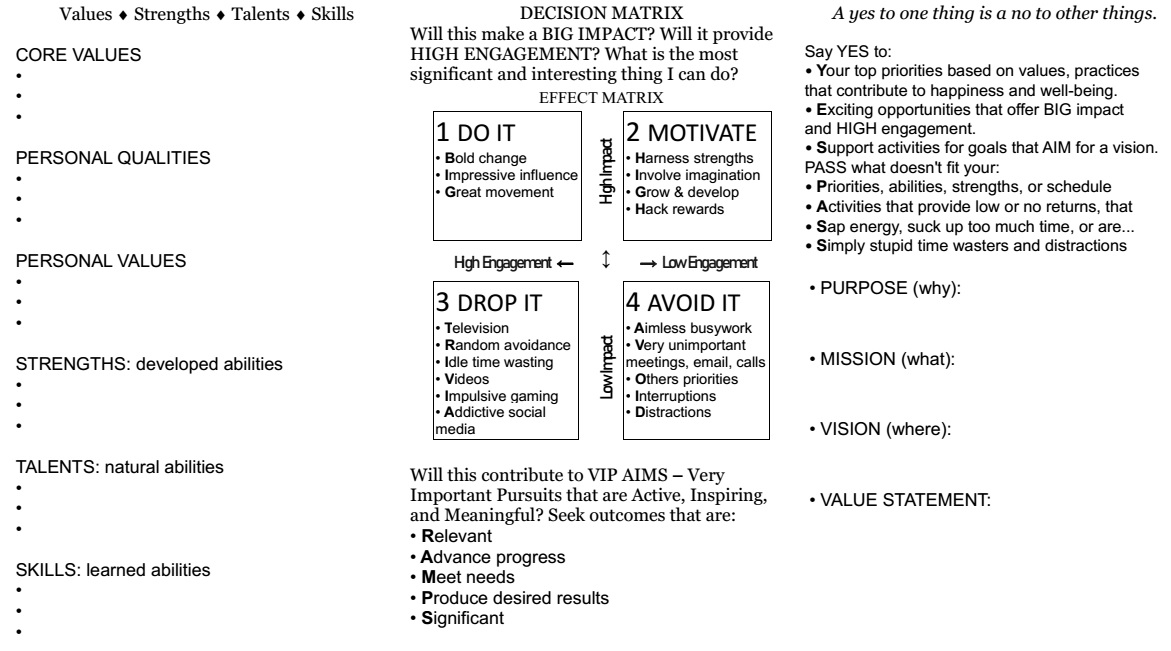
Setting priorities also vital in choosing what to do with your life. For longer range planning, the most effective use of your time is to choose goals, projects, and activities that make a BIG impact and engage your strengths. The Effect Priority Matrix compares impact with engaging strengths to create effective results for achieving VIP AIMS that are Active, Inspiring, Meaningful, and Significant.

  1. Activities in Quadrant 1 may have Big Impact but are Low Strengths. For this area, identify and develop STAR strengths: Skills, Talents, and Abilities that Recharge energy, and Start flow – Develop It!
  2. Effective projects or activities in Quadrant 2 result in a BIG impact with Bold change, Impressive influence, and Great movement. ACT with strengths that Capture interest and imagination and Target growth. They engage STAR Strengths  – Do It!
  3. Activities that do not engage strengths and have Low Impact in Quadrant 3 include Aimless busywork, Very unimportant meetings, emails, calls, Others priorities, Interruptions, Distractions – Avoid It!
  4. When Strengths are High but Impact is Low in Quadrant 4, activities provide low Results, Energy, and little Movement, they Offer less passion, Value, and Engagement – Remove It!

For choosing priorities in longer range planning, ask “Does this contribute to purpose?” and “Will this meet needs?”

Activities that are GREAT priorities:
Give BIG impact
Really significant
Engage strengths
Are meaningful
Target purpose

What results when these are put together, is a Priority Matrix Flow. Download the Priority Matrix Flow pdf.

Run choices through this priority flow to focus on what really matters and Make Shift Happen.

My original thoughts about a priority flowchart included Return on Investment.

priorityflowchart

1. Is anything URGENT?
a. Check calendar for: deadlines, appointments, meetings, etc.
Nope, nothing –
b. Any crisis? Yup – handle it right now.
Nope, nothing awful is happening –
c. Are there unpleasant “frog” must dos? Sadly Yes – suck it up and HOP TO IT! Learn some strategies to combat procrastination.
No, thank goodness! –
d. Have you done the routine, repeating tasks that must be done? Not yet – don’t forget them! Follow a daily routine to automate these tasks and remember to include self-care for wellness.
Yes – Yay! Let’s go to the next step!

2. What else is IMPORTANT to do?
IMPORTANT VIP AIMS are: Vital to values, Increase positive shift, Pursue purpose, Active, Inspiring, Meaningful, Solutions.
You have no idea – a. choose goals b. plan purpose c. include BE MEASURING practices
YES! You’re ready to get goaling, pursue purpose, and create positive shift! Onward to step 3!

a. Have you set written goals? No – Choose goals to improve your life in four life areas.
Yes – go to b.

b. Do you have an AIM for a vision that is Active, Inspiring, and Meaningful? No – higher level goals pursue purpose. Do some purpose planning for higher level goals. Yes – go to c.

c. Have you practiced the four Ps of positive shift? No – Remember to Power up, Pause, pursue Purpose and connect with People. Yes – go to the next step

3. Will this goal or task create a BIG IMPACT? BIG = Bold change, Impressive influence, and Great movement. Not really – maybe later. It sure will! – move to the next step

4. Will this goal or task provide HIGH ENGAGEMENT that will Harness strengths, Ignite imagination, Grow and develop skills, and Have intrinsic rewards? No – a. look for motivation or avoid it. Yes, it’s highly engaging – use caution if the IMPACT is low. Yes, it has both BIG IMPACT and HIGH ENGAGEMENT! – go to the next step to determine the Return on Investment.

5. Are there high BENEFITS for a low investment (ROI)? No – maybe later if costs (consider size, time, energy, access, and money needed) can be reduced and benefits (gain, revenue, appeal, impact, needs met) increased.
Yes, there are lots of benefits compared to the resources required – LET’S GO! It’s time to Make Positive Shift Happen! Read about the BE MEASURING activities that Make Positive Shift Happen.

Posted in goals, positive shift, productivity

Wheel of Awareness

The ability to notice is vital to know when it is time to shift. When we notice our senses, bodily sensations, thoughts and feelings, and interactions with the outer world, we increase our awareness. Dr. Daniel Siegel created a tool called the Wheel of Awareness. Try the Wheel of Awareness spinner variation below.

AwarenessWheel

SENSES
1. sight
2. touch
3. sound
4. smell
5. taste

BODY
6. heart rate
7. breath rate
8. temperature
9. posture
10. tension/pain

MIND
11. goals
12. thoughts
13. beliefs
14. interpretations
15. emotions

OUTER INTERACTIONS
16. actions
17. attention
18. observe
19. reactions
20. actively listen

MatrixAwareness

RESOURCES

Learn more about how to understand and identify emotions, how emotions are revealed in the body, and how to listen.

Posted in positive shift

Purpose Planning

Unlock Purpose

Unlocking purpose is one of the most important and complex puzzles we can undertake. Creating a roadmap that includes the elements of a strategy for a clear purpose are VIP AIMS [Mission – Vision – Values – Goals] provides direction and fuels motivation. Purpose planning is long term thinking to decide what is most important to you so you can focus your attention on that. It is not an easy task and it takes time and work. But the meaning it gives to life makes it worthwhile.

Pursue purpose
Look at mission
Align with values
Name an AIM for a vision
Select significant goals

Value based Vision (where)
Important Mission (what)
Purpose (why)
Active movement
Inspiring appeal
Meaningful measures
Significant solutions

VennDiagramMissionVisionValues

MISSION (what)

Your mission is what you do now and why. A mission includes how you do what you do, who you do it for, and for what benefits and value. It clarifies your purpose and motivates you to accomplish the goals that will move you forward toward your vision. Create a personal mission statement with a value statement formula. This is the power tool for Purpose, one of the four Ps of Positive Psychology. Watch: How to Create a Personal Mission and Vision Statement from Dale Carnegie Training (5:49)

Maps out WHAT you do
Includes WHY you do it (purpose)
Set in present NOW
Shows HOW you do it
Includes special WAY you do it
Outlines benefits to others &
Needs met (value provided)

VISION (where)

Your vision is about where you are going in the future, what you want to achieve, and what the world will look like when you do. A compelling vision provides direction with positive words and emotions. AIM for a vision that is Active, Inspiring, and Meaningful. Simon Sinek describes vision as a “just cause,” one that is so important you are willing to sacrifice and work hard for it. Watch: Is Why or Vision More Important? He says there are 3 Things That Make a Meaningful Vision: 1. It is resilient, able to withstand change. 2. It is inclusive, an invitation to all to contribute to it. 3. It is service oriented, the primary benefit is to others. A vision board collage of positive words and pictures that illustrate goals is a visual and visible reminder to move forward and take action.

Visualize where you are going
Inspire -what success looks like
Set in future –the ultimate goal
Images and words
Objectives and goals
Needs of the world

PURPOSE & VALUES (why)

Purpose is why you exist, your reason for being, the problem you want to solve. Learn more about how to UNLOCK purpose at Clues to Purpose.

  • Understanding of self and what you…
  • Need to chase
  • Love to learn about
  • Often lose track of time doing
  • Changes you want to make
  • Keep wanting to build

Your values are the guiding principles you believe in, and they provide a solid foundation for all other elements. Learn how to Map Your Values to discover what your values are.

GOALS (how)

Once you have a mission and vision that is based on your purpose and values, you can begin to make a plan for how to get there. Your goals are how you will carry out your mission. They outline a plan that describes the special way that you solve the problem and helps establish priorities.

Different goals may all contribute to a central AIM. For example, my own goals to tutor reading, facilitate a vision board workshop, and to write a book about positive shift, all contribute to my central AIM of freedom through education. Goals that align with values have intrinsic motivation built in. Learn more about choosing goals in different life areas. Goals for mission and vision may be general and long term, so planning more specific objectives with measurable actions and SMART wording is the next step.

Download the Mission – Vision – Values – Goals pdf

VisionMission

To select priorities for planning goals and purpose, it is especially important to consider VIP AIMS and the factors of impact and engagement with The Effect Priority Matrix. Setting priorities is also a vital skill for effective time use when planning your day.

PurposePlanning

Download a free pdf that outlines Purpose Planning and Priorities.

Strategies for Planning Purpose

KNOW YOURSELF

The more you know yourself, the better you will be able to develop a plan for purpose. Download a free Self Assessment form at the Brand and Purpose Toolkit. Explore the Discover U series and find links to online tools at the Discover U Toolkit at Wakelet, or in the free ebook on How to Start a Fire. Links are also at Uncover Hidden Talents.

KNOW THE UNIQUE VALUE YOU PROVIDE

How will you use your special mix of strengths and talents? Look for a unique solution to solve the problem that most captivates your attention, and that will meet the needs of Your Target Audience.

ALWAYS BE COMMUNICATING VALUE

To get others interested and involved, be sure to always communicate the value that you add by meeting needs with the benefits that you provide. Watch a video from the Latimer Group on How to Be Heard in a Noisy World.

Purpose planning is a continuous process, and it may need to be updated during an annual review.

Many resources for the career search process are also helpful in purpose planning. Learn more about personal development at the Brand and Purpose Toolkit. Check out Mission and Vision Statements at Mindtools.com and more at the value statement Pinterest board.

Posted in personal development
eBooks

Enter your email address to follow this blog and receive notifications of new posts by email.

Archives
Blog Stats
  • 736,794 hits