Is Your Genius at Work?

Notes on the book “Is Your Genius at Work?” by Dick Richards.

(Affiliate link: I receive a small commission at no additional cost to you if you click through and make a purchase with an affiliate link. Thank you for your support!)

  • Genius=talents
  • Purpose=the reason your talents exist

The author provides 32 exercises to assist in identifying your genius. The primary method is to give it a name that contains one gerund (a verb that ends with the suffix ing) and one noun. Some examples: Digging Deeper, Taking Care…the possibilities are many. You can make guesses as to what it might be, try it on and keep changing it until it feels right.

4 Key Questions:

  1. What is your genius?
  2. Is your genius at work?
  3. What is your purpose?
  4. Is your genius on purpose?

I’m still thinking about mine! This is the most helpful book I’ve ever come across to grapple with this question.

Here’s a free tool with word lists to inspire ideas for Finding Genius I created.

Posted in Books, personal development

Discovery of the Day

How to Get Started with Getting Things Done on BNET. Lots of other neat stuff here too.

Posted in information management

Discovery of the Day

Ageless Learner has a variety of interesting assessments and articles, including a learning culture audit.

Posted in information management

Are You Ready to Succeed?

Notes from the book “Are You Ready to Succeed?” by Srikumar S Rao:

Happiness is not something you “get”-it is what you are.

Our perceptions shape our reality. Do you choose a negative reality?

Become aware of mental chatter, and shift from judgment to awareness to cultivate growth. Don’t feed your mind junk. The dog you feed will grow stronger.

Law of Increase: whatever you are truly grateful for and appreciate will increase in your life. When you change, the universe changes. Visualize what you want and combine doing with being. Recognize and surrender expectations about outcomes. We control actions but not outcomes. Accept outcomes that may be different than we expected without judgment. We think of freedom to…speak, practice the religion we choose. The greatest freedom is freedom from…the belief that something outside of us is the source of happiness.

Passion with detachment. Follow your path motivated to bring about a better outcome, accepting that we can take actions, but not the results are not in our control. Detach from emotional involvement in a particular result.

Set down the burdens of guilt and blame.

Law of Self-Interest: everybody always acts in their personal self-interest. Even our good intentions to help others are motivated by a need to feel good about ourselves. We do the best we can with where we are.

Change to a mental model of a benevolent universe that provides for us in ways we do not understand. You may be on a different path to get where you need to be.

Reconciling tragedy and suffering. Being human means we make mistakes. Being alive means tragedies happen, and we can learn and become stronger. We can gain strength to transcend the fire by connecting with the universe/higher power. We are responsible to do what we can to lessen suffering consciously.

The book contains many exercises to increase awareness.

Posted in Books, personal development

Share the love

Volunteering connects us with others and with a sense of purpose. Finding a meaningful cause we believe in helps to clarify our vision. It can be very satisfying to volunteer to help others with our strengths and talents. See more benefits of volunteering at helpguide.org. Find volunteer opportunities that match your Myers-Briggs Personality Type at Truity and Authory.
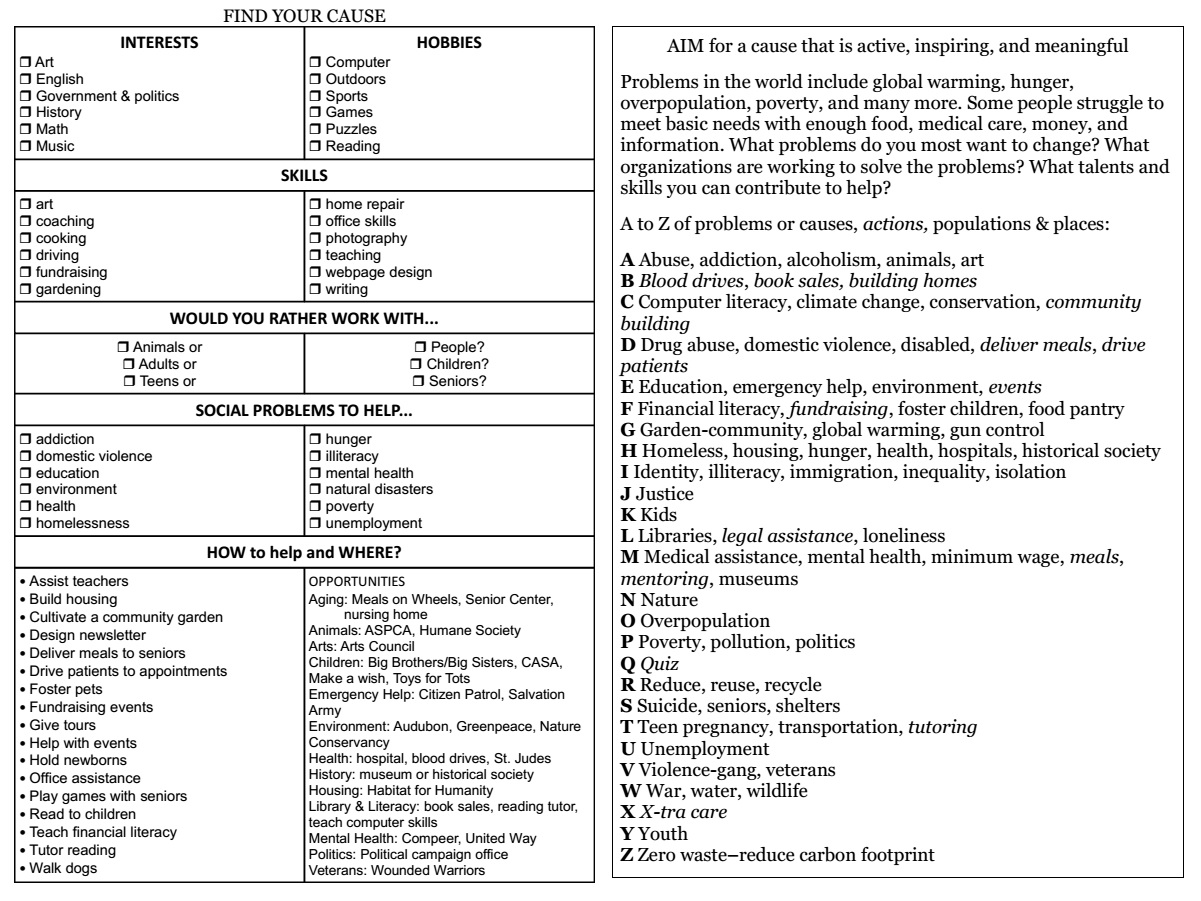
Download a printable Volunteer Bookmark pdf to locate how you might use your interests and skills for the needs of an organization for a cause that is meaningful to you.

Look for a social issue that you feel is most important to improve. What problems do you most want to change? What populations do you most want to help? What organizations serve those populations? What actions can you take to help? How can you contribute your talents and skills?

A to Z of problems or causes, actions, populations & places

A Abuse, addiction, alcoholism, animals, art
B Blood drives, book sales, building homes
C Computer literacy, climate change, conservation, community building
D Drug abuse, domestic violence, disabled, deliver meals, drive patients
E Education, emergency help, environment, events
F Financial literacy, fundraising, foster children, food pantry
G Garden-community, global warming, gun control
H Homeless, housing, hunger, health, hospitals, historical society
I Identity, illiteracy, immigration, inequality, isolation
J Justice
K Kids
L Loneliness, legal assistance, libraries
M Medical assistance, mental health, minimum wage, meals, mentoring, museums
N Nature
O Overpopulation
P Poverty, pollution, politics
Q Quiz – try a quiz to find a good volunteer match
R Reduce, reuse, recycle
S Suicide, seniors, shelters
T Teen pregnancy, transportation, tutoring
U Unemployment
V Violence-gang, veterans
W War, wildlife
X X-tra care
Y Youth
Z Zero waste–reduce carbon footprint

There are many opportunities available, many more than the partial list above which is intended to inspire thinking. They will vary depending on your community, so explore the possibilities!

Almost every organization has a need for financial support and fundraising. Maybe they need help maintaining a webpage, writing a newsletter, or help with landscaping. There may be people who need transportation to doctor’s appointments. You could spend time at a nursing home reading to someone or playing a game they enjoy. You could join a political campaign, or work in a hospital gift store.

Once you identify an organization you would like to volunteer for, contact them to ask what they need and listen to the answer. Offer ideas for ways you could use your skills to help. Decide what kind of time commitment you would like to make, then follow through.

GOAL STATEMENT

I will help [which group or organization] the arts council [when] every Saturday [how much] for an hour a week by [doing what] staffing the gift shop.

Unwrap Your Gifts | 12 Ways to Give | Discover Your Talents at the Daily PlanIt Sticky Wiki | Volunteermatch.org | Networkforgood.org | TED talk: Mark Bezos A Life lesson from a volunteer fireman

This is one of the weekly activities for a Year of Personal Development.

Tagged with:
Posted in personal development

Discovery of the Day

Via Troy Worman at Orbit Now!Persistence or Re-Invention: 10 great tips to re-evaluate your goals at The Ultimate Corporate Entreprenuer“10 ways to explore your direction”

Posted in goals

Time management 101

Time-Management-101

A Tutorial for Increasing Productivity

calendar flip

The System

  • Select a calendar to manage your time, tasks, and lists.
  • Your choice – choose what works best for you.
  • Start with a To Do list and set priorities to complete the most important tasks. ↴
  • Then add other lists that you need, and decide where you will keep them.
  • Essential goals and projects to keep track of.
  • Make lists of repeating tasks.

Possibilities:

compass

The Focus

Adjust direction by embracing values
Clarify what is important – gain direction with a value statement that pinpoints what you do and why (the power tool for purpose). It includes how you add value based on what your values are.
Target GREAT priority tasks to say YES to:

  • Give big impact
  • Requirements that are urgent
  • Extend high engagement
  • Are important
  • Target good return on investment

Four Fantastic Tools for Focus

planner

The Plan

Use your system to:

ClockLarge

The Routine

Get Organized

timetarget

Goals and Productivity are like peanut butter and jelly. To spend your time where it most matters to you, begin by setting goals that align with your value statement or Unique Selling Proposition. Learn how to set goals and achieve them with this free tutorial. Learn more with the Daily PlanIt eBook “Get Goaling”

“Efficiency is doing the job right. Effectiveness is doing the right job.”-Peter Drucker

Toolbox

Tools for Productivity (hint: see Free Tools)

Daily

Weekly

Learn about the study of productivity, with videos and courses

Master Productivity: Productivity Levels (pdf based on posts at The 2Time Mgt Blog)

MORE RESOURCES

Posted in productivity

To Do List

A To Do list is a basic tool to be more productive and an important part of any system for task management. Some people like to keep an electonic list or use a to-do app, while others prefer a written list. Whatever you choose, creating an effective To Do list is a part of daily planning that will help you combat procrastination and get motivated to get the important stuff done.

Has your To Do list gotten out of control? When you list everything you need to remember and get done, the result can be overwhelmingly long.

The To-do Today list is best kept simple.

Superman

Super Simple ways to pick priorities:

  • Oliver Burkeman advocates planning each workday around a 3-3-3 model, with three hours for deep work, three urgent tasks, and three maintenance tasks.
  • The 1 – 3 – 5 Rule suggests choosing one large task, three medium tasks, and five small tasks.
  • The Most Important Tasks (MITs) method from Leo Babuata of Zen Habits. After reviewing your calendar, choose only a few MITs, three things that MUST be done today.

Important tasks can be routine things, like a report that is due today. Sometimes there are unpleasant frogs or DAM CRAP that must be dealt with. But don’t let the less urgent Very Important Pursuits that are Active, Inspiring, and Meaningful Solutions get lost in all the distractions that compete for attention.

With your to do list at hand, begin the day by focusing first on the top priority task. Once that is completed, move on to the next. If time is available, add more tasks from your weekly plan, repeating tasks, work goals, and action steps for goals and projects.

When you keep your To-do Today list simple, you need somewhere else to keep all the OTHER stuff you need to do. That’s why we need more than one to-do list for The Daily PlanIt Keep It Super Simple (K.I.S.S.) System. Decide how you will capture these items in other lists. These may be kept in a To-do app, or a list in Google Drive or Evernote. I have come to really appreciate the abilities of Google Keep for lists and reminders. Or if you prefer paper, you may want to keep them in a planner or notebook.

Beyond the To-Do Today List Options:

  • You can set up a To-do Next list, or lists for To-Do Later, To-do This Week, etc.
  • You can use a master list.
  • You can use lists from Getting Things Done  (GTD):  next actions, projects, waiting for, and someday/maybe. (I prefer different terminology)

Incoming Tasks

During the day, be prepared to capture tasks that arrive in various ways: via email, meetings, conversation, phone messages, etc. Recognize and add incoming tasks into your system, and delete the ones you accomplish.

De-clutter your To-do lists

Are your To-do lists cluttered with repeating tasks and daily routine activities? Few time management systems have a good way to deal with these. Here’s how to de-clutter your To-do lists.

Repeating (or recurring) tasks

We all have repeating tasks for home and work. For home, there are maintenance tasks that are necessary to keep life running smoothly and errands like getting gas or going to the bank. For work, there are often job duties that are done on a regular basis. You can keep a separate list of repeating tasks in a To-do app so they don’t have to be re-entered each time they need to be done. Just assign it to a date within your To Do list and it’s there. Once completed, simply send it back to the repeating task list. Even though I like having a list of repeating tasks, I don’t use the recurring feature in to-do apps, because some of these tasks are needed on an irregular basis. If it’s something I will likely forget without a reminder like changing the oil in the car that I want to remember in a few months, I schedule it in my calendar.

Daily routine activities

I don’t like the things I do as part of my regular daily routine to constantly show up in my tasks or calendar. I prefer to keep them as a separate list in Google Drive.

To-Do Apps: There are many options available for to-do apps. See Apps for Productivity and learn about the Daily PlanIt K.I.S.S. System. Google Tasks is a part of Google Calendar that has become a very useful tool.

For People Who Prefer Paper

Daily PlanIt free printable forms

From Others: The To-do List from Samplewords is a neat pdf you can type your own information in. Find more at the Free Tools page and at the Productivity Tools Pinterest board.

You can manage your tasks with a To-Do Today List and other to-do lists you like. To-do lists are a big part of daily planning. The next step is to actually get them done! Learn more at the Daily PlanIt Time Management 101 Tutorial. You might also like Planning is Thinking, a Planner Checklist, a weekly review and a Weekly Plan.

Further Reading: Craig Jarrow, the timemanagementninja, calls it a TODAY list and shows 10 Things Wrong With Your To-Do List, Back to Basics: How to Simplify Your To-Do List and Make it Useful Again from Lifehacker,  No More Bloated To-Do Lists! at Instigator Blog, Inc Article The Surprising Secret to Time Management,  Do Your Most Important Task First? at 99u & List of Ways to Ruin a List at Brazen Careerist. Watch Creating a To-Do List that Really Works video from Michael Linenberger. See also Time Management at Wikipedia

Posted in productivity

Discovery of the Day

What kind of world do you want? The song “World” by “Five for Fighting” has motivational lyrics and a beautiful melody -on the Two Lights album. Think Anything. Start Now.

Posted in personal development

What’s the Motivation?

Motivation is important to accomplish goals, establish habits, combat procrastination, and get the Important Stuff Done. Motivation drives the desire to act or initiate change, and finding the motivation to take action can be challenging! Motivation is the result of movement, not the other way around. Read more about “The Motivation Myth” by Jeff Haden, Ted talk The most successful person in the world. (Amazon affiliate links to books provide a small commission to support the Daily PlanIt.)

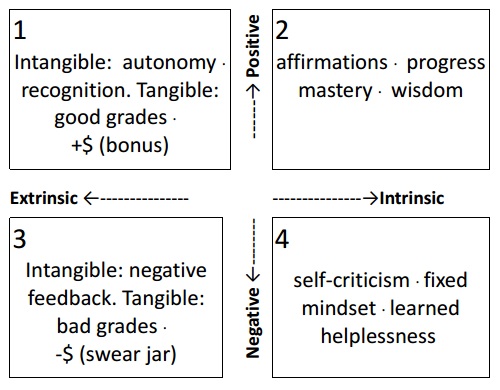
Motivation can come from within (intrinsic) or from outside yourself (extrinsic). It can be intangible, like feedback, or tangible, like grades or money. It may be positive like praise, or negative like losing a privilege.

MotivationMatrix

Some examples of extrinsic motivators that are positive are being paid a bonus for a good job (tangible), and receiving recognition, (intangible). Negative extrinsic consequences may be paying a penalty (tangible) or receiving negative feedback (intangible). Positive intrinsic motivation like affirmations can be powerful, but the opposite of this is negative thoughts like self-criticism, which are demotivating and limit progress.

What motivates each individual varies as we are different in our personalities and what we find rewarding. Explore ways to MOTIVATE!

  • Match Personality
  • Outcomes
  • Timing
  • Intrinsic or Extrinsic
  • Values
  • Add rewards and consequences
  • Tangible or Intangible
  • Energy

Match Personality

Myers-Briggs is a popular method for determining personality types with eight categories in four dichotomies that can combine in sixteen types. Extroverts who organize with order (Judging) are likely to be motivated by external factors such as power and prestige and tangible rewards like money and awards. Extroverts who organize with flexibility (Perceiving) are likely to seek public recognition, novelty, and chances to collaborate with others and express creativity. Introverts who organize with order (J) are likely to be motivated by internal factors and intangible rewards like opportunities to learn, use skills, and generate ideas. Introverts who organize with flexibility (P) are likely to seek creative exploration and want to improve the world and help people. Mastery likely appeals to all types with high Judging, and all types with high Perceiving may seek autonomy.

Outcomes – gain motivation by observing progress on measures.

Timing – consider how often and how soon rewards are received after behaviors. Self-motivation is easier during our peak time. The science shows that prime time for most of us is for two hours about an hour after waking.

Intrinsic or Extrinsic – Intrinsic (internal) motivators are often intangible. Positive intrinsic motivation is powerful, but can be affected by moods, so extrinsic (external) motivators that come from outside of ourselves can have a place. However, be aware that external incentives can decrease intrinsic motivation. Also beware of negative internal thoughts and beliefs that are demotivating and limit progress.

Dan Pink, author of “Drive: the surprising truth about what motivates us,” talks about Mastery, Autonomy, and Purpose. Mastery is the urge to get better at stuff, to learn and create. Autonomy is the desire to act with self-direction. Purpose is the desire to make an impact and add value to life with our strengths and talents. The desire to connect with others is also a powerful motivator. These all related to needs, and are all positive intrinsic motivators. A value statement that clarifies what we do and why is the power tool for purpose.

NeedsMotivation

• Contribution (Purpose) – AIM for a vision that is active, inspiring, and meaningful
• Connection (People) – relate with others
• Competence (Mastery) – correct level of challenge to find flow
• Control (Autonomy) – take action with self directed choices

Valuesmeaningful goals have built-in motivation, so follow your values. AIM for a vision that is Active, Inspiring, and Meaningful.

Add rewards and consequences – a “carrot” is a reward for good behavior. Everyone has their own ideas about what they find most rewarding, so rate the importance level of various rewards for you. Some rewards are bigger than others, so choose a small reward as incentive to accomplishing small steps toward goals, and a larger one for completion. A “stick” is a negative consequence for poor behavior, and they can influence behavior too. For example, putting a dollar in a swear jar each time you slip up can be an effective way to break a bad habit.

Tangible or intangible – rewards can be tangible like grades or money, or intangible like recognition or positive feedback.

Energy – energy is a limited resource. Tasks and projects that require high motivation are best tackled when energy levels are high. Increase energy with self-care activities like getting enough exercise and rest, drinking lots of water, and eating healthy foods.

All of these factors are important for both self-motivation and at work. There are additional things to consider for work motivation.

Motivation at Work

Identifying your work values can help in finding a compatible career and clarifying motivation. Learn more about your work values at careeronestop.org.

Work Values

  • power
  • money
  • prestige
  • independence
  • challenge
  • mastery
  • achievement
  • recognition
  • security
  • self expression
  • collaboration
  • service to others
  • relationships
  • creativity
  • variety

To STREAM motivation in the workplace:

  • Set work goals that are relevant to the mission and goals of the organization. Optimal organizations are clear about them.
  • Train with learning activities to develop skills. Optimal organizations provide opportunities for learning and encourage and support growth.
  • Recognize and reward progress. Optimal organizations provide incentives that employees want. A word of praise for a job well done can go a long way.
  • Expect the best. Optimal organizations communicate their expectations. Employees also have expectations of an employer.
  • Always be aware of the value that your job provides. Optimal organizations provide feedback to employees.
  • Measure outcomes and notice results. Optimal organizations provide information about progress. A simple scorecard makes outcomes like a game providing motivation to improve the score.

Self motivation is one of the skills of emotional intelligence. It can help to mind the GAPPS:

Growth Mindset
• Add habits
• Plan goals
• Pursue purpose
• Set priorities
• Select strategies to overcome procrastination

Books and TED talks

Additional Reading

More on Motivation from the Daily PlanIt:

Posted in personal development, work skills
eBooks

Enter your email address to follow this blog and receive notifications of new posts by email.

Archives
Blog Stats
  • 742,922 hits