Conversation Starters

Conversation starters can lead the way to meaningful conversations. A study by social psychology researcher Arthur Aron at Stony Brook University revealed that 36 questions (available at Greater Good) can lead to closer relationships.

31ConversationStarters

1. The thing you most like about the work you do/have done?
2. Do you have a project that you are proud of?
3. What is your favorite productivity tip or app?
4. What is your favorite game to play?
5. Who was your favorite teacher and why?
6. What is something you wished you had learned in school but didn’t?
7. How can education be improved?
8. Your favorite place to go?
9. Best trip you ever took?
10. The most interesting place you’ve ever been?
11. What is your favorite healthy thing to eat?
12. What was the best advice you ever received?
13. Best compliment you ever received?
14. What is one of your biggest strengths?
15. What super power would you like to have?
16. What do you love to talk about?
17. What causes you to experience flow?
18. Is there something you’ve never done that you’d like to try?
19. Best gift you ever received?
20. Best gift you have given?
21. Nicest thing anyone ever did for you?
22. What would tell your 12 year old self if you could?
23. What is a favorite memory of your childhood?
24. Do you have a dream that you’ll always remember?
25. When have you been happiest in life?
26. What inspires you or gives you hope?
27. What makes you feel peaceful?
28. What social issue or cause would you most like to improve?
29. What has been the biggest challenge you’ve ever overcome?
30. What would your future self tell you to do now?
31. What person (that you know or someone famous) most exemplifies courage or integrity?

Download 31 Great Conversation Starters plus 12 weekly questions for close relationships at Don’t Wait, Relate.

12ConversationStarters

See more ideas at Conversation Bingo at A Networking Game Card and learn more about communication.

RESOURCES

Apps
• Beyond Small Talk (see How to Have Better Conversations)
• Big Talk, card decks at weshouldgettogether.com (see book by Kat Vellos)

Tagged with:
Posted in love & relationships

Planner Checklist

Planning is Thinking: it is important for time managementgoalsprojects, and even purpose. It is one of the top 10 skills employers want. Planning your time helps you to make the most of it so that you can accomplish what matters most to you. This new printable outline for planning and reviewing time use can help – Download the free PLAN & REVIEW bookmark pdf.

PLAN

DAILY

Plan for the day – review calendar
Look at priorities & make to do list
Act – focus on one task at a time
Note peak time & use it well
Tend to focus
Include incoming tasks in system
Manage energy with a regular routine
Examine progress – review the day & repeat daily

WEEKLY

Review progress
Explore options
View schedule and tasks
Important work #1
Examine priorities
What’s next? the Weekly Plan

MONTHLY

Prepare needed information & tools
Realign priorities
Outline a plan
Check systems
Execute updates
Select next projects
Schedule steps

YEARLY

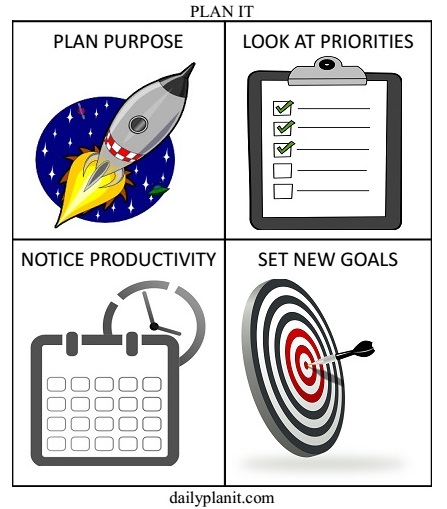
• Annual Review
+Look for GEMS
Goals achieved
Experiences
Milestones
Set goals for next year
-Time LOST
Lessons learned
Obstacles & challenges
Solutions
Time wasted

Explore more ways to optimize your life at http://www.dailyplanit.com!

Posted in productivity

The Priority Flowchart

Knowing where to begin on a to do list is important in day to day planning. To make the most of your time, learn more about Setting priorities with the Time Management Matrix, a well-known method that compares the urgent with the important. The challenge is to deal with the urgent without neglecting the less urgent yet still very important.

“Efficiency is doing things right. Effectiveness is doing the right things.” – Peter Drucker.

Setting priorities also vital in choosing what to do with your life. For longer range planning, the most effective use of your time is to choose goals, projects, and activities that make a BIG impact and engage your strengths. The Effect Priority Matrix compares impact with engaging strengths to create effective results for achieving VIP AIMS that are Active, Inspiring, Meaningful, and Significant.

  1. Activities in Quadrant 1 may have Big Impact but are Low Strengths. For this area, identify and develop STAR strengths: Skills, Talents, and Abilities that Recharge energy, and Start flow – Develop It!
  2. Effective projects or activities in Quadrant 2 result in a BIG impact with Bold change, Impressive influence, and Great movement. ACT with strengths that Capture interest and imagination and Target growth. They engage STAR Strengths  – Do It!
  3. Activities that do not engage strengths and have Low Impact in Quadrant 3 include Aimless busywork, Very unimportant meetings, emails, calls, Others priorities, Interruptions, Distractions – Avoid It!
  4. When Strengths are High but Impact is Low in Quadrant 4, activities provide low Results, Energy, and little Movement, they Offer less passion, Value, and Engagement – Remove It!

For choosing priorities in longer range planning, ask “Does this contribute to purpose?” and “Will this meet needs?”

Activities that are GREAT priorities:
Give BIG impact
Really significant
Engage strengths
Are meaningful
Target purpose

What results when these are put together, is a Priority Matrix Flow. Download the Priority Matrix Flow pdf.
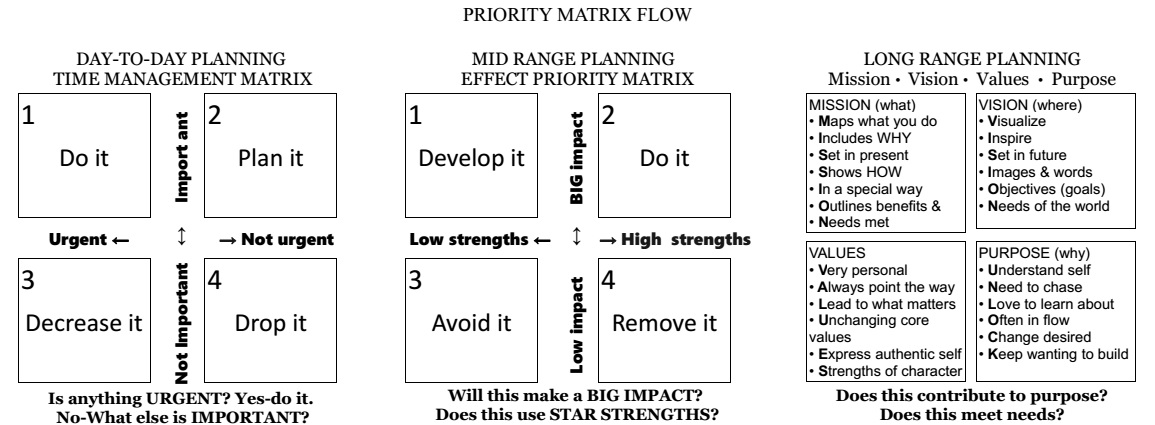
Run choices through this priority flow to focus on what really matters and Make Shift Happen.

My original thoughts about a priority flowchart included Return on Investment.

priorityflowchart

1. Is anything URGENT?
a. Check calendar for: deadlines, appointments, meetings, etc.
Nope, nothing –
b. Any crisis? Yup – handle it right now.
Nope, nothing awful is happening –
c. Are there unpleasant “frog” must dos? Sadly Yes – suck it up and HOP TO IT! Learn some strategies to combat procrastination.
No, thank goodness! –
d. Have you done the routine, repeating tasks that must be done? Not yet – don’t forget them! Follow a daily routine to automate these tasks and remember to include self-care for wellness.
Yes – Yay! Let’s go to the next step!

2. What else is IMPORTANT to do?
IMPORTANT VIP AIMS are: Vital to values, Increase positive shift, Pursue purpose, Active, Inspiring, Meaningful, Solutions.
You have no idea – a. choose goals b. plan purpose c. include BE MEASURING practices
YES! You’re ready to get goaling, pursue purpose, and create positive shift! Onward to step 3!

a. Have you set written goals? No – Choose goals to improve your life in four life areas.
Yes – go to b.

b. Do you have an AIM for a vision that is Active, Inspiring, and Meaningful? No – higher level goals pursue purpose. Do some purpose planning for higher level goals. Yes – go to c.

c. Have you practiced the four Ps of positive shift? No – Remember to Power up, Pause, pursue Purpose and connect with People. Yes – go to the next step

3. Will this goal or task create a BIG IMPACT? BIG = Bold change, Impressive influence, and Great movement. Not really – maybe later. It sure will! – move to the next step

4. Will this goal or task provide HIGH ENGAGEMENT that will Harness strengths, Ignite imagination, Grow and develop skills, and Have intrinsic rewards? No – a. look for motivation or avoid it. Yes, it’s highly engaging – use caution if the IMPACT is low. Yes, it has both BIG IMPACT and HIGH ENGAGEMENT! – go to the next step to determine the Return on Investment.

5. Are there high BENEFITS for a low investment (ROI)? No – maybe later if costs (consider size, time, energy, access, and money needed) can be reduced and benefits (gain, revenue, appeal, impact, needs met) increased.
Yes, there are lots of benefits compared to the resources required – LET’S GO! It’s time to Make Positive Shift Happen! Read about the BE MEASURING activities that Make Positive Shift Happen.

Posted in goals, positive shift, productivity

Wheel of Awareness

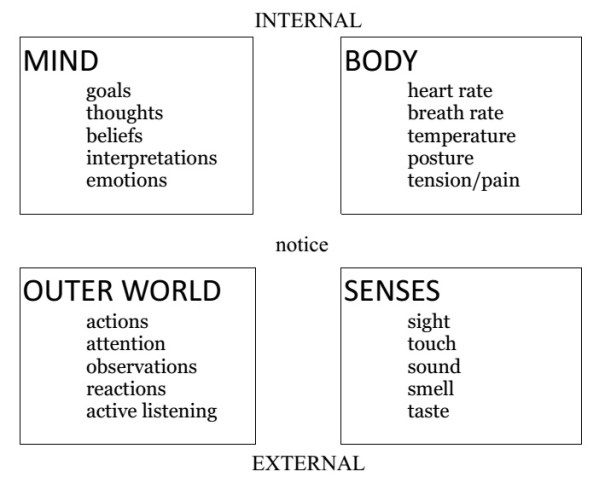
The ability to notice is vital to know when it is time to shift. When we notice our senses, bodily sensations, thoughts and feelings, and interactions with the outer world, we increase our awareness. Dr. Daniel Siegel created a tool called the Wheel of Awareness. Try the Wheel of Awareness spinner variation below.

AwarenessWheel

SENSES
1. sight
2. touch
3. sound
4. smell
5. taste

BODY
6. heart rate
7. breath rate
8. temperature
9. posture
10. tension/pain

MIND
11. goals
12. thoughts
13. beliefs
14. interpretations
15. emotions

OUTER INTERACTIONS
16. actions
17. attention
18. observe
19. reactions
20. actively listen

MatrixAwareness

RESOURCES

Learn more about how to understand and identify emotions, how emotions are revealed in the body, and how to listen.

Posted in positive shift

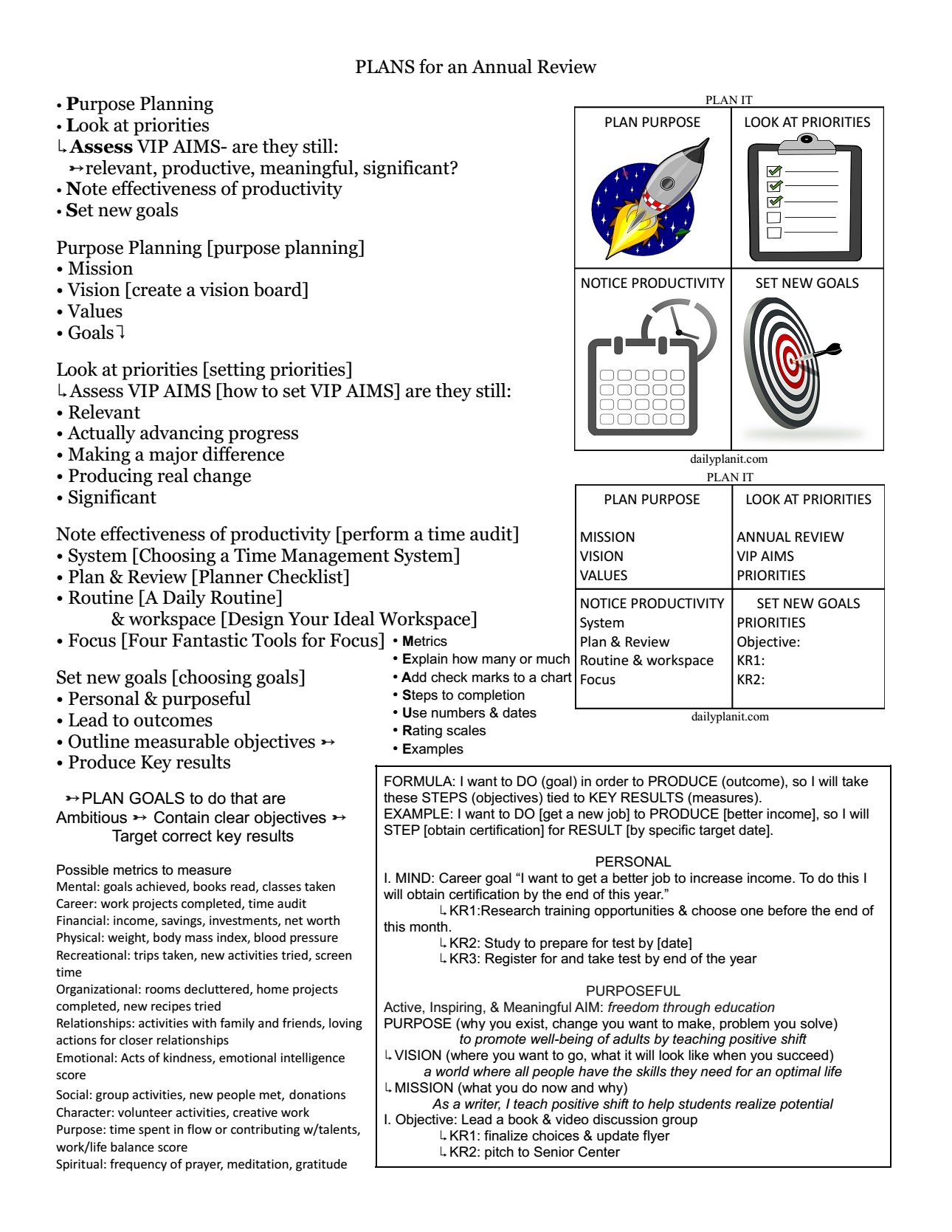
Purpose Planning

Unlock Purpose

Unlocking purpose is one of the most important and complex puzzles we can undertake. Creating a roadmap that includes the elements of a strategy for a clear purpose are VIP AIMS [Mission – Vision – Values – Goals] provides direction and fuels motivation. Purpose planning is long term thinking to decide what is most important to you so you can focus your attention on that. It is not an easy task and it takes time and work. But the meaning it gives to life makes it worthwhile.

Pursue purpose
Look at mission
Align with values
Name an AIM for a vision
Select significant goals

Value based Vision (where)
Important Mission (what)
Purpose (why)
Active movement
Inspiring appeal
Meaningful measures
Significant solutions

VennDiagramMissionVisionValues

MISSION (what)

Your mission is what you do now and why. A mission includes how you do what you do, who you do it for, and for what benefits and value. It clarifies your purpose and motivates you to accomplish the goals that will move you forward toward your vision. Create a personal mission statement with a value statement formula. This is the power tool for Purpose, one of the four Ps of Positive Psychology. Watch: How to Create a Personal Mission and Vision Statement from Dale Carnegie Training (5:49)

Maps out WHAT you do
Includes WHY you do it (purpose)
Set in present NOW
Shows HOW you do it
Includes special WAY you do it
Outlines benefits to others &
Needs met (value provided)

VISION (where)

Your vision is about where you are going in the future, what you want to achieve, and what the world will look like when you do. A compelling vision provides direction with positive words and emotions. AIM for a vision that is Active, Inspiring, and Meaningful. Simon Sinek describes vision as a “just cause,” one that is so important you are willing to sacrifice and work hard for it. Watch: Is Why or Vision More Important? He says there are 3 Things That Make a Meaningful Vision: 1. It is resilient, able to withstand change. 2. It is inclusive, an invitation to all to contribute to it. 3. It is service oriented, the primary benefit is to others. A vision board collage of positive words and pictures that illustrate goals is a visual and visible reminder to move forward and take action.

Visualize where you are going
Inspire -what success looks like
Set in future –the ultimate goal
Images and words
Objectives and goals
Needs of the world

PURPOSE & VALUES (why)

Purpose is why you exist, your reason for being, the problem you want to solve. Learn more about how to UNLOCK purpose at Clues to Purpose.

  • Understanding of self and what you…
  • Need to chase
  • Love to learn about
  • Often lose track of time doing
  • Changes you want to make
  • Keep wanting to build

Your values are the guiding principles you believe in, and they provide a solid foundation for all other elements. Learn how to Map Your Values to discover what your values are.

GOALS (how)

Once you have a mission and vision that is based on your purpose and values, you can begin to make a plan for how to get there. Your goals are how you will carry out your mission. They outline a plan that describes the special way that you solve the problem and helps establish priorities.

Different goals may all contribute to a central AIM. For example, my own goals to tutor reading, facilitate a vision board workshop, and to write a book about positive shift, all contribute to my central AIM of freedom through education. Goals that align with values have intrinsic motivation built in. Learn more about choosing goals in different life areas. Goals for mission and vision may be general and long term, so planning more specific objectives with measurable actions and SMART wording is the next step.

Download the Mission – Vision – Values – Goals pdf

VisionMission

To select priorities for planning goals and purpose, it is especially important to consider VIP AIMS and the factors of impact and engagement with The Effect Priority Matrix. Setting priorities is also a vital skill for effective time use when planning your day.

PurposePlanning

Download a free pdf that outlines Purpose Planning and Priorities.

Strategies for Planning Purpose

KNOW YOURSELF

The more you know yourself, the better you will be able to develop a plan for purpose. Download a free Self Assessment form at the Brand and Purpose Toolkit. Explore the Discover U series and find links to online tools at the Discover U Toolkit at Wakelet, or in the free ebook on How to Start a Fire. Links are also at Uncover Hidden Talents.

KNOW THE UNIQUE VALUE YOU PROVIDE

How will you use your special mix of strengths and talents? Look for a unique solution to solve the problem that most captivates your attention, and that will meet the needs of Your Target Audience.

ALWAYS BE COMMUNICATING VALUE

To get others interested and involved, be sure to always communicate the value that you add by meeting needs with the benefits that you provide. Watch a video from the Latimer Group on How to Be Heard in a Noisy World.

Purpose planning is a continuous process, and it may need to be updated during an annual review.

Many resources for the career search process are also helpful in purpose planning. Learn more about personal development at the Brand and Purpose Toolkit. Check out Mission and Vision Statements at Mindtools.com and more at the value statement Pinterest board.

Posted in personal development

A Self Care Wheel for Wellness

Resilience is the ability to bounce back and adapt to changes. We can develop resilience with activities to care for our Body, Mind, Heart, and Soul. These activities are often coping skills that contribute to wellness.

To be RESILIENT:

Realistic goals – have attainable goals
Explore options – for personal growth
Strengths – know and use your strengths
In perspective – check for rational thinking
Look for the positive – choose a positive mindset
Interact with others – volunteer and spend time with loved ones
Engage in self-care and wellness – activities to care for yourself
Notice thoughts & emotions – develop awareness with the power of a pause
Try coping skills – like meditation and deep breathing

The 7 cs model of resilience:

Also see the 6 Rs of resilience and try more ideas with the Self Care Spinner!

1. eat a healthy diet
2. exercise
3. go for a walk
4. sleep
5. massage
6. aromatherapy
7. bubble bath
8. light a candle
9. take a class
10. choose a growth mindset
11. make a vision board
12. take breaks
13. visit a museum
14. read a good book
15. unplug: turn off devices
16. eliminate clutter
17. affirmations
18. do a Random Act of Kindness
19. call a friend
20. volunteer
21. pet cuddles
22. play a game
23. watch a funny movie
24. try a new hobby
25. meditate
26. breathe deeply
27. reflect
28. journal
29. sing
30. dance
31. draw or paint
32. watch a sunset

SelfCare

RESOURCES

Positive shift happens when we practice the building blocks of positive psychology. Learn more at the Positive Shift Happens Toolkit.

Posted in positive shift

A Path to Being Authentic

Happiness is when what you think, what you say, and what you do are in harmony.” Mahatma Gandhi

To be authentic is to be your real self, to speak your truth, and to follow your values. When you are authentic, real love becomes possible, and you can build a life that is truly fulfilling. But being authentic can be difficult and involves risk. It is an ongoing process of discovery.

Accept yourself
Understand yourself
Treat all with respect (yes, u 2)
Honestly speak your truth
Explore your inner self
Notice feelings & thoughts
Think, learn, & grow
Inspire yourself with a value statement
Courageously be yourself

Strengthen your brain
Express your true self
Listen to your inner voice
Follow your vision

Accept Yourself

Realize if you are here, you are loved. When we love ourselves, we gain the ability to love others. Read “the Six Pillars of Self-esteem” by Nathaniel Branden and take steps to develop self-esteem. While most of us have things that we may want to improve, it first begins with accepting yourself as you are. Understand what we can control and listen to the Serenity Prayer.

Understand Yourself

To be your authentic self, you need to know and understand yourself. Download a self-assessment form at the Brand and Purpose Toolkit, and find links to tools to explore interests, personality, skills, strengths, personal qualities, values, and talents. Find clues to purpose in the free ebook How to Start a Fire and learn more to Discover U.

Treat all with Respect

Treat both others and yourself with respect. Develop character and know how to set healthy boundaries. Treat others as you would wish to be treated – with kindness and compassion.

Honestly Speak Your Truth

Be truthful with yourself and others. To be impeccable with your word is one of the Four Agreements. Know how to think rationally and communicate well. Speak up to share your thoughts and feelings.

Explore Your Inner Self

Embrace your inner child to be open to creativity, curiosity and playfulness. Connect with your inner adult for resilience, courage, and responsibility.

Notice Feelings and Thoughts

Learn to notice and identify emotions and the thoughts that lead to them.

Think, Learn, and Grow

Allow time for learning and reflection to grow and develop skills.

Inspire Yourself with a Value Statement

Gain clarity and focus with a value statement to provide direction and always be communicating value.

Courageously Be Yourself

Courage is the ability to act despite fear in the face of difficulties. Learn to Conquer Your Fears. Watch Jim Carrey’s moving commencement speech about how to choose love over fear. Watch Brene Brown’s TED talk to learn more about the importance of embracing vulnerability. In the book “Real Love,” author Greg Baer tells us that we can only truly be loved when we allow ourselves to be seen. Share your unique talents and let your light shine.

Strengthen Your Brain

Regular physical exercise and meditation can both increase the area of the brain that brings awareness (and also have many more benefits).

Express Your True Self

Beyond our actions, words and voice, the creative arts can be a way to explore and express our true selves.

Listen to Your Inner Voice

Allow time to be mindful and use the power of a pause.

Follow Your Vision

Have an AIM for a vision based on your values that is Active, Inspiring, and Meaningful.

Learn more

Posted in personal development

Books for a Year of Personal Growth

The activities for a year of personal growth are divided in four areas: mind, body, heart, and soul, with three topices within each. I recommend the following books for a personal growth journey.

YearGrowthGridBooks

MIND – Mental

• “Code of the Extraordinary Mind” by Vishen Lakiani
• “Getting Things Done” by David Allen
• “The Personal Efficiency Program” by Kerry Gleeson
• “Seven Habits of Highly Effective People” by Stephen R Covey
• “Mindset” by Carol Dweck

MIND – Career

• “What Color is Your Parachute” by Richard Bolles
• “Now Discover Your Strengths” by Marcus Buckingham
• “The Way We’re Working Isn’t Working” by Tony Schwartz
• “Indistractable” by Nir Eyal
• “Designing Your Work Life” by Bill Burnett & Dave Evans

MIND – Finance

• “Rich Dad, Poor Dad” by Richard Kiyosaki
• “Total Money Makeover” by Dave Ramsey
• “I will Teach You to Be Rich” by Ramit Sethi
• “The Intelligent Investor” by Benjamin Graham

BODY – Physical

• “Breath” by James Nestor
• “The Blue Zones” by Dan Buettner
• “Atomic Habits” by James Clear

BODY – Recreation

• “The Power of Fun” by Catherine Price
• “Flow” by Mihaly Csikszentmihalyl
• “The Exhaustion Cure” by Laura Stack
• “The Art of Gathering” by Priya Parker

BODY – Organization

• “The Organizing Sourcebook” by Kathy Waddill
• “One Year to an Organized Life” by Regina Leeds
• “Get It Together” by Melanie Cullen
• “Organizing for the Rest of Us” by Dana K White

HEART – Relationships

• “The Five Love Languages” by Gary Chapman
• “The Seven Principles for Making Marriage Work” by John Gottman
• “Real Love” by Greg Baer
• “All About Love” by Bell Hooks
• “Getting Love Right” by Terence T. Gorski

HEART – Emotional Intelligence

• “Emotional Intelligence” by Dan Goleman
• “How to Control Your Anger Before It Controls You” by Albert Ellis
• “Taking Charge of Anger” by Dr. Robert Nay
• “Six Pillars of Self-Esteem” by Nathaniel Brandon

HEART – Social

• “You’re Not Listening” by Kate Murphy
• “Connect” by David Bradford and Carole Robin
• “We Should Get Together” by Kat Vellos
• “Getting to Yes” by William Ury

SOUL – Character

• “The War of Art” by Stephen Pressfield
• “Moral Courage” by Rushworth Kidder
• “Healthy, Wealthy, and Wise” by Andrea Rains Waggener
• “Grit” by Angela Duckworth

SOUL – Purpose

• “Designing Your Life” by Bill Burnett & Dave Evans
• “Life on Purpose” by Victor J Strecher
• “What Are You Waiting For?” by Shelley Brunskill-Matson
• “Upgrade” by Rana Florida
• “Is Your Genius at Work?” by Dick Richards

SOUL – Spirituality

• “The Four Agreements” by Don Miguel Ruiz
• “The Road Less Traveled” by Richard Peck
• “Fully Present” by Diana Winston and Susan Smalley
• “Emotional Life of Your Brain” by Richard Davidson

Download the Year of Personal Growth Booklist pdf and learn more at the Brand and Purpose Toolkit.

Posted in Books, personal development

32 Creative Arts to Try

The creative arts can be a wonderful way to add beauty and enjoyment to life. Try the 32 Creative Arts spinner for ideas to get started! See a list of A to Z Creative Arts to print.


1. Alcohol ink
2. Beading
3. Calligraphy
4. Cartooning
5. Crochet
6. Clay
7. Drawing
8. Engraving
9. Flower arranging
10. Glass etching
11. Home & interior design
12. Ink & pen
13. Jewelry making
14. Knitting
15. Lettering
16. Macrame
17. Needlework (cross stitch, etc)
18. Origami
19. Painting (acrylic, oil, watercolors, etc)
20. Photography
21. Quilting
22. Rock painting
23. Stained glass
24. Sculpture
25. Tie dying
26. Upcycle
27. Videos
28. Woodcarving
29. Writing
30. Xacto knife paper cutting
31. Yarn crafts
32. Zentangles

See more ideas for how to get creative.

Posted in personal development

Scheduling with Time Blocking and Focus Themes

Schedule the action required today

Scheduling can sometimes be as simple as adding an appointment or meeting to your calendar. Scheduling is one of the skills of time management, and an important part of Planning. Remembering to include action steps for your goals on your To Do List or schedule is the way to make progress towards their achievement. But other things like repeating tasks can be handled with time blocking and focus themes.

TimeBlockScheduling

Time Blocking, (sometimes called time chunking) is about blocking off chunks of time in your schedule to group like tasks together and optimize your day to make the most of a daily routine. It helps you to focus more intensely on one thing at a time. First break your day into four blocks with a: Wake up routine, Morning routine, Afternoon routine, and Evening routine. Make checklists for these daily routines. Also think of things that you want to Always do today. These may include habits you want to create, like drinking 8 glasses of water daily, etc.

Focus Themes can be used to block out times during the week for various tasks. Themes can handle things like a daily focus, menus, cleaning, and adding positive shift throughout the week into your schedule. The Weekly Schedule above includes examples of Daily Themes that I use. Both Time Blocking and Focus Themes are not meant to box you in, but to free you up! They provide a flexible structure for organizing time.

Download a blank Weekly Schedule (pdf): 1. Write daily routines in the first column. 2. Fill in regular weekly meetings, appointments, etc. 3. Add themes for each day of the week for: focus, +shift, cleaning & menus, or whatever works for you.

ColorCode

Color coding is an option that can be helpful. Assign a color for different focus themes or activities to your calendar. This can work for an electronic calendar or with paper planners. See Color Coded Calendar from dansilvestre.com and Why You Need to Color Code Your Calendar at Asian Efficiency.

REMEMBER to SOAR:

  • Start with regular meetings and routines that must be done.
  • Open space to allow for the unknown – don’t schedule every minute of your day
  • Add incoming tasks and update your lists and calendar as things change.
  • Reserve your highest energy time for high priorities as much as possible.

Read more:

See also Weekly Plan

Posted in productivity
eBooks

Enter your email address to follow this blog and receive notifications of new posts by email.

Archives
Blog Stats
  • 741,508 hits