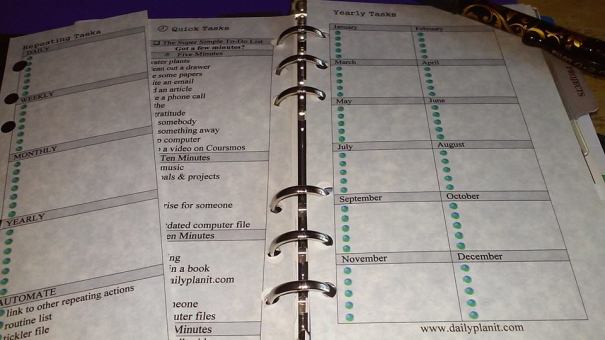
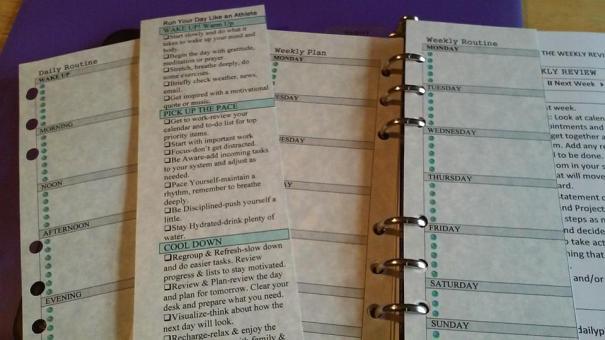
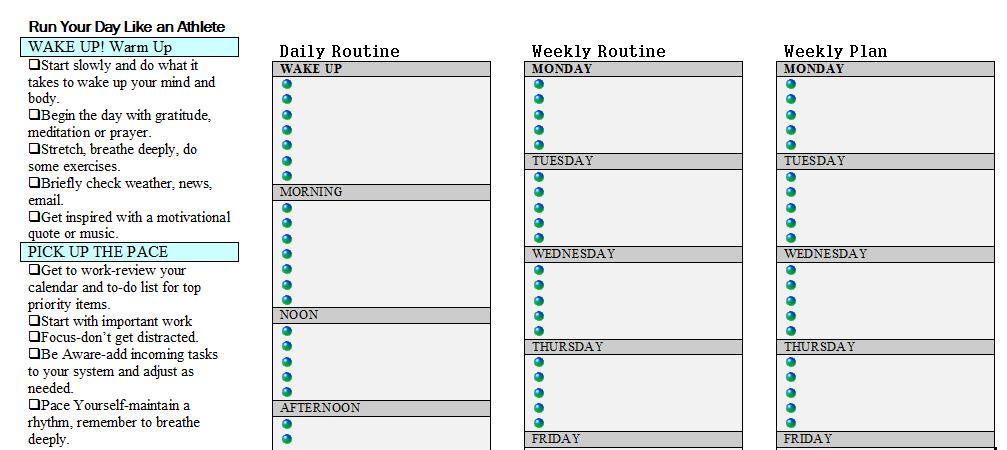
The planner inserts last week were so much fun, I was inspired to make a few more! This week’s installment includes a list for repeating or recurring tasks, and one for yearly tasks.
PLUS the Super Simple To-Do List of quick tasks to do when you have a few minutes.
When it comes to time managment systems, I have wondered about the percentage of people who:
use only paper
use only electronic
use a combination
have no time management system
I couldn’t find any statistics on this, but in an article I read awhile back a good percentage of 61 productivity experts used a combination, or hybrid system. Everyone is different, and what really matters is to come up with a productivity system that works for you.
Still, it is fun to see how others manage their time, and sometimes you can even get ideas that will work for you. You can learn from reading and studying about productivity, so that is okay as long as you do not spend all day doing it!
It can be a lot more enjoyable to spend time learning about productivity than to actually act on the information. Keep in mind the ratio of time spent studying vs. the number of ideas you find that will work for you. Try setting a limit on the amount of time on these activities so you can focus on getting the important stuff done.
I have a confession to make: I sometimes rather enjoy a well-written snarky movie review. Like this one about Jupiter Ascending that made me laugh out loud. And this one about Fifty Shades of Grey. Opinions will vary and viewpoints can be quite different. It’s far easier to be the one dishing it out than to be the one who put their hard work out there and now sees it being unappreciated.
There is movement away from performance appraisals to more of an emphasis on developing strengths. Why Evaluate Performance from The Huffington Post mentions maintaining a ratio of more positive feedback than negative, similar to research on predictors of survival or failure in marriage from researcher John Gottman.
How Are You Doing?
Walking the line between constructive criticism, appreciation and feedback can be like balancing on a tightrope. Feedback and appreciation are both keys to engagement at work. We need to know how we’re doing. Though it can be difficult to listen to, at times we may even need to hear about areas where there is room for improvement. Requesting feedback is one way to take charge of our own engagement at work. We can also devise ways to build in feedback on our progress with checkpoints on goals and projects to see how we’re doing. Learn more about The Art and Science of Giving and Receiving Criticism at Work at Fastcompany.
The fact is, every time we attempt a goal or try something new, there is a risk of mistakes, setbacks, or failure. This is why courage is so important to take action, and to persevere when setbacks occur.
Watching the Academy Awards recently has inspired me to suggest nominations for the Keep It Super Simple (K.I.S.S.) Productivity Award. The criteria for winning is to be the simplest method or tool. Some methods and tools are obvious winners, but the results are undecided in some categories. Add your nominations and cast your votes at the Daily PlanIt facebook page.
Sometimes there is resistance to the idea of a routine, but the most productive people follow a routine-www.bakadesuyo.com. Putting the things we need to do on a regular basis on autopilot allows us to focus on more important matters. Studies have revealed statistics about the effects of interruptions and multi-tasking, the best environments for productivity and more. Do some experiments to see how you work best, and shape your daily routine (as much as possible) with these results from research in the area of productivity. While some aspects may not be within our control depending on our workplace, others may be possible to regulate.
via easel.ly download at Slideshare
A Daily Routine based on the Science of Productivity
Dan Ariely, Professor of Behavioral Economics, concludes that generally people are most productive in the morning for two hours after fully waking. Don’t waste your most productive time from New Republic.
We can’t store much in our memory, and it drains energy if we try. We can only remember about 7 things (plus or minus two)- research at wikipedia.
With Google Keep, you can make a to do list, plus other lists, and quick temporary notes. If you want more to do list features, you can use Google Tasks (or another to do app). With Google Docs in Google Drive, you can create the more permanent lists you need: Goal and Project Master Lists, value statement, and more. If you follow the GTD system, you can set your lists up for that. The Evernote app is also popular for keeping lists, but Google Drive works great for me. Create a system that works for you from the K.I.S.S. System or whatever works for you. Share your system at the Daily PlanIt Facebook page.
“Doing work that matters is much harder than doing work that doesn’t.” – Peter Bregman, author of “18 Minutes.”
The important work that we say that we want to do is often hard. It’s so much easier to fritter away time on things that don’t matter like Facebook, Pinterest, or Farmville. These easy distractions give us an immediate pay-off which is hard to resist. The long-term pay-off of pursuing our goals is much more valuable, but also much farther away.
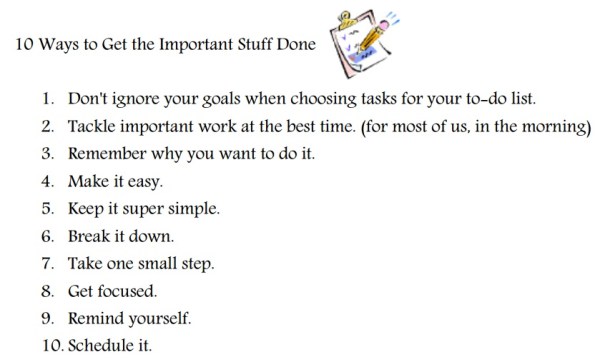
Once the important and urgent DAM CRAP from Stephen R Covey’s Time Management Matrix are out of the way, it’s time to include the VIP AIMS in the important but not urgent quadrant. This include things like planning, clarifying values, and relationship building. These are the activities we should spend more time on, but that often fall by the wayside, pushed aside by more trivial matters. Take these steps to overcome the pitfalls and get important stuff done.
Important tasks can be routine work, like the report that is due today and repeating tasks like the car that needs an oil change. Important activities are also in the important but not urgent quadrant of the time management matrix, but without a deadline they can often be easily postponed. Take time to pursue purpose and practice activities that increase happiness and well-being.
Consider the consequences if it is not done, and the benefits of accomplishing it.
Make it easy
In his book and TED Talk, Peter Bregman uses an example to illustrate this. His family thought they would eat outdoors at a table, but found they never used it…until they moved it a little closer to their door. Make good habits easy, and bad habits hard.
Maybe you don’t need a complicated plan. Maybe you only need to know the first step. Some projects may be complex, but keep them as simple as possible. Don’t make it harder than it needs to be.
Break it down
Big tasks can seem overwhelming unless they are broken down into smaller action steps.
Take one small step
Get started by telling yourself you will do just one small step. Often once inertia is overcome, it’s easy to keep the momentum going.
Keep it visual, and keep it on your radar. Peter Bregman’s 18 minutes: 5 minutes in the morning to plan, 5 minutes in the evening to review, and a timer set hourly during the day to re-focus.
Schedule it
Assign a date and time in your calendar. In “18 Minutes,” Peter Bregman describes studies from the book “The Power of Full Engagement” by Jim Loehr and Tony Schwartz which reveal that deciding when and where we will do something makes it 80-100% more likely to be done.
Want to learn more? Read “18 Minutes” by Peter Bregman, download an excerpt, and watch his TED Talk, The Work Buffet.
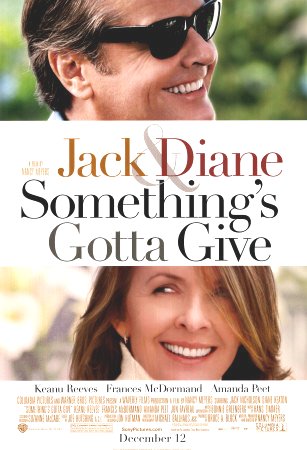
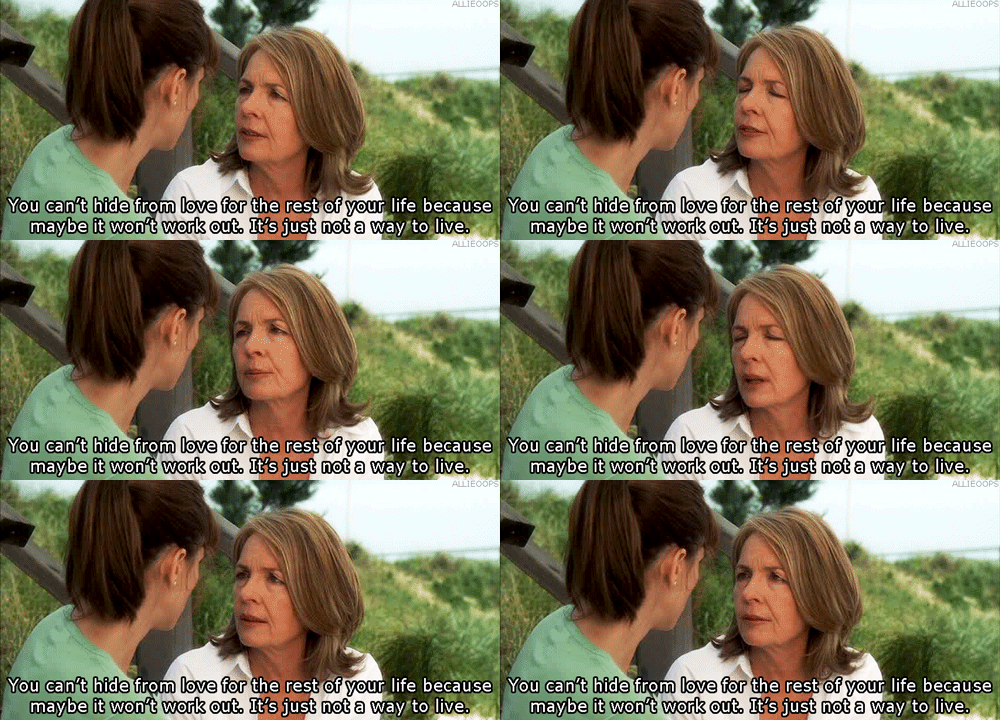
Something’s Gotta Give is one of my favorite romantic comedies. I’ve watched it many times and know almost all the lines by heart. Diane Keaton somehow makes having a broken heart funny in her crying scene. One of the lessons of the movie is this: the heart wants what the heart wants. But the lines below are among the most powerful.
Erica Barry: Listen to me. You can’t hide from love for the rest of your life because maybe it won’t work out… maybe you’ll become unglued? It’s just not a way to live.
Marin: Are you telling me this is good? What’s happened to you?
Erica Barry: I think you should consider the possibility that you and I are more alike than you realize. I let someone in, and I had the time of my life.
Erica Barry: I know, baby. And I say this from the deepest part of my heart. What are you waiting for?
The lesson: In romance, you have to take a risk. Yes, there may be pain. But if you see a chance, take it. Here’s a few more things I’ve learned about love from the movies:
“Love is a gift, Alex, not an obligation.” –Fools Rush In
“You are what you love, not what loves you.” –Adaptation
“The greatest thing you’ll ever know, is just to love, and be loved in return.” –Moulin Rouge
An animated version of the Secret Powers of Time at the RSA
And a longer version at the RSA
The Positive Present and the ability to shift
As the above graphic from “Time Perspective” shows, Zimbardo describes the Present time perspective as Hedonism or Fatalism. But when I apply the ideas of time perspective to the Happiness Habits identified by Positive Psychology, the majority have a primary focus on the present, in a positive way.
Primarily Present Happiness Habits:
Breathing
Meditation
In Flow
Share
Uplift
Noticing
Primarily Future: Aspire
Both Present and Future: Exercise. (We exercise in the present, often with a goal for the future.)
Both Present and Past: Gratitude
A mixture of Present, Past, and Future:
Emotional awareness
Relating
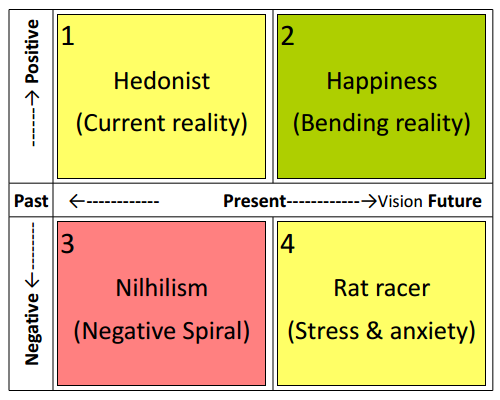
Tal Ben Shahar’s model of happiness describes four different states of mind related to time perspectives. These four states correspond with those (in parentheses) described by Vishen Lakhiani in his book, “The Code of the Extraordinary Mind.”



 Sometimes there is resistance to the idea of a





 Daily PlanIt